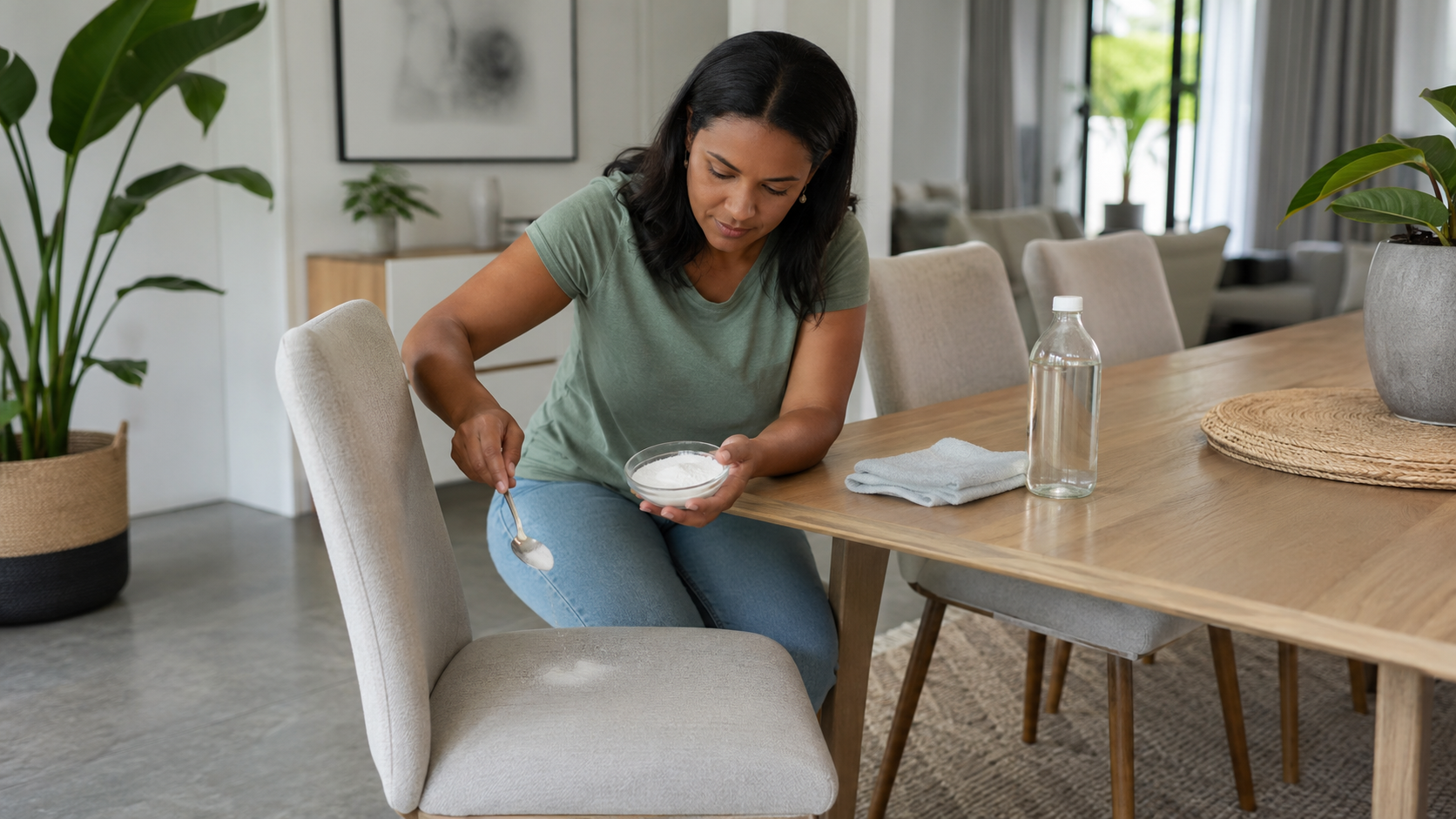
Baking soda and vinegar are often suggested as home remedies for cleaning fabric chairs, office chairs, dining chairs and other upholstered seating.
In some cases, baking soda may help absorb light surface odours. In some cases, diluted vinegar may help with minor surface freshness. But neither option is a guaranteed fabric chair cleaning method, and both can cause problems if used incorrectly.
The short answer is: you can use baking soda or vinegar on some fabric chairs, but only with caution. Baking soda may leave powder residue or become difficult to remove. Vinegar may cause water marks, colour changes, lingering smells or fabric damage on some upholstery. Always test a hidden area first, avoid soaking the fabric, and do not rely on baking soda or vinegar for deep stains, body oils, pet odours, urine smells or heavily used chairs.
If your fabric chairs already smell stale, look dull, or have visible marks, professional upholstery cleaning may be safer than experimenting with home remedies. You can review CleanLab SA’s fabric chair, couch and upholstery cleaning page or choose a local carpet and upholstery cleaning page near you.
Why people use baking soda or vinegar on fabric chairs
People usually try baking soda or vinegar on fabric chairs because they are common household products.
They are often used for:
- light smells
- food marks
- drink marks
- pet odours
- stale fabric
- small stains
- chair freshness
- DIY cleaning
- quick home maintenance
The problem is that fabric chairs are not all made from the same material.
One fabric chair may tolerate a light home remedy. Another may water-mark, fade, hold residue, or smell worse after being treated.
That is why baking soda and vinegar should be treated carefully, not as automatic solutions for every upholstered chair.
Can you use baking soda on fabric chairs?
You can use baking soda on some fabric chairs, but it should be used carefully.
Baking soda may help absorb light surface odours when the chair is dry and the fabric is suitable. It is sometimes used on fabric chairs, office chairs, dining chairs and upholstered seating as a light freshness step before vacuuming.
However, baking soda does not properly deep clean a fabric chair.
It does not reliably remove:
- body oils
- sweat residue
- deep odours
- old stains
- drink spills
- food grease
- pet urine
- dirty armrests
- dirty seat cushions
- embedded fabric buildup
It may help with mild freshness, but it is not the same as professional upholstery cleaning.
Risks of using baking soda on fabric chairs
Baking soda can cause problems when it is used too heavily, used on damp fabric, or not removed properly.
Possible risks include:
- powder residue left in the fabric
- white marks on dark fabric
- baking soda trapped in seams
- residue inside textured upholstery
- clogged vacuum filters
- powder mixing with moisture
- paste-like residue on damp areas
- fabric feeling gritty
- odour returning later
- difficulty removing all powder from the chair
The risk is higher on textured fabric, dark upholstery, damp fabric, thick seat cushions, office chairs with seams, and chairs that already have spills or moisture.
If baking soda is used on a damp chair, it can stick to the fabric and become harder to remove.
Can baking soda remove smells from fabric chairs?
Baking soda may help reduce some light surface smells, but it is not reliable for deeper chair odours.
Fabric chair smells can come from:
- sweat
- body oils
- skin particles
- pet dander
- food residue
- drink spills
- dampness
- old stains
- poor airflow
- moisture inside the cushion
If the odour is only light and near the surface, baking soda may help slightly.
If the smell comes from body oils, pet use, urine, sweat, old spills or deeper fabric buildup, baking soda may only mask or reduce the smell temporarily.
A chair may smell fresh for a short time and then start smelling stale again because the source of the odour is still in the upholstery.
Can you use vinegar on fabric chairs?
You can use diluted vinegar on some fabric chairs, but it is not safe for every upholstery fabric.
Vinegar may help with some light surface odours or minor marks, but it can also create problems.
A fabric chair may react badly to vinegar if:
- the fabric is delicate
- the dye is unstable
- the chair is light-coloured
- the chair is dark-coloured and prone to marks
- the upholstery is water-sensitive
- the chair already has water marks
- the fabric has been cleaned before with other products
- the stain is old or oily
- the chair has pet urine or deep odour
- too much liquid is used
Vinegar should not be sprayed heavily over a fabric chair.
If used at all, it should be diluted, applied lightly, and tested on a hidden area first.
Risks of using vinegar on fabric chairs
Vinegar can cause visible or lingering problems on fabric chairs.
Possible risks include:
- water marks
- colour fading
- dye transfer
- fabric stiffness
- uneven patches
- lingering vinegar smell
- spread stains
- larger wet marks
- moisture entering the cushion
- texture changes
- damage from scrubbing
- poor drying
- musty smell if the chair stays damp
The biggest risk is usually over-wetting.
Fabric chairs can hold moisture in the seat cushion or padding. The outside may look dry while moisture remains deeper inside.
This can make the chair smell damp, musty or stale after cleaning.
Can vinegar remove smells from fabric chairs?
Vinegar may reduce some light surface odours, but it is not a full odour-removal solution.
Fabric chair smells often come from deeper buildup, including:
- body oils
- sweat residue
- pet hair
- pet dander
- food crumbs
- drink residue
- urine smells
- dampness
- dirty cushions
- repeated daily use
A light vinegar wipe may make the surface smell different for a while, but it may not remove the source of the odour.
If the chair smells stale again after drying, the problem is probably deeper than vinegar can fix.
Professional fabric chair cleaning is usually better for odours caused by body oils, sweat, pet use, old spills or heavy use.
Can you use baking soda and vinegar together on fabric chairs?
Baking soda and vinegar are often suggested together, but they are not always a good choice for fabric chairs.
The fizzing reaction may look like it is doing something powerful, but it does not automatically deep clean upholstery.
Using baking soda and vinegar together can create problems such as:
- extra moisture
- powder residue
- sticky residue
- water rings
- fabric patches
- trapped residue in seams
- difficult cleanup
- lingering smell
- spreading the mark
- making the chair harder to clean later
For fabric chairs, the reaction is not the goal. Safe cleaning and proper removal of dirt, residue and moisture matter more.
If the chair has serious stains, smells, pet odours, body oils or dirty cushions, baking soda and vinegar are unlikely to be the best solution.
Should you use baking soda on office chairs?
Baking soda may help slightly with light odours on some fabric office chairs, but it should be used carefully.
Office chairs often have:
- seat cushions
- seams
- textured fabric
- mesh sections
- padding
- armrests
- wheels and bases
- high-contact sitting areas
These areas can trap powder and residue.
An office chair that smells stale usually has buildup from long sitting periods, sweat, body oils, dust, food crumbs and drink marks.
Baking soda may reduce light surface smell, but it will not properly remove body oils or sweat residue from the cushion.
If a fabric office chair smells stale, looks dull, or has a dirty seat cushion, professional upholstery cleaning is usually more effective than covering the chair with powder.
Should you use vinegar on office chairs?
Vinegar should be used cautiously on office chairs.
Fabric office chairs are often used for long hours, which means the smell or dullness may come from body oils, sweat and deeper cushion buildup.
Vinegar may not remove these problems properly.
It may also leave a lingering vinegar smell, create water marks, or add too much moisture to the cushion.
Be careful using vinegar on:
- fabric office chairs
- desk chairs
- computer chairs
- gaming chairs
- mesh office chairs
- ergonomic chairs
- light-coloured office chairs
- chairs with thick cushions
If the chair is used daily and already smells stale, vinegar is usually not the best long-term solution.
Should you use baking soda or vinegar on dining chairs?
Dining chairs can collect food, drink marks, body oils, children’s mess, hand marks and crumbs.
Baking soda may be tempting for odours, and vinegar may be tempting for food marks, but dining chair fabric should still be treated carefully.
Dining chairs are often light-coloured or made from decorative upholstery, which can show water marks or residue easily.
Be careful with baking soda or vinegar if the dining chair has:
- light fabric
- textured upholstery
- old food marks
- drink stains
- sauce marks
- unknown fabric
- previous DIY product residue
- padding that may hold moisture
For a single tiny fresh mark, careful spot treatment may help.
For several dining chairs, visible stains, dull fabric or stale odours, professional upholstery cleaning is usually safer than experimenting on each chair.
Should you use baking soda or vinegar on upholstered chairs?
Upholstered chairs include fabric chairs, office chairs, dining chairs, armchairs, reception chairs, boardroom chairs and other fabric-covered seating.
Because upholstery fabrics vary, there is no single home remedy that is safe for all chairs.
Before using baking soda or vinegar, consider:
- the fabric type
- the chair colour
- the chair age
- the care label
- whether the fabric is delicate
- whether the chair has padding
- whether there are old stains
- whether the chair smells from pets or sweat
- whether previous products were already used
The more valuable, delicate, light-coloured or heavily used the chair is, the more careful you should be.
When baking soda may be reasonable
Baking soda may be reasonable only for very light freshness issues on suitable dry fabric.
It may be worth considering when:
- the chair is dry
- the fabric is not delicate
- the smell is light
- the chair is not valuable
- the area is small
- the chair has no urine issue
- the chair is not damp
- the chair is not heavily stained
- you can vacuum thoroughly afterwards
- you are willing to test first
Use a light amount, avoid damp fabric, and vacuum carefully.
Do not use baking soda as a substitute for proper cleaning when the chair has deep odours, body oils, sweat marks, pet urine, old stains or heavy use.
When vinegar may be reasonable
Vinegar may be reasonable only for minor surface freshness on suitable fabric after testing.
It may be worth considering when:
- the chair fabric tests safely
- the mark is very light
- the smell is mild
- the area is small
- the fabric is not delicate
- the chair is not valuable
- there is no urine issue
- the chair is not deeply soiled
- you use very little moisture
- the chair can dry properly
Use diluted vinegar lightly with a clean cloth. Do not soak the fabric.
Do not spray vinegar heavily over the chair.
When not to use baking soda or vinegar
Avoid baking soda or vinegar when the fabric chair has:
- strong odours
- pet urine smells
- old stains
- body oil buildup
- sweat residue
- darkened armrests
- dirty seat cushions
- water marks
- delicate fabric
- unknown fabric
- expensive upholstery
- previous DIY product damage
- dampness or musty smell
- heavy daily use
- visible colour change
These are signs that the chair probably needs proper upholstery cleaning rather than another home remedy.
Why DIY products can make fabric chairs harder to clean later
DIY products can sometimes make later professional cleaning more difficult.
This can happen when home remedies:
- leave residue
- spread stains
- create water marks
- push moisture deeper
- affect fabric colour
- mix with old cleaning products
- change the stain chemically
- trap powder in seams
- make odours harder to identify
This does not mean professional cleaning cannot help afterwards. In many cases, it still can.
But results may be less predictable if the chair has already been over-wet, scrubbed aggressively or treated with multiple products.
If you have already used baking soda, vinegar or another DIY product, mention it when booking.
Why fabric chairs smell even after home remedies
A fabric chair may still smell after baking soda or vinegar because the source of the smell remains inside the upholstery.
Common causes include:
- sweat residue
- body oils
- food crumbs in seams
- pet dander
- pet hair
- urine residue
- drink spills
- damp padding
- old stains
- poor airflow
- daily sitting use
Baking soda and vinegar may affect the surface, but they may not remove the deeper buildup.
This is why the smell may return after the chair dries or after someone sits on it again.
Can professional cleaning remove baking soda or vinegar residue?
Professional upholstery cleaning may help remove residue left by baking soda, vinegar or other DIY products, depending on the fabric and what was used.
This may include:
- powder residue
- light soap residue
- vinegar smell
- surface dirt
- water marks in some cases
- buildup from repeated home cleaning
Results depend on the fabric, the amount used, whether the residue has dried, and whether the chair has been damaged.
Professional cleaning cannot guarantee reversal of colour loss, permanent water marks, damaged fibres or fabric that has reacted badly to chemicals.
But if the issue is residue rather than permanent damage, professional cleaning may help.
When should fabric chairs be professionally cleaned?
Fabric chairs may need professional upholstery cleaning when:
- the chair smells stale
- the chair looks dull
- there are food or drink marks
- the seat cushion looks dirty
- armrests are dark or oily
- pets use the chair
- the chair has urine smell
- baking soda or vinegar did not work
- DIY cleaning created residue
- the chair is used daily
- several chairs need cleaning at once
- the chair is part of a larger room refresh
Professional cleaning is especially useful when the chair needs more than light surface maintenance.
It may also make sense to clean fabric chairs together with carpets, rugs or couches in the same room.
Should fabric chairs be cleaned with carpets and couches?
In many homes and businesses, yes.
Fabric chairs often share the same room with carpets, couches, rugs and other soft furnishings.
For example:
- a dining room may have upholstered dining chairs and a rug
- a home office may have a fabric office chair and carpeted floor
- a reception area may have fabric chairs and carpeted walkways
- a lounge may have armchairs, couches, carpets and rugs
- a boardroom may have fabric chairs and office carpets
Cleaning one chair can help, but the room may still feel stale if other soft surfaces are holding odours.
This is why fabric chair, couch, carpet and upholstery cleaning often work well together.
For office spaces, CleanLab SA also has a guide on how often office carpets should be cleaned.
Why professional upholstery cleaning is safer than guessing
Professional upholstery cleaning is useful because different fabric chairs need different treatment.
A technician can consider:
- fabric type
- chair colour
- chair condition
- stain type
- odour source
- previous DIY products
- body oil buildup
- whether the fabric may watermark
- whether extraction is suitable
- drying requirements
This matters because the wrong home remedy can make the problem worse.
Too much water, vinegar, baking soda, excess soap, harsh stain removers or aggressive scrubbing can leave residue, spread marks, create water rings, affect colour or make odours harder to remove.
Professional cleaning does not guarantee every mark will disappear, but it gives the chair a better chance of being cleaned safely and appropriately.
Why book fabric chair and upholstery cleaning through CleanLab SA?
Booking through CleanLab SA gives customers a structured way to arrange carpet and upholstery cleaning in South Africa.
CleanLab SA’s listed professionals are reviewed by customers and expected to meet clear standards. Customers can view available options, compare booking details, and get support from booking to completion.
This can be useful when customers need help with fabric chairs, office chairs, dining chairs, couches, carpets, rugs or other upholstered furniture.
Customers may need help with:
- selecting the right service
- understanding what is included
- clarifying fabric concerns
- cleaning several chairs at once
- dealing with DIY product residue
- refreshing a room before guests or customers arrive
- arranging related carpet and upholstery cleaning
- understanding drying and aftercare
The value is in the full booking structure:
- reviewed listed professionals
- clear standards to remain listed
- customer review visibility during booking
- support from booking to completion
- a practical way to arrange upholstery cleaning
- local booking options across major South African areas
You can also learn more from CleanLab SA’s Booking Protection and Professional Standards pages.
Find fabric chair and upholstery cleaning in your area
If you are thinking about using baking soda or vinegar because your fabric chairs smell stale, look dull or have visible marks, professional cleaning may be the safer option.
You can start with CleanLab SA’s fabric chair, couch and upholstery cleaning page.
Main city pages include:
- Cape Town carpet and upholstery cleaners
- Durban carpet and upholstery cleaning
- Johannesburg fabric chair and upholstery cleaning
- Pretoria carpet and upholstery cleaners
- Randburg upholstery and carpet cleaners
- Sandton carpet and upholstery cleaners
You can also browse the wider cleaning services hub or explore available cleaning service locations.
Final answer: can you use baking soda or vinegar on fabric chairs?
You can use baking soda or vinegar on some fabric chairs, but only with caution.
Baking soda may help absorb light surface odours, but it can leave powder residue, get trapped in seams, and fail to remove deeper smells, body oils or stains.
Vinegar may help with minor surface freshness on some fabrics, but it can also cause water marks, colour changes, lingering vinegar smell, fabric stiffness or moisture problems if used incorrectly.
Always test a hidden area first, avoid soaking the fabric, avoid harsh scrubbing, and do not rely on baking soda or vinegar for deep odours, pet urine, body oil buildup, old stains or valuable upholstered chairs.
For stained, smelly, pet-used or heavily used chairs, professional upholstery cleaning is usually the safer and more complete option. For professional help, review CleanLab SA’s professional fabric chair and upholstery cleaning page and use Get Rates & Availability to view prices, select your location and secure your booking.