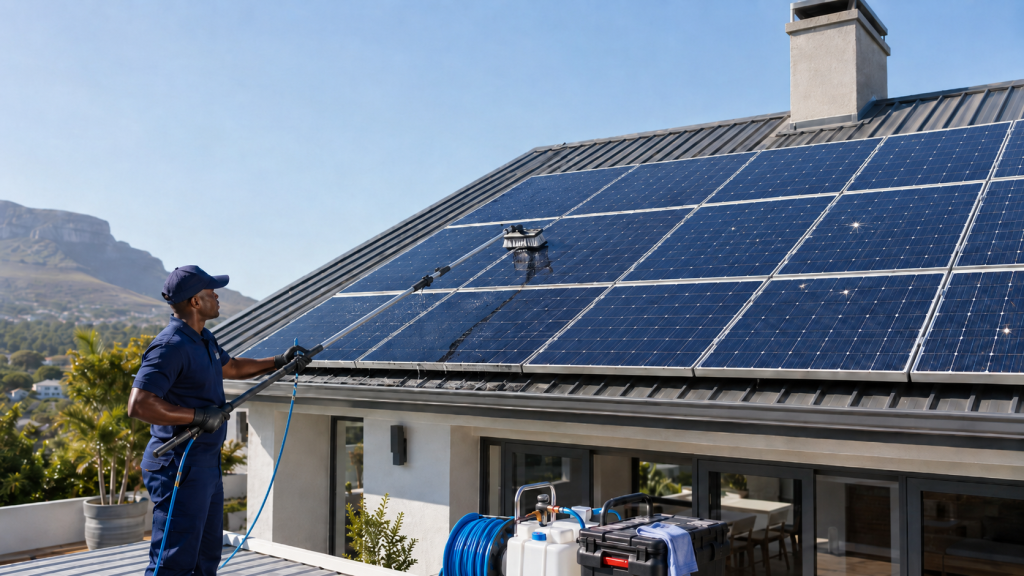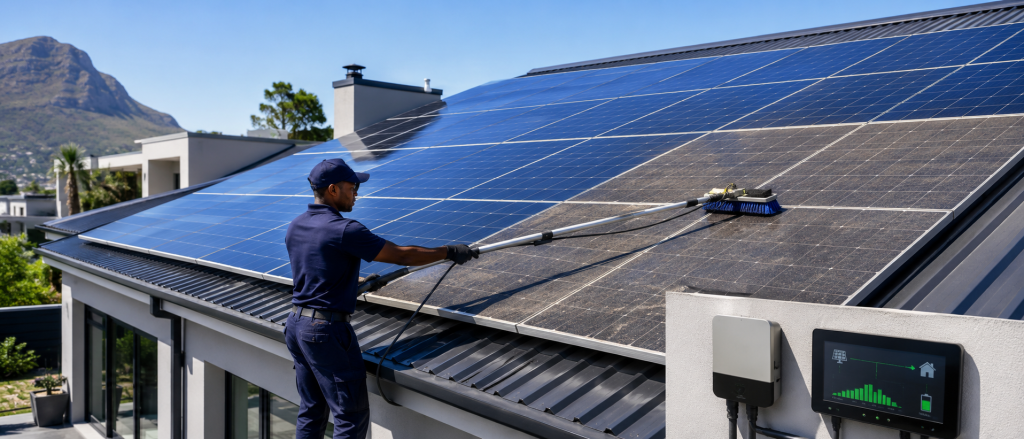
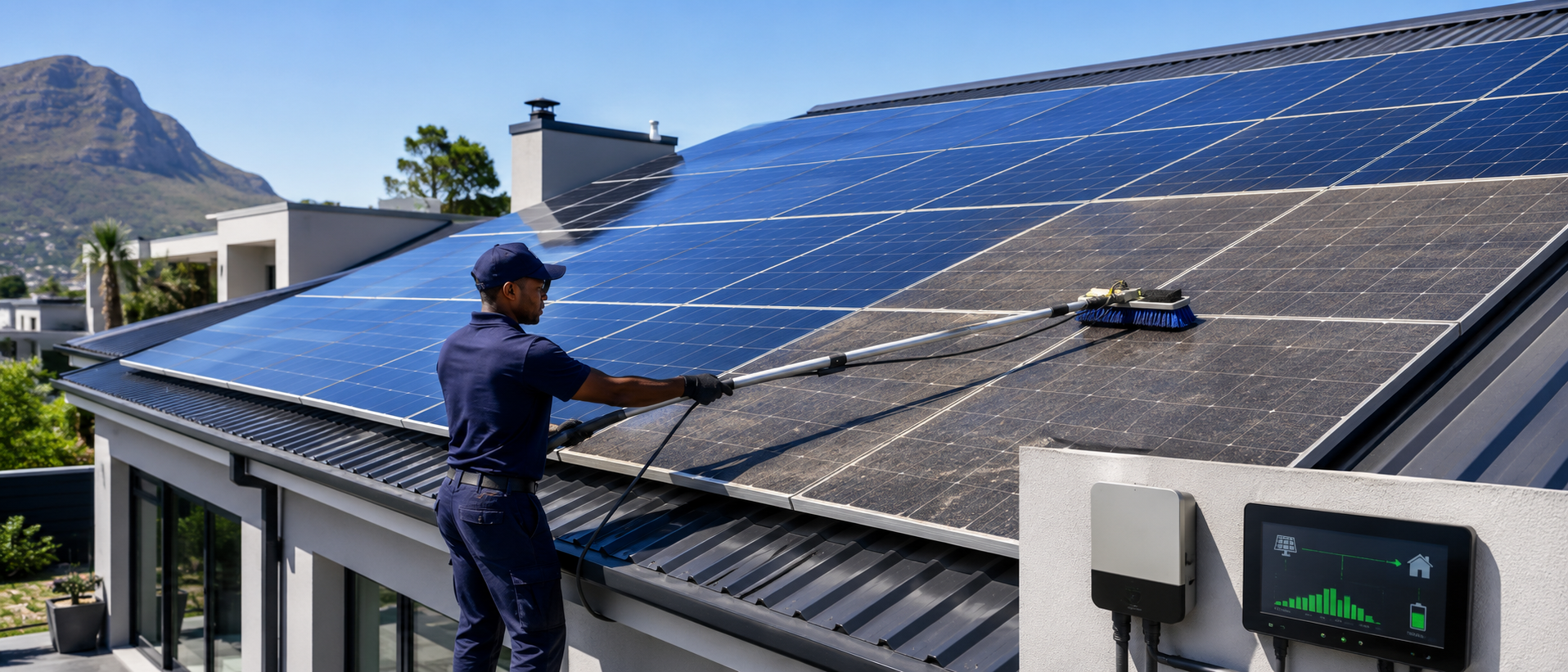
Cleaning solar panels can improve efficiency and electricity output when dirt, dust, bird droppings, pollen, pollution, leaves or coastal salt are blocking sunlight from reaching the panel surface.
The improvement depends on how dirty the panels are, where the property is located, how much rain the area gets, the angle of the panels, the type of dirt present and how long the build-up has been sitting.
Some solar systems may show a noticeable improvement after cleaning, especially if the panels were visibly dirty. Other systems may show only a small difference if the panels were already fairly clean or if rainfall had been helping to rinse away loose dust.
So the honest answer is:
Yes, cleaning solar panels can improve output, but the improvement is not the same for every property.
For homes and businesses with visible dust, bird droppings, sticky residue, nearby trees, coastal exposure or long periods without rain, solar panel cleaning can be a practical way to help the panels receive more sunlight again.
To view current CleanLab SA listed options and live pricing for your area, use the Get Rates & Availability CTA where available. This lets you select your location, view listed solar panel cleaning options and check open slots.
Quick answer: does cleaning solar panels improve efficiency?
Yes. Cleaning solar panels can improve efficiency when dirt or grime is reducing the amount of sunlight reaching the panel surface.
Solar panels work by converting sunlight into electricity. If the glass surface is covered by dust, bird droppings, leaves, pollen, soot, pollution or other build-up, less light can reach the solar cells underneath.
Cleaning may help improve output when:
- panels are visibly dusty
- bird droppings are present
- there is sticky pollen or tree residue
- the property is near busy roads
- the property is near the coast
- the area has lots of dry weather
- there has been construction dust nearby
- panels have not been cleaned for a long time
- rain has not removed the build-up properly
- the system appears to be producing less than expected
Cleaning is less likely to make a dramatic difference when the panels are already clean or only lightly dusty.
How dirty solar panels affect output
Solar panels need sunlight to work efficiently. Dirt on the panel surface can act like a barrier between the sun and the panel.
Common build-up includes:
- dust
- bird droppings
- pollen
- leaves
- tree sap or sticky residue
- pollution film
- soot
- coastal salt
- mud splash
- lichen or organic growth
- general outdoor grime
Loose dust may reduce output slightly or temporarily. Heavier dirt, bird droppings or sticky residue can have a bigger effect because they block sunlight more directly.
Bird droppings can be especially problematic because they may cover part of a panel more heavily than ordinary dust. Even if the rest of the panel looks fairly clean, a few blocked areas may still affect performance.
Does cleaning solar panels increase electricity production?
Cleaning solar panels may increase electricity production if the panels were dirty enough to reduce output.
After cleaning, panels may be able to absorb more sunlight because the glass surface is clearer. This may help the system produce closer to its normal expected output, depending on the weather, system condition and sunlight available.
However, cleaning does not upgrade the system or make the panels more powerful than their normal capacity. It simply helps remove surface barriers that may have been reducing performance.
A useful way to think about it is:
Solar panel cleaning does not create extra sunlight. It helps remove anything that may be blocking the sunlight already available.
This is why the effect can vary. A very dirty system may show a noticeable improvement. A fairly clean system may show a smaller change.
How much can cleaning solar panels improve output?
There is no single guaranteed percentage that applies to every property.
The improvement depends on:
- how dirty the panels were before cleaning
- whether bird droppings were present
- whether dirt covered the whole panel or only small areas
- panel angle
- roof position
- rainfall
- dust levels in the area
- nearby trees
- coastal salt exposure
- local pollution
- age and condition of the solar system
- whether the system has any technical faults
Some panels may show only a small improvement after cleaning. Others may show a more noticeable difference if there was heavy dust, bird mess or sticky build-up.
Be careful with any provider that promises a fixed output increase for every property. Solar panel cleaning can help, but the result depends on the actual condition of the panels and the solar system.
When solar panel cleaning is most likely to improve efficiency
Solar panel cleaning is most likely to help when there is visible build-up on the panels.
This includes:
- dusty panels after a long dry period
- bird droppings on the glass
- panels under or near trees
- properties near dirt roads
- properties near construction activity
- panels exposed to coastal salt
- homes near heavy traffic or pollution
- panels that have not been cleaned for months or years
- panels with uneven dirty patches
- panels where rainfall does not rinse the surface properly
In these cases, cleaning may help restore clearer sunlight exposure to the panel surface.
When cleaning may not make much difference
Cleaning may not make a major difference if:
- panels are already clean
- recent rain has removed most loose dust
- the panels have only very light surface dust
- the system issue is electrical, not dirt-related
- the inverter or battery system has a fault
- the panels are shaded by trees or buildings
- the panels are old or damaged
- output is low because of weather, not dirt
This is important because low solar output is not always caused by dirty panels.
If the panels are clean but performance is still poor, the issue may be shading, inverter settings, wiring, battery behaviour, panel damage or another technical solar problem. In that case, a qualified solar technician may be needed.
Does rain clean solar panels properly?
Rain can help rinse loose dust from solar panels, but it does not always clean them properly.
Rain may not remove:
- bird droppings
- sticky pollen
- tree sap
- pollution film
- coastal salt residue
- mud splash
- lichen
- greasy residue
- dirt trapped near panel edges
- dust that has dried into a film
Rain can also leave marks behind depending on water quality, dust levels and drying conditions.
So while rain helps, it should not always be treated as a full replacement for proper cleaning.
In some areas, rain may keep panels reasonably clean for longer. In other areas, especially dusty, coastal, polluted or bird-heavy properties, panels may still need periodic cleaning.
Can dirty solar panels reduce performance even if they look mostly clean?
Yes. Sometimes solar panels can look acceptable from the ground but still have a thin layer of dust, pollen, pollution film or salt residue on the surface.
This can be hard to see from below, especially on roof-mounted panels.
However, the most obvious warning signs are usually:
- visible dust
- dull-looking panels
- bird droppings
- streaks
- cloudy patches
- leaf debris
- uneven dirt marks
- panels that look less reflective than usual
If panels look dirty from the ground, they are usually worth inspecting more carefully from a safe position.
Do bird droppings affect solar panel output?
Bird droppings can affect solar panel output because they block sunlight from reaching part of the panel surface.
Unlike light dust, bird droppings may stick to the glass and remain in place after light rain. They may also create concentrated dirty patches rather than an even thin layer.
This can make bird droppings more disruptive than ordinary dust.
If bird droppings are present, cleaning may be useful even if the rest of the panel surface does not look very dirty.
Does dust affect solar panel efficiency?
Dust can affect solar panel efficiency when it builds up enough to reduce sunlight exposure.
A small amount of loose dust may not make a major difference, especially if rain soon rinses it away. But heavier dust, dry-season build-up or dust mixed with moisture can create a film that is harder to remove.
Dust may be more of a problem in areas with:
- dry weather
- construction nearby
- dirt roads
- open fields
- high traffic
- industrial activity
- low rainfall
- dusty wind
In these conditions, periodic solar panel cleaning may help the panels maintain better performance.
Does coastal salt affect solar panels?
Coastal areas can expose solar panels to salt residue carried by wind and sea air.
Salt residue may settle on the glass surface and mix with dust or moisture. Over time, this can create a dull layer that rainfall may not fully remove.
For coastal properties, solar panel cleaning may be useful more often than for inland properties with lower salt exposure.
This may apply to areas such as Cape Town, Durban and other coastal regions where panels are exposed to sea air, wind and salt build-up.
Does lichen or organic growth affect solar panels?
Lichen, moss or organic growth can affect solar panels if it grows on or near the panel surface and blocks sunlight.
This type of build-up is different from ordinary dust. It may be more difficult to remove and should not be scraped aggressively.
Harsh scraping, high pressure or unsuitable chemicals may damage the panel surface, seals or frame.
If lichen or organic growth is present, professional cleaning is usually safer than aggressive DIY cleaning.
How often should solar panels be cleaned for better output?
Many residential solar panels may benefit from cleaning every 6 to 12 months, depending on the property.
More frequent cleaning may be useful when there is:
- visible dust
- bird activity
- nearby trees
- coastal salt
- construction dust
- industrial pollution
- dry weather
- low rainfall
- heavy pollen
- dirt roads nearby
Some properties may need cleaning less often if the panels stay fairly clean naturally.
The best guide is the actual condition of the panels, local environment and any noticeable change in output.
How can you tell if solar panel cleaning helped?
The simplest way is to compare system output before and after cleaning under similar conditions.
For example, you may look at:
- inverter app data
- daily production figures
- similar sunny days before and after cleaning
- visible panel condition
- whether bird droppings or heavy dust were removed
- whether the system is now producing closer to expected levels
Be careful when comparing different days because output can change due to:
- cloud cover
- temperature
- shade
- season
- time of day
- battery behaviour
- household electricity usage
- inverter settings
A good comparison looks at similar sunny conditions, not one random day before and one random day after cleaning.
Is solar panel cleaning worth it?
Solar panel cleaning can be worth it when the panels are visibly dirty, difficult for rain to clean, or exposed to conditions that cause regular build-up.
It may be especially worthwhile for:
- homes with roof-mounted solar panels
- properties with bird droppings
- panels near trees
- dusty areas
- coastal properties
- small businesses with visible panel build-up
- systems that have not been cleaned for a long time
- customers who want safer cleaning without climbing onto the roof
Solar panel cleaning is not always about making panels look better. It can also help remove surface build-up that may be reducing sunlight exposure.
For customers comparing cost, see the Solar Panel Cleaning Prices in South Africa guide.
Can you improve output by cleaning solar panels yourself?
Some homeowners may be able to clean low, safely accessible panels themselves using clean water, a soft brush or a solar-safe cleaning tool.
However, DIY cleaning is not always the best option.
DIY cleaning may be risky when:
- panels are on a high roof
- the property is two storeys
- the roof is steep
- the roof surface is slippery
- panels are near roof edges
- the customer is unsure how to switch off the system
- bird droppings are baked on
- lichen or sticky residue is present
- the person is tempted to use a pressure washer
- safe access is not available
For roof-mounted panels, professional solar panel cleaning is often safer and more practical.
For step-by-step cleaning guidance, see the related guide: How to Clean Solar Panels Safely.
Can pressure washing improve solar panel output?
Pressure washing may remove dirt, but it is generally not recommended unless the manufacturer or installer specifically confirms that it is safe.
High pressure can damage:
- panel seals
- frames
- wiring
- junction boxes
- coatings
- roof components
It may also void warranty conditions if used incorrectly.
A safer method is usually clean water, soft-brush cleaning and gentle pressure.
If the panels are too dirty for gentle cleaning, professional solar panel cleaning is usually better than increasing water pressure aggressively.
Cleaning solar panels vs fixing a solar system problem
Solar panel cleaning can help when the problem is surface dirt.
It cannot fix:
- faulty inverters
- damaged wiring
- battery issues
- broken panels
- poor installation
- shading from trees or buildings
- incorrect system settings
- roof-position problems
- old or failing equipment
If output is low and the panels are visibly dirty, cleaning is a sensible first step.
If output remains low after cleaning, or if the system shows warnings, faults or unusual behaviour, a qualified solar technician may be needed.
Professional solar panel cleaning and output
Professional solar panel cleaning may help improve output when panels are dirty, but the main benefits are often safety, proper equipment and reduced risk of damage.
Professional cleaning may be useful for:
- roof-mounted panels
- two-storey homes
- hard-to-reach panels
- small business systems
- larger residential systems
- panels with bird droppings
- panels with dust build-up
- panels with lichen or stubborn grime
- customers who do not want unsafe DIY access
To view current CleanLab SA listed options and live pricing for your area, use the Get Rates & Availability CTA where available. This lets you select your location, view listed solar panel cleaning options and check open slots.
For other home and business cleaning services, visit the main professional cleaning services hub.
Can solar panel cleaning be combined with other cleaning services?
Solar panel cleaning may be more practical when booked with other listed cleaning services, especially if the solar panel job is small on its own.
Depending on availability, customers may also want to look at listed services such as:
- Window Cleaning
- Carpet Cleaning
- Couch Cleaning
- Chair Cleaning
- Mattress Cleaning
- Blind Cleaning
- Curtain Cleaning
This can help customers address more than one cleaning need in a single organised booking.
CleanLab SA also lists many other cleaning and property-care service options, depending on area availability.
Solar panel cleaning services by area
Solar panel cleaning availability can vary by area. You can view listed solar panel cleaning options in major areas here:
- Solar panel cleaners in Sandton
- Solar panel cleaners in Randburg
- Solar panel cleaners in Johannesburg
- Solar panel cleaners in Pretoria
- Solar panel cleaners in Cape Town
- Solar panel cleaners in Durban
You can also browse all available service areas on the main CleanLab SA locations page.
To view current CleanLab SA listed options and live pricing for your area, use the Get Rates & Availability CTA where available. This lets you select your location, view listed solar panel cleaning options and check open slots.
Why book solar panel cleaning through CleanLab SA?
CleanLab SA helps customers find listed solar panel cleaning options, view upfront pricing where available and book online.
This can be useful when customers want to compare listed options, check area availability and see open slots without needing to phone around for every quote.
Solar panel cleaning may also be more practical when booked as part of a broader cleaning visit. If customers are already arranging services such as window cleaning, carpets, couches, chairs, mattresses, blinds or curtains, adding solar panel cleaning can help turn a small stand-alone job into a more useful property-care booking.
Booking through CleanLab SA can also help with peace of mind because the platform includes support around Booking Protection and Professional Standards.
FAQs about solar panel cleaning and efficiency
Does cleaning solar panels improve efficiency?
Yes, cleaning solar panels can improve efficiency when dirt, dust, bird droppings or grime are blocking sunlight from reaching the panel surface. The improvement depends on how dirty the panels were before cleaning.
Does cleaning solar panels increase output?
Cleaning may increase output if the panels were dirty enough to reduce sunlight exposure. It will not increase the panels beyond their normal capacity, but it may help them produce closer to their expected level.
How much does cleaning solar panels improve efficiency?
There is no fixed percentage for every property. The improvement depends on dirt level, weather, panel angle, local environment, shade, system condition and whether bird droppings or heavy grime were present.
Do dirty solar panels produce less electricity?
Dirty solar panels can produce less electricity if dust, bird droppings, pollen, pollution, leaves or salt residue reduce the amount of sunlight reaching the panel surface.
Does rain clean solar panels enough?
Rain can help remove loose dust, but it may not fully remove bird droppings, sticky pollen, coastal salt, lichen, pollution film or dirt that has dried onto the glass.
Is solar panel cleaning worth it?
Solar panel cleaning can be worth it when panels are visibly dirty, exposed to dust or bird droppings, near trees, close to the coast, or producing less than expected because of surface build-up.
Can I clean solar panels myself?
Some low, safely accessible panels may be cleaned by homeowners with water and soft cleaning tools. Roof-mounted, high, steep or difficult-to-reach panels are usually better suited to professional cleaning.
Can pressure washing improve solar panel output?
Pressure washing may remove dirt, but it is generally not recommended unless specifically approved by the manufacturer or installer. Incorrect pressure may damage seals, frames, wiring or coatings.
How often should solar panels be cleaned for best performance?
Many homes may benefit from cleaning every 6 to 12 months, depending on dust, bird activity, nearby trees, coastal salt, pollution, rainfall and visible grime.
Can I check solar panel cleaning options online?
Yes. To view current CleanLab SA listed options and live pricing for your area, use the Get Rates & Availability CTA where available. This lets you select your location, view listed solar panel cleaning options and check open slots.
Final answer
Cleaning solar panels can improve efficiency and output when dirt, dust, bird droppings, pollen, pollution, leaves or coastal salt are blocking sunlight from reaching the panel surface.
The result depends on how dirty the panels were before cleaning. Heavily soiled panels may show a more noticeable improvement, while already-clean panels may show only a small difference.
Solar panel cleaning is most worthwhile when there is visible dirt, bird mess, coastal salt, nearby trees, construction dust, pollution or a long period without cleaning.
To view current CleanLab SA listed options and live pricing for your area, use the Get Rates & Availability CTA where available, or see the Solar Panel Cleaning Prices in South Africa guide.