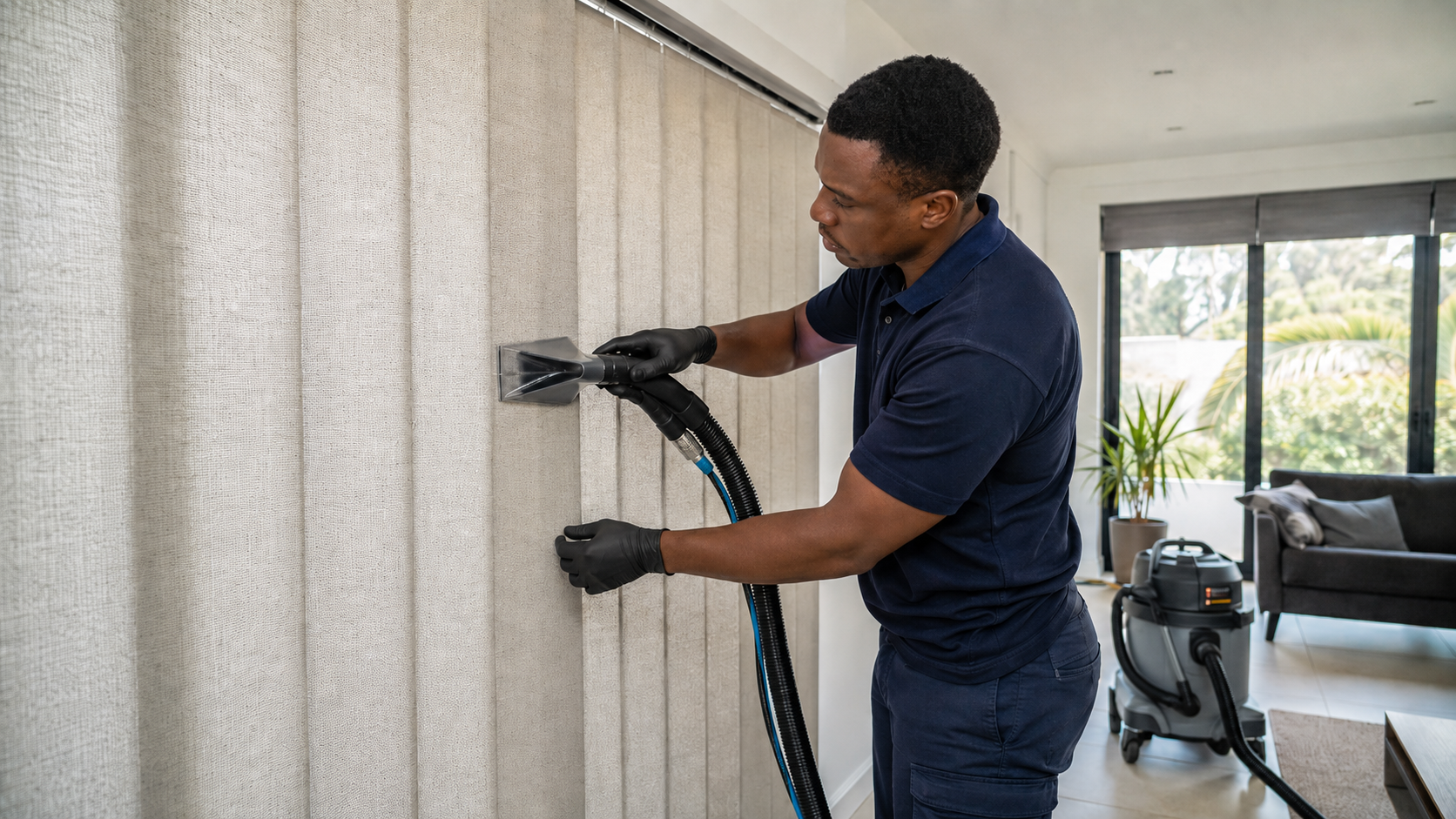
Professional blind cleaning usually includes more than simply dusting or wiping the visible surface of the blinds. Depending on the blind type, material, size and cleaning method, it may include dust removal, professional cleaning solutions, controlled moisture, extraction for suitable fabric blinds, odour removal or improvement, stain removal or improvement, and cleaning while the blinds remain hanging where suitable.
Professional blind cleaning can apply to many common blind types, including most fabric, Venetian, roller, vertical, Roman, zebra, aluminium, wooden, woven and other household or office blinds, depending on the selected service option and area availability.
This makes professional blind cleaning different from basic home maintenance. Dusting and wiping can help with light surface dust, but professional blind cleaning is designed to give blinds a deeper, more thorough clean using proper equipment, professional cleaning solutions and a controlled process.
For many homes, offices, guesthouses and rental properties, professional blind cleaning is also more convenient because large, fabric or difficult-to-remove blinds can often be cleaned on-site without the customer needing to remove, transport, clean, dry and reinstall them.
Quick answer: what is included in professional blind cleaning?
Professional blind cleaning may include:
- checking the blind type, size and material
- cleaning most common blind types, including fabric, Venetian, roller, vertical, Roman, zebra, aluminium, wooden and woven blinds
- removing loose dust and surface dirt
- cleaning slats, panels, fabric sections or woven surfaces
- applying professional blind-cleaning solutions where suitable
- controlled moisture application where appropriate
- extraction for suitable fabric blinds
- targeted treatment of general marks and stains
- odour removal or improvement for smoke, cooking smells, pets and stale smells
- cleaning while blinds remain hanging where suitable
- drying or airflow guidance after cleaning
- advice where a blind material is delicate, damaged or unsuitable for a specific cleaning method
The exact process can vary depending on the blind material and service option selected. Fabric vertical blinds are not cleaned in exactly the same way as wooden blinds, Venetian blinds, roller blinds, Roman blinds, zebra blinds, aluminium blinds or woven blinds.
Blind types commonly included in professional blind cleaning
Professional blind cleaning may be available for most common blind types used in homes, offices, guesthouses, rental properties and commercial spaces.
These may include:
| Blind type | Cleaning notes |
|---|---|
| Fabric blinds | Need careful moisture control and fabric-safe cleaning methods |
| Venetian blinds | Individual slats may need dusting, wiping and careful cleaning |
| Roller blinds | Usually cleaned while extended, with controlled moisture where suitable |
| Vertical blinds | Individual hanging panels or slats may need detailed cleaning |
| Roman blinds | Fabric folds may hold dust, odours and residue |
| Zebra blinds | Layered sheer and fabric sections need careful handling |
| Aluminium blinds | Can collect dust, fingerprints and grease |
| Wooden blinds | Need limited moisture and careful cleaning to avoid damage |
| Faux wood blinds | Usually more moisture-resistant than real wood but still need care |
| PVC blinds | Often easier to wipe, depending on condition and construction |
| Woven blinds | Need careful cleaning because textured fibres can trap dust |
| Bamboo or natural woven blinds | May need a gentler dry or low-moisture approach |
| Block-out roller blinds | May need careful treatment because of backing or coating |
| Office blinds | Often collect dust, fingerprints and stale indoor-air residue |
| Kitchen blinds | May hold cooking residue, grease and odours |
| Bathroom blinds | May be affected by moisture, soap residue or mould-prone marks |
This broader blind-type coverage is important because customers often use different names for blinds. Some may search for “fabric blinds,” others for “material blinds,” “roller blinds,” “Venetian blinds,” “zebra blinds,” “Roman blinds” or “wooden blinds.”
A professional blind cleaning service should therefore explain the cleaning process across the main blind categories, while still making clear that the exact method depends on the material and condition.
Professional blind inspection before cleaning
A professional blind cleaning appointment usually starts with checking the type of blinds being cleaned. This helps the technician understand the material and choose a suitable cleaning approach.
The technician may check:
- the blind type
- the blind length
- whether the blinds are standard length or extra length
- whether the blinds are fabric, wooden, aluminium, PVC, faux wood, woven or coated
- whether they are roller, vertical, Venetian, Roman, zebra or woven blinds
- whether the blinds are block-out, lined, layered or delicate
- visible dust, dirt or general marks
- odours from pets, smoke, cooking or stale air
- sun fading, water marks or age-related wear
- whether on-site cleaning while hanging is suitable
This step matters because blinds are not all cleaned the same way. A fabric roller blind is different from a wooden Venetian blind. A PVC blind may tolerate more wiping than a real wooden blind. A fabric vertical blind may need a more careful cleaning process than a hard-slat blind. A woven blind may trap dust differently from a smooth aluminium blind.
Dust and surface dirt removal
Dust removal is one of the most common parts of professional blind cleaning.
Blinds collect dust on slats, folds, fabric panels, woven fibres, rails, edges and lower sections. This is especially common near windows, open doors, kitchens, pets and high-traffic rooms.
Professional blind cleaning may include removing loose dust and surface dirt before deeper cleaning begins. This may involve vacuuming, brushing, wiping or other dust-removal methods depending on the blind type.
Dust removal is important because dust can make blinds look dull, feel dirty and contribute to stale room odours. It also helps prepare the blind surface for the next stage of cleaning.
Cleaning slats, panels, fabric sections and woven surfaces
Professional blind cleaning usually includes cleaning the main blind surface.
Depending on the blind type, this may involve:
- wiping hard blind slats
- cleaning individual Venetian blind slats
- cleaning vertical blind panels
- cleaning fabric blind sections
- cleaning roller blind fabric where suitable
- cleaning Roman blind folds where suitable
- cleaning zebra blind fabric and sheer sections carefully
- cleaning woven or textured blind surfaces
- cleaning lower sections where dust and pet hair collect
- cleaning edges and high-contact areas
- cleaning accessible fittings where included
This is where professional blind cleaning can be more detailed than a quick home dust. Instead of only wiping the front surface, the cleaning process can focus on the areas where dust, residue and marks tend to build up.
Professional blind-cleaning solutions
Professional blind cleaning may include the use of cleaning solutions suitable for the blind material.
These are different from simply spraying blinds with strong household chemicals. The wrong product can cause staining, fading, water marks, warping, coating damage, fabric changes or texture damage.
Professional cleaning solutions can help loosen:
- dust residue
- cooking residue
- smoke residue
- sticky build-up
- pet-related residue
- general marks
- some odour-causing build-up
- light surface stains
The correct solution depends on the blind type. Fabric blinds, roller blinds, zebra blinds, Roman blinds, wooden blinds, aluminium blinds, PVC blinds, woven blinds and faux wood blinds may all need different levels of moisture and different cleaning methods.
Controlled moisture application
One of the biggest differences between professional blind cleaning and home cleaning is moisture control.
At home, it is easy to over-wet blinds. This can be a problem for fabric blinds, roller blinds, Roman blinds, zebra blinds, wooden blinds, woven blinds, coated blinds and older blinds.
Too much moisture can cause:
- water marks
- fabric distortion
- shrinkage
- warping
- coating damage
- mould-prone dampness
- streaking
- slow drying
- damage to wooden blinds
- damage to woven or natural fibres
Professional blind cleaning uses a more controlled approach. Moisture can be applied carefully where suitable, instead of soaking the blinds or using too much water.
This is especially useful for material blinds, fabric vertical blinds, roller blinds, Roman blinds, zebra blinds, woven blinds and blinds that are difficult to remove.
Extraction for suitable fabric blinds
For suitable fabric blinds, professional blind cleaning may include extraction.
Extraction helps remove moisture, loosened soil, cleaning solution residue and dirt from the fabric. This can make the cleaning process more thorough than basic vacuuming, dusting or light spot cleaning at home.
Extraction may be useful for:
- fabric vertical blinds
- certain fabric roller blinds
- some material blinds
- some Roman blinds
- blinds affected by odours
- fabric blinds with built-up dust
- blinds with pet smells
- blinds with cooking or smoke residue
- blinds that need more than surface dusting
Not every blind type is suitable for extraction. Wooden blinds, certain woven blinds, delicate blinds, some coated blinds or blinds with fragile materials may need a different cleaning approach.
Cleaning while blinds remain hanging
One major advantage of professional on-site blind cleaning is that blinds can often be cleaned while they are still hanging.
This is useful because many blinds are:
- awkward to remove
- difficult to reinstall
- fitted to large windows
- installed across sliding doors
- long or extra length
- connected to rails, brackets or tracks
- easy to damage during removal
- inconvenient to transport
Cleaning blinds while hanging can save time and reduce hassle. It also avoids the common problem of customers needing to remove blinds, transport them somewhere else, wait for them to be cleaned, collect them and then reinstall them.
This is one reason many customers choose professional on-site blind cleaning instead of trying to wash or clean large blinds at home.
Can professional blind cleaning remove dust, odours and stains?
Professional blind cleaning can usually remove or significantly reduce dust and surface dirt.
For odours, professional blind cleaning can in most cases remove or improve smells caused by stale air, smoke, cooking residue, pets, dust build-up or moisture, depending on the blind material and condition.
For stains and general marks, professional blind cleaning can remove or improve many marks, depending on the blind material, what caused the stain, how long it has been there and whether the material has been permanently affected.
Blinds often hold:
- dust
- pollen
- pet hair
- pet smells
- smoke odours
- cooking residue
- fingerprints
- moisture-related smells
- general dirt
- light surface marks
- handling marks
- some stains
Professional cleaning can often improve these issues because it uses professional equipment, suitable cleaning solutions and a controlled process instead of only wiping the surface.
However, results still depend on the blind condition. Permanent staining, sun fading, old water marks, mould staining, rust marks, dye changes, chemical damage, age-related yellowing or damaged material may not fully reverse.
Odour removal and improvement from smoke, pets and cooking smells
Blinds can absorb and hold odours from the surrounding room. This is common in homes with pets, indoor smoking, cooking smells, closed windows, moisture or poor airflow.
Basic airing and dusting may help with mild stale smells, but deeper odours can sit in fabric blinds, roller blinds, vertical blinds, Roman blinds, woven blinds and dusty slat areas.
Professional blind cleaning can in most cases remove or improve blind odours by cleaning the material more thoroughly and removing residue that contributes to bad smells.
This is especially useful for blinds in:
- lounges
- bedrooms
- kitchens
- rental properties
- guesthouses
- offices
- rooms with pets
- rooms exposed to smoke or cooking smells
The result depends on the type of odour, how long it has been present, the blind material and whether the odour has penetrated deeply into the fabric, coating or woven texture. Smoke, pet and cooking odours can often be improved significantly, but severe or long-standing odours may not disappear completely in every case.
General mark and stain treatment
Professional blind cleaning may include targeted treatment of general marks and stains where suitable.
This can help improve:
- handling marks
- dust lines
- pet contact marks
- light water marks
- cooking residue
- smoke residue
- fingerprints
- general dirt build-up
- marks on fabric slats or panels
Professional blind cleaning can remove or improve many blind stains, depending on:
- the blind material
- the age of the stain
- what caused the stain
- whether the blind has been cleaned before
- whether the material is sun damaged
- whether the blind is fabric, wooden, woven, PVC, aluminium or coated
- whether the stain has permanently changed the material
- whether the mark is sitting on the surface or has bonded into the fibres
Some stains may come out well. Others may improve but still remain partly visible. Old water marks, mould staining, rust, dye transfer, sun fading, chemical damage and age-related yellowing may not be fully removable.
The goal of professional cleaning is to remove or improve what can safely be treated, while avoiding unnecessary damage to the blind material.
Fabric blind cleaning
Fabric blinds need more care than hard-slat blinds because the material can hold dust, odours, moisture and marks more deeply.
Professional fabric blind cleaning may include:
- dust removal
- gentle vacuuming or brushing
- professional fabric-cleaning solutions where suitable
- controlled moisture
- extraction where suitable
- odour removal or improvement
- treatment of general marks
- drying or airflow guidance
Fabric blinds can include fabric vertical blinds, fabric roller blinds, Roman blinds, zebra blinds and some woven or layered blind styles. The cleaning method should match the exact blind construction.
Fabric vertical blind cleaning
Fabric vertical blinds are one of the most common blind types where professional cleaning can be useful.
They are often used on:
- sliding doors
- patio doors
- large windows
- offices
- guesthouses
- rental properties
- open-plan living areas
Fabric vertical blinds collect dust along the edges, lower sections and individual hanging slats. They can also hold smells from pets, cooking, smoke or stale indoor air.
Professional fabric vertical blind cleaning may include:
- dust removal
- cleaning individual fabric slats
- controlled moisture where suitable
- extraction where suitable
- odour removal or improvement
- treatment of general marks
- careful drying guidance
- cleaning while hanging where suitable
This is often more practical than removing every slat and trying to wash or dry them at home.
Roller blind cleaning
Roller blinds can be made from fabric, sunscreen material, PVC-coated material or block-out material. This means the cleaning process depends on the blind material.
Professional roller blind cleaning may include:
- rolling the blind down fully
- removing loose dust
- cleaning the blind surface where suitable
- targeted spot treatment for general marks
- controlled moisture application
- odour improvement where possible
- careful drying guidance before the blind is rolled back up
Roller blinds should not usually be soaked or aggressively scrubbed. Too much water can cause water marks, fabric changes, coating damage or mould-prone dampness if the blind is rolled up before fully dry.
Professional cleaning can be useful for roller blinds affected by dust, dullness, stale smells, cooking residue, pet odours or light general marks.
Venetian blind cleaning
Venetian blinds have horizontal slats and may be made from aluminium, PVC, faux wood or real wood.
Professional Venetian blind cleaning may include:
- dusting or vacuuming slats
- cleaning both sides of the slats where accessible
- wiping fingerprints and general marks
- using controlled moisture where suitable
- avoiding excess water on wooden Venetian blinds
Venetian blinds can be time-consuming to clean properly at home because every slat needs attention. Professional cleaning can be useful when there are many blinds, large blinds or blinds with sticky residue, dust build-up or fingerprints.
Roman blind cleaning
Roman blinds are fabric blinds that fold into soft horizontal sections when raised. Because of these folds, they can collect dust, odours and residue in areas that are not always visible.
Professional Roman blind cleaning may include:
- dust removal from folds
- careful fabric cleaning where suitable
- controlled moisture application
- treatment of general marks
- odour improvement
- drying or airflow guidance
Roman blinds should not usually be soaked or aggressively scrubbed unless the care instructions clearly allow it. The folds, lining and stitching can react badly to too much moisture or harsh cleaning.
Professional cleaning is often useful when Roman blinds are dusty, dull, odour-affected or difficult to remove.
Zebra blind cleaning
Zebra blinds, also known as day-night blinds, are made with alternating fabric and sheer sections. They need careful cleaning because the layered structure can be more delicate than a simple hard blind.
Professional zebra blind cleaning may include:
- dust removal from fabric and sheer sections
- gentle cleaning of the blind surface
- treatment of general marks where suitable
- careful moisture control
- odour improvement where possible
- drying guidance before the blind is rolled or adjusted
Zebra blinds should not usually be over-wet or scrubbed aggressively. The sheer sections, fabric bands and alignment can be affected if cleaned incorrectly.
Professional cleaning can be helpful for zebra blinds with dust build-up, fingerprints, stale odours or light marks.
Wooden blind cleaning
Wooden blinds need careful cleaning because excess moisture can damage them.
Professional wooden blind cleaning usually focuses on:
- dry dust removal
- gentle wiping where suitable
- avoiding soaking
- avoiding harsh chemicals
- using minimal moisture
- drying the slats properly
- protecting the wood finish where possible
Wooden blinds should not usually be soaked or washed like plastic blinds. Too much water can cause swelling, warping, cracking or finish damage.
If wooden blinds have smoke residue, sticky build-up or years of dust, professional cleaning is usually safer than aggressive DIY scrubbing.
Aluminium, PVC and faux wood blind cleaning
Aluminium, PVC and faux wood blinds are usually more moisture-resistant than real wood blinds, but they still need the correct approach.
Professional cleaning may include:
- dust removal
- wiping slats
- removing fingerprints
- cleaning light residue
- treating general marks
- drying the surface properly
- avoiding bent or damaged slats
These blinds are common in kitchens, bathrooms, offices and rental properties. They may collect grease, steam residue, fingerprints and dust. Professional cleaning can help restore a cleaner, fresher appearance without the customer needing to clean each slat by hand.
Woven blind cleaning
Woven blinds can include woven wood, bamboo, natural fibre or textured material blinds. These blinds can trap dust in the weave, making them harder to clean with a simple cloth.
Professional woven blind cleaning may include:
- careful dust removal
- gentle vacuuming or brushing
- low-moisture cleaning where suitable
- treatment of general surface marks
- odour improvement where possible
- drying or airflow guidance
Woven blinds need care because natural fibres and textured materials may react badly to too much moisture, harsh chemicals or aggressive scrubbing.
Professional cleaning can be useful where woven blinds look dull, dusty or stale, but the cleaning method should remain controlled to protect the material.
Block-out blind cleaning
Block-out blinds, especially block-out roller blinds, may have backing, coating or lining that reacts differently from the front fabric.
Professional block-out blind cleaning may include:
- dust removal
- surface cleaning where suitable
- controlled moisture application
- treatment of general marks
- careful drying guidance
- avoiding damage to backing or coating
Block-out blinds should not usually be soaked, scrubbed harshly or rolled up while damp. Too much moisture or heat can damage some backing materials.
Professional cleaning can be useful when block-out blinds are dusty, dull, marked or holding odours, especially when they are large or difficult to remove.
Office blind cleaning
Office blinds often collect dust, fingerprints, stale indoor-air residue and general grime from daily use.
Professional office blind cleaning may be useful for:
- boardrooms
- reception areas
- office windows
- meeting rooms
- rental offices
- medical rooms
- guest-facing spaces
- commercial properties
Office blinds may include Venetian blinds, roller blinds, vertical blinds, aluminium blinds, fabric blinds or zebra blinds.
Professional cleaning can help improve appearance, reduce dust and make the workspace feel fresher without staff needing to clean each blind manually.
Kitchen and bathroom blind cleaning
Kitchen and bathroom blinds often need more attention because they are exposed to moisture, grease, steam and residue.
Kitchen blinds may hold:
- cooking smells
- oil residue
- dust mixed with grease
- fingerprints
- food splatter
- sticky build-up
Bathroom blinds may hold:
- steam residue
- moisture marks
- soap residue
- mildew-prone marks
- stale damp smells
Professional cleaning can help improve these blinds where the material allows it. Aluminium, PVC and faux wood blinds may tolerate more wiping than wooden, woven or fabric blinds, but the method should still match the material.
What may not be included in standard blind cleaning?
Standard blind cleaning may not include every possible issue. Depending on the service option and blind condition, the following may not be included or may need a specialist service:
- repairing broken slats
- replacing damaged cords
- fixing rails or tracks
- repairing roller mechanisms
- removing permanent sun fading
- removing old water marks completely
- removing mould staining completely
- removing rust marks or dye transfer
- removing paint, glue or chemical damage
- removing blinds from very difficult fittings
- reinstalling blinds if removal is required and not part of the selected service
- specialist dry cleaning for materials not suitable for on-site cleaning
- restoring blinds that are already damaged, brittle or sun-weakened
This does not mean professional cleaning is not worthwhile. It simply means customers should understand the difference between cleaning, stain improvement, odour improvement and material restoration.
How long does professional blind cleaning take?
The time needed for professional blind cleaning depends on the number of blind drops, blind type, blind size, material and cleaning method.
A small blind cleaning job may take less time, while larger homes, offices, guesthouses or properties with many blinds may take longer.
Drying time can also vary depending on the blind material, airflow, humidity and weather conditions.
Fabric blinds, roller blinds, Roman blinds, zebra blinds, woven blinds and extra-length blinds may need more drying care than hard slat blinds.
How to prepare for a blind cleaning appointment
Before a blind cleaning appointment, it helps to make the area around the blinds easy to access.
Customers can usually prepare by:
- removing fragile items from nearby tables or window sills
- keeping pets away from the work area
- pointing out specific marks, stains or odours
- mentioning if the blinds are delicate, old or previously damaged
- allowing airflow after cleaning where possible
CleanLab SA teams can move furniture away from the window area where needed, so customers do not usually need to move small furniture themselves before the appointment.
In many cases, customers do not need to remove the blinds before the appointment if on-site cleaning while hanging is suitable.
Professional blind cleaning vs home cleaning
Home blind cleaning can help with light maintenance, but professional blind cleaning is usually stronger for deeper freshness, odour removal or improvement, stain removal or improvement, and built-up dirt.
| Home blind cleaning | Professional blind cleaning |
|---|---|
| Dusting, wiping or vacuuming | Professional cleaning process |
| Useful for light dust | Better for built-up dirt and odours |
| Can help with small surface marks | Can remove or improve many general marks |
| Can be risky for fabric, wooden or woven blinds | More controlled for delicate materials |
| May require removal or awkward handling | Blinds can often be cleaned while hanging |
| Limited cleaning power | Professional solutions and suitable equipment |
| Can over-wet blinds if done incorrectly | Controlled moisture where suitable |
| Customer does the work | Technician handles the cleaning process |
For light dust, DIY maintenance may be enough. For fabric blinds, roller blinds, vertical blinds, Roman blinds, zebra blinds, woven blinds, stale odours, smoke smells, pet smells, visible marks, stains or many blinds, professional blind cleaning is usually more practical.
Blind cleaning prices and booking options
If you want to understand the cost before booking, see the blind cleaning prices in South Africa guide.
Blind cleaning prices may depend on the number of blind drops, blind length, blind type, material and whether the blinds are standard length or extra length.
To view listed options, visit the blind cleaning service page and use the Get Rates & Availability CTA to select your location, view prices and check live open slots.
Blind cleaning services by area
Blind cleaning availability can vary by area. You can view listed blind cleaning options in major areas here:
- Blind cleaners in Sandton
- Blind cleaners in Randburg
- Blind cleaners in Johannesburg
- Blind cleaners in Pretoria
- Blind cleaners in Cape Town
- Blind cleaners in Durban
You can also browse all available service areas on the main CleanLab SA locations page.
For other home and business cleaning services, visit the main professional cleaning services hub.
Why book blind cleaning through CleanLab SA?
CleanLab SA helps customers find listed blind cleaning options, view upfront pricing where available and book online without needing to phone around for every quote.
For blind cleaning, this is useful because different blinds may need different cleaning methods. Fabric, Venetian, roller, vertical, Roman, zebra, aluminium, wooden and woven blinds may all require different levels of care, so it helps to book through a platform where listed service options can be viewed more clearly.
Customers can select their area, view available options and use the Get Rates & Availability CTA to check prices and open slots where available.
Booking through CleanLab SA can also help with peace of mind because the platform includes support around Booking Protection and Professional Standards.
This gives customers a clearer booking process, especially when arranging blind cleaning for homes, offices, rental properties or guesthouses.
FAQs about what is included in professional blind cleaning
Does professional blind cleaning include dust removal?
Yes, professional blind cleaning usually includes removing loose dust and surface dirt as part of the cleaning process. Blinds collect dust on slats, panels, edges, rails, fabric sections and woven surfaces over time.
What types of blinds can be professionally cleaned?
Professional blind cleaning may be available for most common blind types, including fabric, Venetian, roller, vertical, Roman, zebra, aluminium, wooden, woven, PVC, faux wood and block-out blinds. The exact method depends on the blind material and selected service option.
Does blind cleaning remove odours?
Professional blind cleaning can in most cases remove or improve odours from stale air, smoke, cooking smells, pets and general build-up. Results depend on the blind material, condition, source of the odour and how long the odour has been present.
Does blind cleaning remove stains?
Professional blind cleaning can remove or improve many general blind stains and marks, depending on the material, the cause of the stain and how long it has been present. Permanent staining, yellowing, sun damage, old water marks, mould staining, dye transfer or damaged material may not fully reverse.
Do blinds need to be taken down before cleaning?
In many cases, no. Professional on-site blind cleaning can often be done while the blinds are still hanging, depending on the blind type, material, condition and selected service option.
Is professional blind cleaning suitable for fabric blinds?
Yes, professional blind cleaning is often useful for fabric blinds, including fabric vertical blinds, roller blinds, Roman blinds and zebra blinds. Fabric blinds can hold dust, odours and general marks more deeply than hard blinds, so they often benefit from a more controlled cleaning process.
Is professional blind cleaning suitable for wooden blinds?
Wooden blinds need more careful cleaning because excess moisture can damage them. Professional cleaning may be suitable where the method focuses on dry dust removal, gentle wiping and controlled moisture rather than soaking or aggressive washing.
Is professional blind cleaning suitable for woven blinds?
Yes, woven blinds can often benefit from professional cleaning because dust can sit inside the woven texture. The cleaning method should be gentle and controlled because some natural woven materials may react badly to too much moisture or harsh chemicals.
Is professional blind cleaning better than cleaning blinds at home?
For light dust, home cleaning may be enough. For fabric blinds, roller blinds, vertical blinds, Roman blinds, zebra blinds, woven blinds, wooden blinds, odours, stains, sticky residue or many blinds, professional blind cleaning is usually more practical and more thorough.
Final answer
Professional blind cleaning may include checking the blind type and material, dust removal, cleaning slats or fabric panels, professional cleaning solutions, controlled moisture, extraction for suitable fabric blinds, odour removal or improvement, stain removal or improvement, and cleaning while blinds remain hanging where suitable.
It can include many common blind types, including most fabric, Venetian, roller, vertical, Roman, zebra, aluminium, wooden, woven and other blinds, depending on area availability and the selected service option.
It is different from basic home cleaning because it is designed to clean blinds more thoroughly while reducing the hassle of removing, transporting, drying and reinstalling them.
For light dust, home dusting may be enough. But for fabric blinds, roller blinds, vertical blinds, Roman blinds, zebra blinds, wooden blinds, woven blinds, stale odours, smoke smells, pet odours, cooking residue, stains or built-up dirt, professional on-site blind cleaning is often the more practical option.