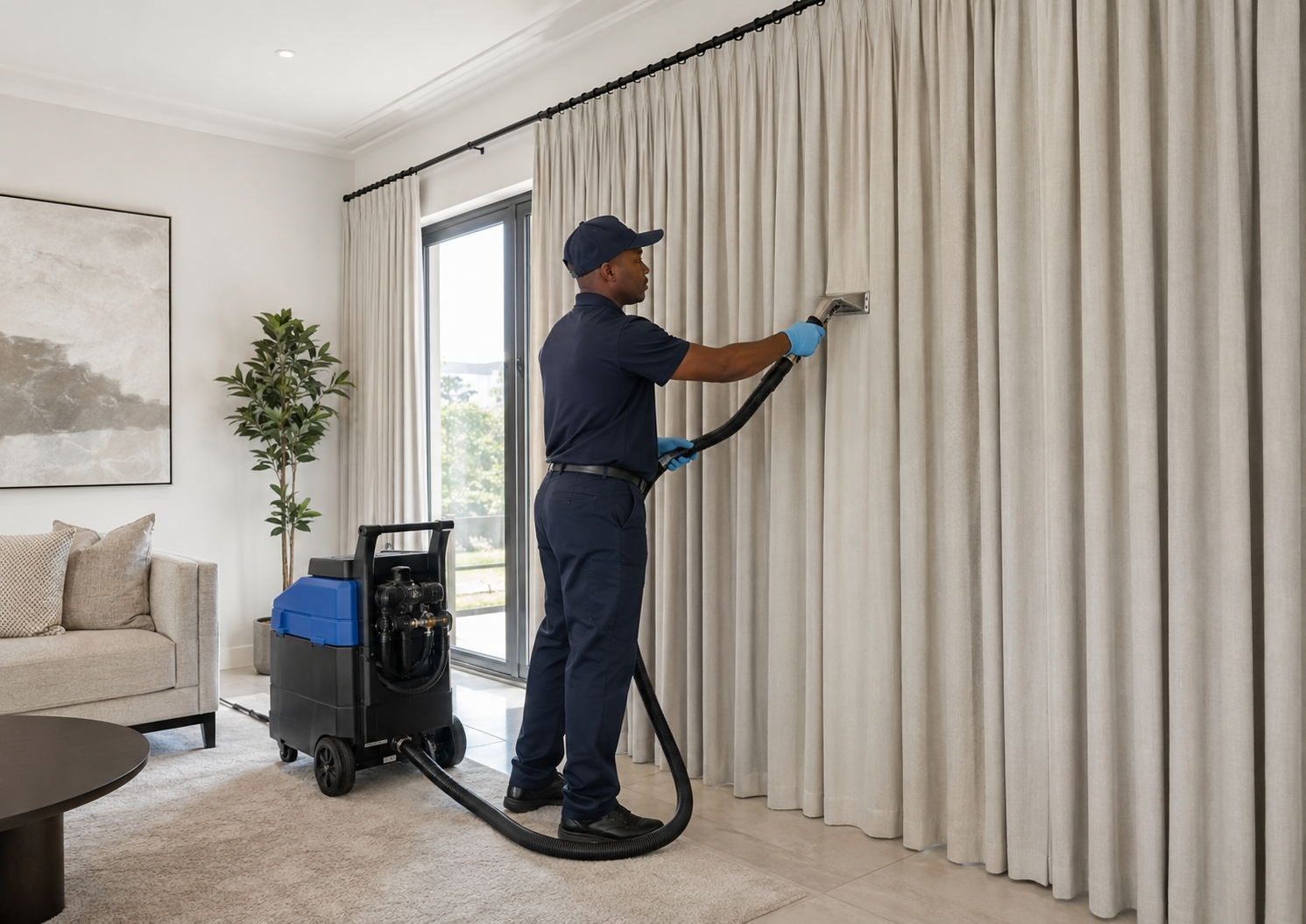
Curtains collect dust, odours, cooking smells, pet smells, moisture, pollen and everyday dirt over time. To clean curtains properly, first check the care label, fabric type, lining and curtain size. Some curtains can be vacuumed and freshened while hanging, some can be washed at home, and larger or heavier curtains are often easier to clean professionally while still hanging.
The best way to clean curtains depends on the curtain type:
| Curtain type | Best cleaning approach |
|---|---|
| Light dusty curtains | Vacuum and freshen while hanging |
| Washable unlined curtains | Gentle machine wash or hand wash |
| Heavy curtains | Professional on-site curtain cleaning is often easier |
| Block-out curtains | Professional on-site cleaning is often more convenient |
| Curtains with odours or built-up dirt | Professional cleaning is usually more practical |
| Large lounge or bedroom curtains | On-site cleaning can avoid removal and rehanging |
For light dust, regular vacuuming and airing may be enough. But home methods are mostly surface-level. They can freshen curtains, remove loose dust and help with small marks, but they do not usually offer the same cleaning power as professional curtain cleaning equipment, controlled moisture application, fabric-safe cleaning solutions and extraction.
For dirty curtains, stale odours, block-out curtains, large curtains or curtains that are difficult to remove, professional curtain cleaning is often the easier and more effective option because the curtains can often be cleaned at the property while still hanging.
Quick answer: how to clean curtains
To clean curtains properly, first check the care label, fabric type, lining and curtain size. For light dust, vacuum the curtains while they are hanging using a soft brush attachment. For washable lightweight curtains, hand washing or machine washing may be suitable if the care label allows it.
For heavy curtains, block-out curtains, lined curtains, odours, smoke smells, cooking residue, pet smells or built-up dirt, professional on-site curtain cleaning is often the better option. It can clean more deeply than basic home methods using professional cleaning solutions, controlled moisture and extraction, while often avoiding the need to remove, transport and rehang the curtains.
The safest basic steps are:
- Check the care label.
- Identify whether the curtains are washable, lined, block-out or dry-clean-only.
- Vacuum the curtains from top to bottom while hanging.
- Spot-clean small marks carefully.
- Wash only if the fabric and lining are suitable.
- Use mild detergent and cool water.
- Avoid harsh scrubbing, bleach and high heat.
- Dry the curtains properly before rehanging.
- Use professional curtain cleaning for heavy, lined, block-out or difficult-to-remove curtains.
Do not assume all curtains can be washed in a washing machine. Some curtains shrink, crease, fade, lose shape or develop lining damage if cleaned incorrectly.
What is the best way to clean curtains?
The best way to clean curtains depends on the curtain type, fabric, lining and how dirty they are. Light dust, washable curtains, block-out curtains, heavy drapes and curtains with odours all need different levels of care.
For light dust and routine maintenance, the best method is to vacuum the curtains while they are hanging using a soft brush attachment. This removes loose dust from the folds, pleats, edges and lower sections without needing to take the curtains down.
For washable lightweight curtains, a gentle machine wash or hand wash may be suitable if the care label allows it. Use cool water, mild detergent and gentle handling. Avoid hot water, bleach, harsh scrubbing and high heat unless the care label clearly says it is safe.
For heavy curtains, block-out curtains, lined curtains, stale odours, smoke smells, cooking residue, pet smells or built-up dirt, professional on-site curtain cleaning is often the better option. It can use professional cleaning solutions, controlled moisture and extraction to clean more thoroughly than basic home methods, while often allowing the curtains to remain hanging.
As a simple guide:
| Curtain problem | Best cleaning method |
|---|---|
| Light dust | Vacuum while hanging |
| Mild stale smell | Vacuum, air out and improve airflow |
| Small marks | Gentle spot cleaning |
| Washable lightweight curtains | Gentle wash if the care label allows it |
| Heavy curtains | Professional on-site curtain cleaning |
| Block-out curtains | Professional cleaning is often more convenient |
| Smoke, cooking or pet odours | Professional curtain cleaning |
| Built-up dirt | Professional cleaning with fabric-safe solutions and extraction |
| Delicate or uncertain fabrics | Check the care label and avoid risky washing |
So the best way to clean curtains is not always to wash them. For some curtains, washing works well. For others, especially heavy, lined or block-out curtains, professional on-site cleaning is usually safer, easier and more practical.
Before cleaning curtains, check these things first
Before you clean curtains, check:
- the care label
- whether the curtains are lined
- whether they have block-out backing
- whether the fabric is colourfast
- whether the curtains are washable
- whether they are too heavy for your washing machine
- whether they are difficult to remove and rehang
- whether they have hooks, rings, eyelets or special fittings
- whether the main issue is dust, odour, stains, mould or general dirt
This step matters because curtains are not all made the same. A thin washable curtain is very different from a heavy block-out curtain, a lined bedroom curtain or a large lounge curtain.
If you are unsure whether the curtains can be washed safely, avoid machine washing and consider a professional cleaning option instead.
How to clean curtains while hanging
You can clean curtains while hanging if the main issue is dust, light dirt or stale odours.
This is the easiest home method because you do not need to remove the curtains from the rail.
Step 1: Close the curtains fully
Close the curtains so the fabric hangs flat and the folds are easy to access.
Step 2: Vacuum from top to bottom
Use a vacuum cleaner with a soft brush attachment. Start at the top and work downward in slow vertical passes.
Pay attention to:
- curtain tops
- pleats
- folds
- edges
- lower sections near the floor
- areas near open windows
- areas near pets or smoke exposure
Vacuuming removes loose dust and surface dirt before any damp cleaning.
Step 3: Shake or tap the fabric lightly
For thicker curtains, gently shake or tap the fabric to loosen trapped dust. Then vacuum again.
Step 4: Spot-clean small marks
For small marks, use a lightly damp white cloth and a mild cleaning solution. Blot gently. Do not soak the fabric.
Avoid rubbing aggressively because this can spread the mark, damage fibres or create a water ring.
Step 5: Freshen with airflow
Open windows if weather allows, or use a fan to improve airflow. Fresh air can help reduce stale smells after vacuuming.
This method works best for regular maintenance. It is useful, but it is not the same as professional curtain cleaning. Vacuuming and airing mainly remove loose dust and improve freshness. Professional on-site cleaning can go further by using specialised cleaning solutions, controlled moisture and extraction equipment to help remove more embedded soil, odours and residue from the curtain fabric.
How to clean curtains without taking them down
To clean curtains without taking them down, focus on dry dust removal, light spot cleaning and odour freshening.
Use this method:
- Keep the curtains hanging.
- Vacuum the full curtain from top to bottom.
- Use a soft brush for folds and pleats.
- Blot small marks with a damp white cloth.
- Avoid soaking the curtain.
- Improve airflow to help the curtain dry.
- Repeat on both sides if accessible.
This is useful for curtains that are dusty but not heavily soiled.
However, if the curtains are dirty, stained, smelly, heavy or block-out lined, home cleaning while hanging may only improve the surface. In those cases, professional on-site curtain cleaning is usually more practical because proper equipment can clean the curtain fabric more thoroughly without the customer needing to remove and rehang the curtains.
How to clean curtains while hanging without washing them
If you want to clean curtains while hanging without washing them, use a dry-first approach.
The safest basic method is:
- vacuum the curtains thoroughly
- brush the folds gently
- spot-clean small marks only
- use airflow to freshen the fabric
- avoid soaking the curtain
- avoid steam if the fabric or lining may react badly
- do not spray strong fragrances over dirty fabric
This can help with light dust and mild stale smells.
But if the curtains have deep odours, smoke smells, cooking residue, pet odours or visible built-up dirt, cleaning without washing may not be enough. Professional on-site cleaning can usually give a better result because it uses professional equipment and cleaning methods while avoiding the hassle of taking curtains down.
Can curtains be washed in the washing machine?
Some curtains can be washed in the washing machine, but not all.
Machine washing may be suitable for:
- washable unlined curtains
- some polyester curtains
- some cotton curtains
- some lightweight curtains
- some voile curtains
- some net curtains
- some lace curtains, if handled gently
Before washing curtains in a washing machine, check the care label. If the label says dry clean only, do not machine wash them.
How to wash curtains in a washing machine
If the curtains are machine washable:
- Remove hooks, rings and loose fittings.
- Shake or vacuum off loose dust.
- Wash curtains separately.
- Use a gentle cycle.
- Use cool or cold water.
- Use mild detergent.
- Avoid bleach unless the care label allows it.
- Avoid overloading the machine.
- Remove curtains promptly after washing.
- Hang to dry where possible.
Do not use high heat unless the care label allows it. Heat can shrink fabric, damage lining or create creasing.
Machine washing can work for some light washable curtains, but it can be risky for large, lined, heavy or block-out curtains. These curtains can become very heavy when wet, difficult to dry properly and difficult to rehang.
How to wash curtains by hand
Hand washing may be safer than machine washing for some lightweight washable curtains.
To hand wash curtains:
- Fill a clean bath or large basin with cool water.
- Add a small amount of mild detergent.
- Submerge the curtains gently.
- Move the fabric through the water without harsh scrubbing.
- Let the curtains soak briefly if needed.
- Rinse with clean cool water.
- Gently squeeze out water without twisting.
- Hang to dry.
Do not wring curtains aggressively. This can stretch the fabric, damage stitching or create deep creases.
Hand washing is better suited to smaller, washable curtains. It is usually not practical for heavy lounge curtains, large bedroom curtains, block-out curtains or multiple rooms of curtains.
What should I soak my curtains in?
For washable curtains, soak them in cool water with a mild detergent.
For white washable curtains, some people use oxygen-based laundry products, but only if the fabric allows it. Always check the care label first.
Avoid soaking curtains in:
- bleach, unless the label clearly allows it
- strong chemicals
- hot water
- harsh stain removers
- strong vinegar mixtures on delicate or lined curtains
- anything that may damage backing or lining
Soaking can help loosen dust and general dirt, but it is not always suitable for lined, block-out or heavy curtains. If the curtain is large, lined or difficult to dry, soaking at home can create more problems than it solves.
For heavier curtains, professional on-site cleaning is often more practical because it avoids fully soaking the curtain at home and avoids the difficulty of handling a heavy wet fabric.
How to wash block-out curtains
Block-out curtains need more care than ordinary lightweight curtains.
They are often heavier and may have a backing or lining that reacts differently from the face fabric. This makes them harder to wash, dry and rehang at home.
Before trying to wash block-out curtains:
- check the care label
- avoid hot water
- avoid harsh scrubbing
- avoid high heat drying
- avoid twisting or wringing
- avoid soaking for too long
- test any cleaning method on a hidden area first
Some block-out curtains may be lightly vacuumed and spot-cleaned. Others may need professional cleaning.
For many customers, professional on-site curtain cleaning is more convenient for block-out curtains because the curtains are often heavy, bulky and awkward to take down, transport and rehang.
Professional on-site cleaning can also be more suitable because it uses professional equipment, controlled cleaning methods and extraction to clean the curtain fabric without turning the job into a full home laundry project.
How to wash blackout curtains
Blackout curtains are similar to block-out curtains. They are designed to reduce light and often have a coated or lined backing.
To wash blackout curtains safely, first check the care label. If washable, use cool water, mild detergent and gentle handling.
Avoid:
- hot water
- tumble drying on high heat
- bleach
- harsh brushing
- wringing
- long soaking
- ironing directly on coated backing
If the curtains are large or heavy, professional on-site cleaning may be the better option because it avoids the difficulty of removing and rehanging them.
Professional cleaning can also help with dust, odours and built-up residue using equipment designed for fabric cleaning, instead of relying only on home washing, soaking or spot cleaning.
How to clean dirty curtains
Dirty curtains may need more than simple vacuuming.
Use this approach:
- Vacuum first to remove loose dust.
- Identify the main problem: dust, odour, stain, smoke, moisture or general dirt.
- Spot-clean small marks carefully.
- Wash only if the care label allows it.
- Dry fully before rehanging.
- Use professional cleaning for heavy dirt, odours or large curtains.
If curtains are heavily soiled, machine washing at home may not give the result you expect. Large curtains can also become very heavy when wet, making them difficult to handle and dry properly.
Professional curtain cleaning is usually more practical when curtains have built-up dirt, stale odours, smoke smells, pet smells or multiple rooms need cleaning.
The advantage of professional cleaning is not only convenience. Professional curtain cleaning can use targeted fabric cleaning solutions, agitation where appropriate, controlled moisture and extraction to remove more soil and residue than basic vacuuming or light spot cleaning.
What is the best thing to clean curtains with?
The best thing to clean curtains with depends on the curtain type and the problem.
For routine maintenance, use:
- a vacuum cleaner with a soft brush attachment
- a clean white cloth
- cool water
- mild detergent
- gentle airflow for drying
For washable curtains, mild laundry detergent is usually better than strong chemicals.
For curtains that are heavy, lined, block-out, stained or holding odours, professional curtain cleaning equipment and professional cleaning solutions are usually more effective than basic home methods.
Professional cleaning is different because it can combine fabric assessment, professional cleaning solutions, controlled application and extraction. This helps lift and remove more dust, soil, odour-causing residue and general build-up from the fabric instead of only masking smells or wiping the surface.
Avoid using strong products directly on curtains without testing, especially on coloured, lined or block-out curtains.
How to make old curtains look new
Old curtains may not become fully new again, but they can often look fresher and cleaner.
To improve old curtains:
- vacuum them thoroughly
- remove dust from folds and pleats
- freshen them with airflow
- spot-clean visible marks
- wash only if the care label allows it
- avoid high heat and harsh chemicals
- clean the surrounding window area and rails
- consider professional curtain cleaning for deeper freshness
Professional cleaning can often improve the look, feel and freshness of curtains affected by dust, odours and general dirt. It is especially useful where curtains look dull because of built-up dust, stale air, cooking residue, pet odours or smoke exposure.
However, permanent sun fading, fabric wear, old water marks or damaged lining may not be fully reversible.
How to clean drapes
Drapes are usually heavier than standard curtains, so they need careful handling.
To clean drapes at home:
- Vacuum them while hanging.
- Use a soft brush attachment.
- Clean from top to bottom.
- Spot-clean small marks carefully.
- Avoid soaking unless the fabric is washable.
- Avoid machine washing unless the care label allows it.
Because drapes are often heavy, lined and full-length, they are usually more difficult to remove, wash, dry and rehang. For this reason, professional on-site cleaning is often the more convenient option.
Professional cleaning is also stronger than simple home maintenance because it can help remove built-up dust, odour-causing residue and surface soil using professional fabric-cleaning equipment instead of relying only on vacuuming or home washing.
Why home curtain cleaning has limits
Home curtain cleaning is useful, but it has limits.
Vacuuming removes loose dust. Airing helps with mild stale smells. Spot cleaning can help with small marks. Washing may work for some washable curtains.
But home methods may struggle with:
- heavy curtains
- large curtain drops
- block-out curtains
- lined curtains
- stale odours
- smoke smells
- cooking residue
- pet odours
- built-up dust
- multiple rooms of curtains
- curtains that are awkward to remove
- curtains that are difficult to dry properly
- curtains that are difficult to rehang
This is where professional curtain cleaning becomes more valuable.
Why professional curtain cleaning is more powerful than home methods
Professional curtain cleaning is different from basic home cleaning because it is designed to clean curtain fabric more thoroughly while reducing the hassle for the customer.
Depending on the curtain type and service method, professional on-site curtain cleaning may include:
- fabric inspection
- dust and surface soil removal
- professional fabric cleaning solutions
- targeted treatment of general marks
- odour reduction
- allergen and dust reduction
- controlled moisture application
- extraction of moisture, soil and residue
- careful cleaning of curtain folds and high-contact areas
- cleaning while the curtains remain hanging
- professional equipment designed for fabric cleaning
This gives professional curtain cleaning several advantages over home methods:
| Home curtain cleaning | Professional curtain cleaning |
| Mainly vacuuming, spot cleaning or washing | Professional fabric-cleaning process |
| Can freshen light dust | Can remove more embedded soil and residue |
| Often surface-level | Uses professional solutions and extraction |
| Customer handles removal and drying | Curtains can often be cleaned while hanging |
| Difficult for heavy curtains | Better suited to heavy or large curtain drops |
| Risk of over-wetting at home | Controlled moisture and extraction |
| May struggle with odours | Better odour and residue reduction |
| Time-consuming for multiple rooms | More practical for larger jobs |
This is the key difference. DIY cleaning can help maintain curtains. Professional curtain cleaning is usually the better option when curtains need a deeper clean, better odour improvement, less effort and a more practical process.
When DIY curtain cleaning is enough
DIY curtain cleaning may be enough when:
- curtains are lightly dusty
- curtains are washable
- curtains are small or lightweight
- there are no strong odours
- there are no major marks
- the curtains are easy to remove and rehang
- the care label clearly allows washing
For these curtains, vacuuming, airing and gentle washing may be enough.
When professional curtain cleaning is the better option
Professional curtain cleaning is usually the better option when:
- curtains are large or heavy
- curtains are block-out or lined
- curtains are difficult to remove
- curtains are difficult to rehang
- curtains smell stale
- curtains have smoke, cooking or pet odours
- curtains have visible dirt or marks
- several rooms need cleaning
- the property is a guesthouse, office or rental
- you want the curtains cleaned with less hassle
- you want more than surface-level freshening
This is where on-site curtain cleaning becomes attractive. The curtains can often be cleaned while hanging, which saves the customer from removing, transporting, collecting and rehanging them.
You can view listed curtain cleaning services in your area and use the Rates & Availability Calendar to check prices and live open slots.
Why on-site curtain cleaning is more convenient
On-site curtain cleaning is often more convenient than washing curtains at home or taking them to a laundromat.
| On-site curtain cleaning | Washing or laundromat cleaning |
| Curtains can often stay hanging | Curtains usually need to be removed |
| Cleaner comes to the property | Customer may need to transport curtains |
| Useful for heavy curtains | Heavy curtains are difficult to carry |
| Helpful for block-out curtains | Block-out curtains can be bulky |
| Less disruption | More handling and waiting |
| No rehanging hassle in many cases | Customer may need to rehang curtains |
| Better for multiple rooms | Multiple curtain drops can become a lot of work |
| Professional equipment and solutions | Home equipment is usually limited |
| Controlled moisture and extraction | Home washing can over-wet curtains |
For large, heavy or block-out curtains, convenience is a major part of the value. Even if DIY cleaning looks cheaper, the time and effort can be significant.
Curtain cleaning prices and booking options
If you are comparing DIY cleaning with professional cleaning, see the curtain cleaning prices in South Africa guide.
As a general guide, on-site curtain cleaning while hanging may be priced per curtain drop, while laundromat-style curtain cleaning is often priced per kg.
Per kg cleaning may look cheaper at first, but curtains can weigh several kilograms. Once weighed, the final price can be closer to or sometimes more than on-site cleaning, while still requiring the customer to remove, transport, collect and rehang the curtains.
To view current options, use the Rates & Availability Calendar on the curtain cleaning service page to select your location, view prices and check live open slots.
Curtain cleaning services by area
Curtain cleaning availability can vary by area. You can view listed curtain cleaning options in major areas here:
- Curtain cleaners in Sandton
- Curtain cleaners in Randburg
- Curtain cleaners in Johannesburg
- Curtain cleaners in Pretoria
- Curtain cleaners in Cape Town
- Curtain cleaners in Durban
You can also browse all available service areas on the main CleanLab SA locations page.
For other home and business cleaning services, visit the main professional cleaning services hub.
Why book curtain cleaning through CleanLab SA?
CleanLab SA helps customers find listed curtain cleaning options, view upfront pricing where available and book online without needing to phone around for every quote.
For curtain cleaning, this is useful because large, heavy, lined or block-out curtains can be difficult to remove, transport, clean, dry and rehang. It helps to book through a platform where listed service options can be viewed more clearly.
Customers can select their area, view available options and use the Get Rates & Availability CTA to check prices and open slots where available.
Booking through CleanLab SA can also help with peace of mind because the platform includes support around Booking Protection and Professional Standards.
This gives customers a clearer booking process, especially when arranging curtain cleaning for homes, offices, rental properties or guesthouses.
FAQs about how to clean curtains
How to clean curtains while hanging without washing them?
Vacuum the curtains from top to bottom using a soft brush attachment, gently brush folds and pleats, spot-clean small marks with a lightly damp cloth, and improve airflow to freshen the fabric. This works best for light dust and mild odours.
For deeper dust, odours or built-up dirt, professional on-site curtain cleaning is usually more effective because it can use professional cleaning solutions and extraction while the curtains remain hanging.
Can curtains be washed in the washing machine?
Some curtains can be washed in the washing machine if the care label allows it. Use a gentle cycle, cool water and mild detergent. Do not machine wash dry-clean-only curtains, heavy lined curtains or block-out curtains unless the label says it is safe.
What should I soak my curtains in?
For washable curtains, soak them in cool water with mild detergent. Avoid bleach, hot water and harsh chemicals unless the care label specifically allows them.
How to clean dirty curtains without taking them down?
Vacuum the curtains thoroughly while hanging, spot-clean small marks, brush the folds and use airflow to freshen the fabric. For heavy dirt, smoke smells, cooking odours or pet odours, professional on-site curtain cleaning is usually more effective.
What is the best way to clean curtains?
The best way to clean curtains depends on the curtain type. Light dusty curtains can usually be vacuumed while hanging. Washable lightweight curtains may be hand washed or machine washed if the care label allows it. Heavy, lined, block-out or odour-affected curtains are usually better suited to professional on-site curtain cleaning.
What is the best thing to clean curtains with?
For basic home cleaning, use a vacuum with a soft brush attachment, mild detergent, cool water and a clean white cloth. For deeper cleaning, professional curtain cleaning equipment, professional cleaning solutions and extraction are usually better.
How to make old curtains look new?
Vacuum them, remove dust from pleats and folds, freshen them with airflow, spot-clean visible marks and wash only if the care label allows it. Professional cleaning can often improve freshness and appearance, although sun fading, fabric wear and permanent marks may not fully reverse.
Final answer
To clean curtains, first check the care label, fabric, lining and curtain size. Light dusty curtains can often be vacuumed and freshened while hanging. Washable curtains may be hand washed or machine washed using cool water and mild detergent, if the care label allows it.
Home curtain cleaning is useful for light maintenance, but it has limits. It is usually surface-level and can become difficult with heavy, lined, block-out or full-length curtains.
Professional on-site curtain cleaning is often the better option for large curtains, block-out curtains, drapes, curtains with odours and curtains that are difficult to remove. It can use professional cleaning solutions, controlled moisture and extraction to clean more thoroughly, while often allowing the curtains to be cleaned while hanging.