Blinds collect dust, fingerprints, cooking residue, pet hair, smoke smells, moisture and everyday dirt over time. The best way to clean blinds depends on the type of blinds you have, how dirty they are, and whether they can safely be cleaned while hanging.
For light dust, most blinds can be cleaned at home with a microfibre cloth, vacuum cleaner and gentle wiping. For dirty blinds, fabric blinds, greasy kitchen blinds, old blinds, smoke-exposed blinds or blinds that have not been cleaned in years, professional blind cleaning is often the better option because it can remove or improve more built-up dirt, residue and odours than basic home dusting.
The safest starting point is simple:
- Identify the blind type.
- Dust or vacuum first.
- Avoid soaking blinds unless the material allows it.
- Use mild cleaning methods.
- Avoid harsh chemicals on wood, fabric or coated blinds.
- Clean slats, cords, folds and edges carefully.
- Use professional blind cleaning for delicate, fabric, very dirty or difficult-to-remove blinds.
Different blinds need different methods. Venetian blinds, wooden blinds, fabric blinds, roller blinds and vertical blinds should not all be cleaned the same way.
Quick answer: how to clean blinds
To clean blinds at home, first close the blinds and dust them from top to bottom using a microfibre cloth, blind duster or vacuum with a soft brush attachment. Then tilt the slats the opposite way and repeat. For small marks, wipe gently with a damp cloth and mild soapy water.
For fabric blinds, roller blinds and vertical blinds, avoid soaking the material. Vacuum gently, spot-clean carefully and allow good airflow. For wooden blinds, avoid excess water because moisture can damage or warp the wood.
For blinds with heavy dust, grease, smoke residue, pet odours, mould-prone moisture marks or years of build-up, professional blind cleaning is usually more effective than basic home dusting. Professional cleaning can in many cases remove or improve built-up dirt, odours and general marks, depending on the blind type, material and condition.
What is the best way to clean blinds?
The best way to clean blinds depends on the blind material.
For light dust, the best method is to dust or vacuum the blinds while they are still hanging. This removes loose dust without needing to remove the blinds from the window.
For washable PVC, aluminium or faux wood blinds, a gentle wipe with a damp cloth and mild soapy water may be suitable. For wooden blinds, use as little moisture as possible. For fabric, roller and vertical blinds, vacuuming and careful spot cleaning are usually safer than soaking.
As a simple guide:
| Blind type or problem | Best cleaning method |
|---|---|
| Light dust | Microfibre cloth or vacuum with soft brush |
| Venetian blinds | Slat-by-slat dusting and gentle damp wiping |
| Wooden blinds | Dry dusting with minimal moisture |
| Faux wood blinds | Dusting and gentle damp wiping |
| Aluminium blinds | Dusting and mild soapy wipe |
| Fabric blinds | Gentle vacuuming and careful spot cleaning |
| Roller blinds | Vacuuming and light spot cleaning |
| Vertical blinds | Vacuuming and wiping each panel carefully |
| Greasy kitchen blinds | Mild degreasing where material allows |
| Blinds not cleaned in years | Professional blind cleaning |
| Yellowed or stained blinds | Professional assessment; results vary |
So the best way to clean blinds is not always to wash them. For some blinds, washing helps. For others, especially wood, fabric, roller and vertical blinds, too much water can cause damage.
Before cleaning blinds, check the blind type
Before you clean blinds, identify what type of blinds you have.
Common blind types include:
- Venetian blinds
- wooden blinds
- faux wood blinds
- aluminium blinds
- PVC blinds
- vertical blinds
- roller blinds
- fabric blinds
- Roman blinds
- honeycomb or cellular blinds
- day-night blinds
This matters because each type reacts differently to water, wiping, dusting and cleaning products.
A plastic or aluminium blind may tolerate gentle damp wiping. A wooden blind may be damaged by too much water. A fabric blind may stain, watermark, shrink or lose shape if cleaned incorrectly.
If you are unsure what the blinds are made from, start with dry dusting and avoid strong cleaning products.
How to dust blinds
Dusting is the first step when cleaning almost any blind.
To dust blinds:
- Close the blinds fully.
- Use a microfibre cloth, blind duster or vacuum with a soft brush attachment.
- Work from top to bottom.
- Dust across each slat or panel.
- Tilt the slats the opposite way.
- Repeat on the other side.
- Wipe the surrounding window sill and frame.
Dusting first is important because wetting dusty blinds can turn dry dust into a dirty smear.
For regular maintenance, dusting once every week or two can help keep blinds looking cleaner for longer.
How to clean blinds while hanging
You can clean many blinds while they are still hanging. This is usually the easiest home method because you do not need to remove the blinds from the window.
Use this method:
- Close the blinds.
- Dust from top to bottom.
- Tilt the slats or panels the opposite way.
- Dust again.
- Wipe marks with a lightly damp cloth.
- Dry the area with a clean cloth.
- Open the window or improve airflow if any moisture was used.
This works well for regular dust, light dirt and small marks.
For heavily soiled blinds, greasy kitchen blinds, fabric blinds or blinds that have not been cleaned in years, cleaning while hanging at home may only improve the surface. Professional blind cleaning can usually give a better result because proper equipment, cleaning solutions and technique can remove or improve more built-up dirt and residue.
How to clean blinds without removing them
To clean blinds without removing them, use a dry-first method.
The safest basic process is:
- vacuum or dust the blinds first
- clean one section at a time
- avoid soaking the blinds
- use a lightly damp cloth only where suitable
- dry the blinds after wiping
- avoid strong chemicals
- clean the window sill and surrounding frame afterwards
This is useful for most everyday blind cleaning.
However, not all blinds should be wet-cleaned while hanging. Fabric blinds, wooden blinds, lined blinds and delicate blinds need more care. If the blinds are valuable, delicate, stained, greasy, very dirty or difficult to access, professional cleaning is usually safer.
How to clean Venetian blinds
Venetian blinds are one of the most common types of window blinds. They have horizontal slats, usually made from aluminium, PVC, faux wood or wood.
To clean Venetian blinds:
- Close the slats.
- Dust from side to side using a microfibre cloth or blind duster.
- Tilt the slats the other way.
- Dust the opposite side.
- Wipe marks with a damp cloth if the material allows it.
- Dry the slats afterwards.
- Clean the cords, rail and window sill.
For aluminium, PVC or faux wood Venetian blinds, a mild soapy wipe may help remove fingerprints and general dirt.
For wooden Venetian blinds, avoid soaking or using too much water. Moisture can damage the finish or cause warping.
How to wash Venetian blinds
Some Venetian blinds can be washed more thoroughly, but this depends on the material.
PVC, aluminium and some faux wood blinds may tolerate gentle washing better than real wood blinds. Wooden Venetian blinds should generally not be soaked.
If the blinds are washable:
- Remove loose dust first.
- Use mild soapy water.
- Wipe each slat carefully.
- Avoid bending the slats.
- Rinse with a lightly damp cloth if needed.
- Dry each slat properly.
Do not use harsh chemicals, abrasive brushes or excessive water.
For very dirty Venetian blinds, professional cleaning may be better than trying to wash each slat at home, especially if the blinds are large, delicate or difficult to remove.
How to clean wooden blinds
Wooden blinds need careful cleaning because excess moisture can damage them.
To clean wooden blinds:
- Close the blinds.
- Dust with a dry microfibre cloth.
- Use a vacuum with a soft brush attachment if needed.
- Wipe small marks with a barely damp cloth.
- Dry immediately.
- Avoid soaking, spraying or scrubbing.
Do not wash wooden blinds in a bath or soak them in water. This can cause swelling, warping, cracking or finish damage.
For wooden blinds with heavy dirt, smoke residue or sticky build-up, professional cleaning is often safer than aggressive DIY cleaning.
How to clean faux wood blinds
Faux wood blinds are usually more moisture-resistant than real wooden blinds, but they still need gentle cleaning.
To clean faux wood blinds:
- Dust first.
- Wipe with a damp microfibre cloth.
- Use mild soapy water for marks if needed.
- Avoid abrasive scrubbing.
- Dry the slats after cleaning.
Faux wood blinds can often handle more cleaning than real wood blinds, but strong chemicals may still damage the finish.
How to clean aluminium blinds
Aluminium blinds can collect dust, fingerprints and grease, especially in kitchens.
To clean aluminium blinds:
- Dust the slats first.
- Wipe with a damp cloth and mild soapy water.
- Clean both sides of the slats.
- Avoid bending the slats.
- Dry with a clean cloth.
For greasy blinds, a mild degreasing solution may help, but test first and avoid harsh products that could damage the coating.
How to clean fabric blinds
Fabric blinds need more care than hard slat blinds because moisture can cause staining, water marks, shrinkage or texture changes.
This keyword matters because “how to clean fabric blinds” and related searches had strong search volume in the Keyword Planner data.
To clean fabric blinds:
- Keep the blinds hanging if possible.
- Vacuum gently with a soft brush attachment.
- Work from top to bottom.
- Spot-clean small marks with a lightly damp cloth.
- Use mild detergent only if suitable.
- Avoid soaking the fabric.
- Avoid harsh scrubbing.
- Allow airflow to help drying.
For fabric blinds with odours, dust build-up, stains or years of dirt, professional blind cleaning is usually the better option. Professional cleaning can in most cases remove or improve odours and can remove or improve many general marks, depending on the fabric and condition.
How to wash fabric blinds
Some fabric blinds can be washed, but many should not be soaked or machine washed without checking the care instructions.
Fabric blinds may include:
- roller blinds
- Roman blinds
- vertical fabric blinds
- honeycomb blinds
- cellular shades
- day-night blinds
Before washing fabric blinds, check the care label or manufacturer guidance.
Avoid:
- hot water
- bleach
- strong chemicals
- soaking
- machine washing unless clearly allowed
- tumble drying
- harsh scrubbing
If the fabric is delicate, lined, coated, old or stained, professional cleaning is safer than home washing.
How to clean roller blinds
Roller blinds can be made from fabric, sunscreen material, PVC-coated material or block-out fabric. This means the safest cleaning method depends on the material.
To clean roller blinds:
- Roll the blind down fully.
- Vacuum gently from top to bottom.
- Use a soft brush attachment.
- Spot-clean small marks with a lightly damp cloth.
- Avoid soaking the blind.
- Let it dry fully before rolling it back up.
Do not roll up a damp roller blind. This can trap moisture and encourage odours or mould.
For roller blinds with heavy dust, stains, kitchen residue or old marks, professional cleaning may be the better option.
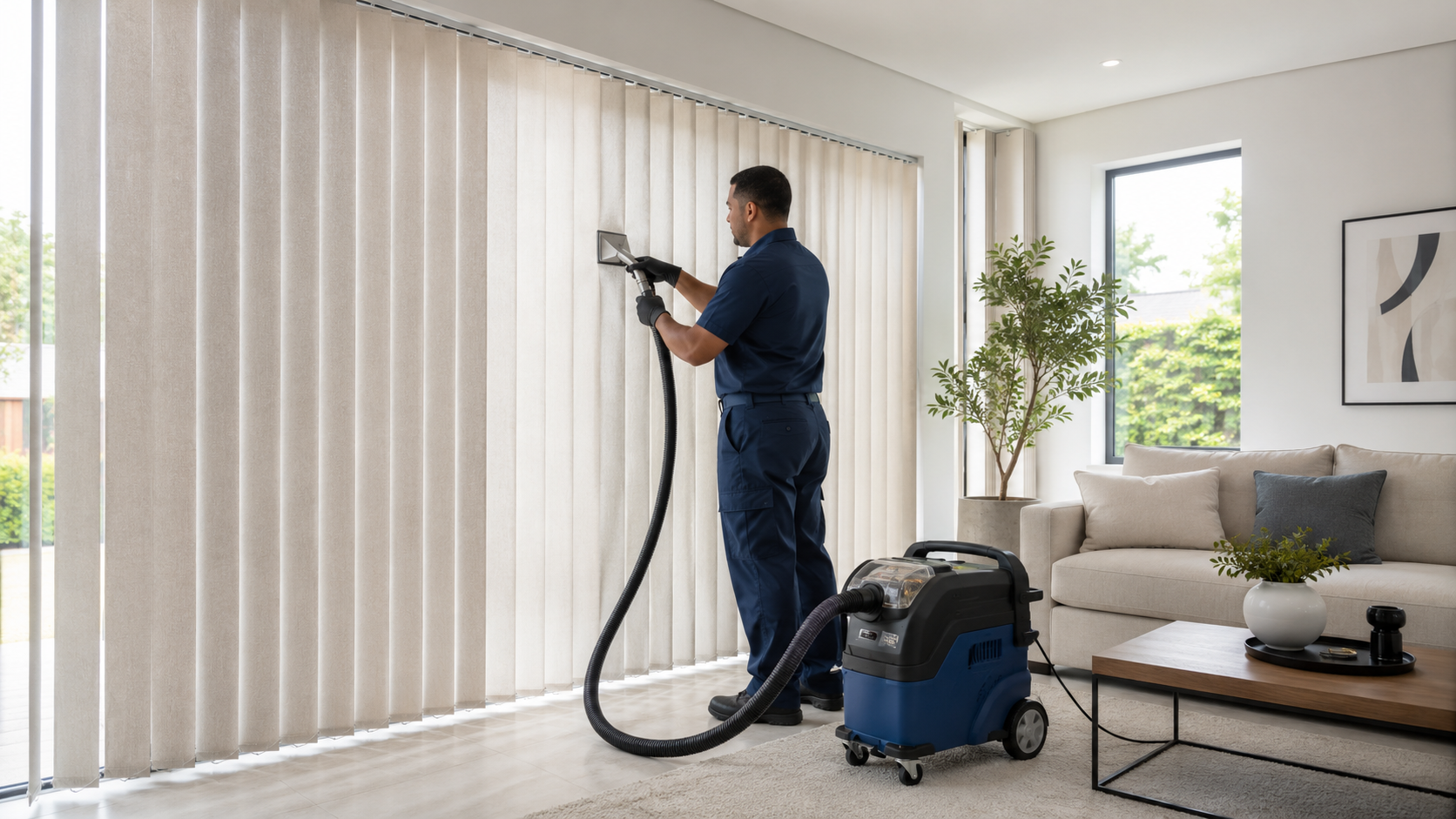
How to clean vertical blinds
Vertical blinds can be made from fabric, PVC or other materials. They collect dust along the edges and lower sections.
To clean vertical blinds:
- Close the blinds.
- Vacuum each panel from top to bottom.
- Wipe hard panels with a damp cloth if suitable.
- Spot-clean fabric panels carefully.
- Avoid soaking fabric panels.
- Let panels dry fully before stacking them together.
If the vertical blinds are very dirty, stained, yellowed or old, professional cleaning may be more practical than cleaning each panel by hand.
How to clean dirty blinds
Dirty blinds usually need more than quick dusting.
Use this process:
- Dust or vacuum first.
- Identify the blind material.
- Remove loose dirt before using moisture.
- Use mild cleaning solution only where suitable.
- Clean slats, panels, cords and edges.
- Dry the blinds properly.
- Use professional cleaning for heavy build-up.
If blinds have not been cleaned in a long time, dirt may be mixed with grease, smoke, moisture and dust. That build-up can be difficult to remove with basic home cleaning.
Professional blind cleaning can often remove or improve this build-up more effectively than wiping alone, especially on fabric blinds, vertical blinds, roller blinds and large window blinds.
How to clean blinds that have not been cleaned in years
Blinds that have not been cleaned in years often have layered dust, sticky residue, grease, stains, smoke marks, pet hair or yellowing.
For old dirty blinds:
- Start with dry dusting.
- Vacuum gently.
- Do not wet the blinds before removing loose dust.
- Clean a small test area first.
- Use mild cleaning only if the material allows it.
- Avoid aggressive scrubbing.
- Dry each section properly.
- Consider professional cleaning if the build-up is heavy.
If blinds have years of dirt, professional cleaning is usually the better option. It can in most cases remove or improve general dirt, odours and many marks, but permanent staining, yellowing, sun damage or material ageing may not fully reverse.
What is the best blind cleaner?
The best blind cleaner depends on the blind material.
For most home maintenance, the safest options are:
- microfibre cloth
- soft blind duster
- vacuum with soft brush attachment
- mild dish soap diluted in water
- clean white cloth
- gentle airflow for drying
Avoid using strong chemicals unless you know the blind material can handle them.
For fabric blinds, roller blinds, wooden blinds and delicate blinds, the best “cleaner” is often not a product but the right method. Too much water or the wrong chemical can cause staining, warping, fading or damage.
For deeper dirt, smoke residue, pet odours, cooking residue or old build-up, professional blind cleaning is usually better than relying on a household spray.
Can vinegar be used to clean blinds?
Some people use diluted vinegar for certain household cleaning tasks, but it is not always suitable for blinds.
Vinegar may be too harsh or risky for:
- wooden blinds
- delicate fabric blinds
- coated roller blinds
- coloured fabrics
- old or sun-weakened materials
- special finishes
For general blind cleaning, mild soapy water is usually safer than vinegar. Always test any cleaning solution on a hidden area first.
How to get blinds white again
White blinds can become yellow, grey or dull because of dust, sunlight, smoke, cooking residue, moisture, age or material changes.
To improve white blinds:
- Dust or vacuum first.
- Wipe hard blinds with mild soapy water if suitable.
- Avoid harsh bleaching unless the material clearly allows it.
- Dry the blinds properly.
- Improve airflow around the window.
- Use professional cleaning for heavy residue or old build-up.
Professional cleaning can often improve dull or dirty white blinds, but it may not fully reverse permanent yellowing, UV damage, nicotine staining, material ageing or chemical damage.
This is important: not all yellowing is dirt. Sometimes the blind material has permanently changed colour.
How to remove yellowing from blinds without taking them off the window
If you cannot remove the blinds from the window, start with a gentle method:
- Dust the blinds thoroughly.
- Vacuum with a soft brush attachment.
- Wipe a hidden test area with mild soapy water.
- If safe, wipe one section at a time.
- Dry each section immediately.
- Avoid soaking cords, fabric or wooden parts.
- Improve airflow while the blinds dry.
If the yellowing is from surface dirt, smoke or grease, cleaning may improve the appearance. If the yellowing is from sun damage, ageing or material change, it may not fully come out.
For yellowed blinds that are valuable, large, fabric-based or difficult to remove, professional assessment is the safer option.
How to clean blinds fast
To clean blinds fast, focus on dust removal first.
The quickest method is:
- Close the blinds.
- Dust with a microfibre cloth or blind duster.
- Tilt the slats the other way.
- Dust again.
- Vacuum the floor or sill.
- Spot-clean obvious marks.
This is good for regular maintenance, but it is not a deep clean.
For deep dirt, grease, odours or old build-up, a fast wipe will not be enough.
How to keep blinds cleaner for longer
To keep blinds cleaner for longer:
- dust regularly
- keep windowsills clean
- improve airflow
- reduce indoor smoke exposure
- clean kitchen blinds more often
- vacuum fabric blinds gently
- avoid letting moisture sit on blinds
- clean pet hair from nearby areas
- wipe spills or marks quickly
- avoid strong sprays that leave sticky residue
Regular maintenance prevents dust and residue from becoming harder to remove later.
When DIY blind cleaning is enough
DIY blind cleaning may be enough when:
- the blinds are only lightly dusty
- there are no strong odours
- there is no heavy grease
- the blinds are easy to reach
- the material is not delicate
- there are no major stains or yellowing
- the blinds are cleaned regularly
For these blinds, dusting, vacuuming and gentle wiping may be enough.
When professional blind cleaning is the better option
Professional blind cleaning is usually the better option when:
- blinds are very dirty
- blinds have not been cleaned in years
- blinds are fabric, roller or vertical blinds
- blinds have smoke smells
- blinds have cooking residue
- blinds have pet odours or pet hair
- blinds are yellowed or stained
- blinds are large or difficult to remove
- blinds are delicate or expensive
- blinds are in an office, guesthouse or rental property
- several rooms need cleaning
- you want more than surface-level dusting
Professional cleaning is especially useful when home cleaning is unlikely to reach the level of freshness or detail needed.
Professional blind cleaning vs home cleaning
| Home blind cleaning | Professional blind cleaning |
|---|---|
| Good for light dust | Better for built-up dirt |
| Usually cloth, duster or vacuum | Professional equipment and methods |
| May be surface-level | More thorough cleaning process |
| Can be risky on fabric or wood | More controlled approach |
| Customer does the work | Technician handles the cleaning |
| Can struggle with odours | Can remove or improve odours in most cases |
| Can struggle with stains | Can remove or improve many general marks |
| Good for maintenance | Better for deep cleaning |
Home cleaning is useful for maintenance. Professional blind cleaning is usually better when blinds need a deeper clean, odour improvement, stain improvement or careful handling.
Blind cleaning prices and booking options
Blind cleaning prices can depend on the blind type, size, number of blinds, material, condition, access and whether the blinds can be cleaned while hanging.
Fabric blinds, vertical blinds, roller blinds, Venetian blinds and wooden blinds may need different cleaning approaches.
To view listed cleaning options, visit the professional cleaning services hub or browse service areas on the CleanLab SA locations page. Use the Get Rates & Availability CTA where available to select your location, view options, check prices and see open slots.
Why book blind cleaning through CleanLab SA?
CleanLab SA helps customers find listed blind cleaning options, view upfront pricing where available and book online without needing to phone around for every quote.
For blind cleaning, this is useful because different blinds may need different cleaning methods. Fabric blinds, roller blinds, vertical blinds, Venetian blinds and wooden blinds may all require different levels of care, so it helps to book through a platform where listed service options can be viewed more clearly.
Customers can select their area, view available options and use the Get Rates & Availability CTA to check prices and open slots where available.
Booking through CleanLab SA can also help with peace of mind because the platform includes support around Booking Protection and Professional Standards.
This gives customers a clearer booking process, especially when arranging blind cleaning for homes, offices, rental properties or guesthouses.
FAQs about how to clean blinds
What is the best method to clean blinds?
The best method is to dust or vacuum blinds first, then clean according to the material. Hard blinds can often be wiped gently with mild soapy water, while wooden and fabric blinds need less moisture and more careful handling.
What is the best blind cleaner?
For most blinds, a microfibre cloth, vacuum with soft brush attachment and mild soapy water are safest. For deeper dirt, odours, stains or delicate blinds, professional blind cleaning is usually the better option.
How do you clean blinds while they are still hanging?
Close the blinds, dust or vacuum from top to bottom, tilt the slats the other way and repeat. Spot-clean marks with a lightly damp cloth if the material allows it, then dry the blinds properly.
How do I get blinds white again?
Dust first, then gently clean with mild soapy water if the material allows it. Professional cleaning can often improve white blinds affected by dirt, smoke or residue, but permanent yellowing from sun damage or ageing may not fully reverse.
How do you clean blinds that have not been cleaned in years?
Start with dry dusting and vacuuming before using any moisture. Test a small area before wiping. If the blinds have heavy dust, grease, smoke residue, stains or yellowing, professional cleaning is usually more practical.
How can I remove yellowing from window blinds if I cannot take them off the window?
Clean them while hanging by dusting first, then wiping gently with mild soapy water if safe for the material. Dry each section properly. If yellowing is caused by UV damage, ageing or material change, it may not fully come out.
Final answer
To clean blinds, first identify the blind type. For light dust, use a microfibre cloth, blind duster or vacuum with a soft brush attachment. For hard blinds, gentle wiping with mild soapy water may be suitable. For wooden, fabric, roller and vertical blinds, avoid too much water and clean carefully.
For blinds with heavy dust, odours, grease, stains, yellowing or years of build-up, professional blind cleaning is usually the better option. It can in most cases remove or improve odours, and can remove or improve many general marks and stains, depending on the blind material and condition.