Knowing how to clean a mattress properly can help with light dust, everyday freshness, small surface marks and mild smells. But mattresses are thick, absorbent and difficult to rinse or dry properly, so DIY cleaning has clear limits.
The safest way to clean a mattress at home is to vacuum it well, treat light marks carefully, avoid soaking the mattress and let it dry completely. For sweat odours, urine smells, visible stains, pet accidents, yellow marks or stale mattress smells, professional mattress cleaning is usually the better option. In most normal treatable cases, professional mattress cleaning can remove or significantly reduce visible marks and odours far more effectively than DIY surface cleaning.
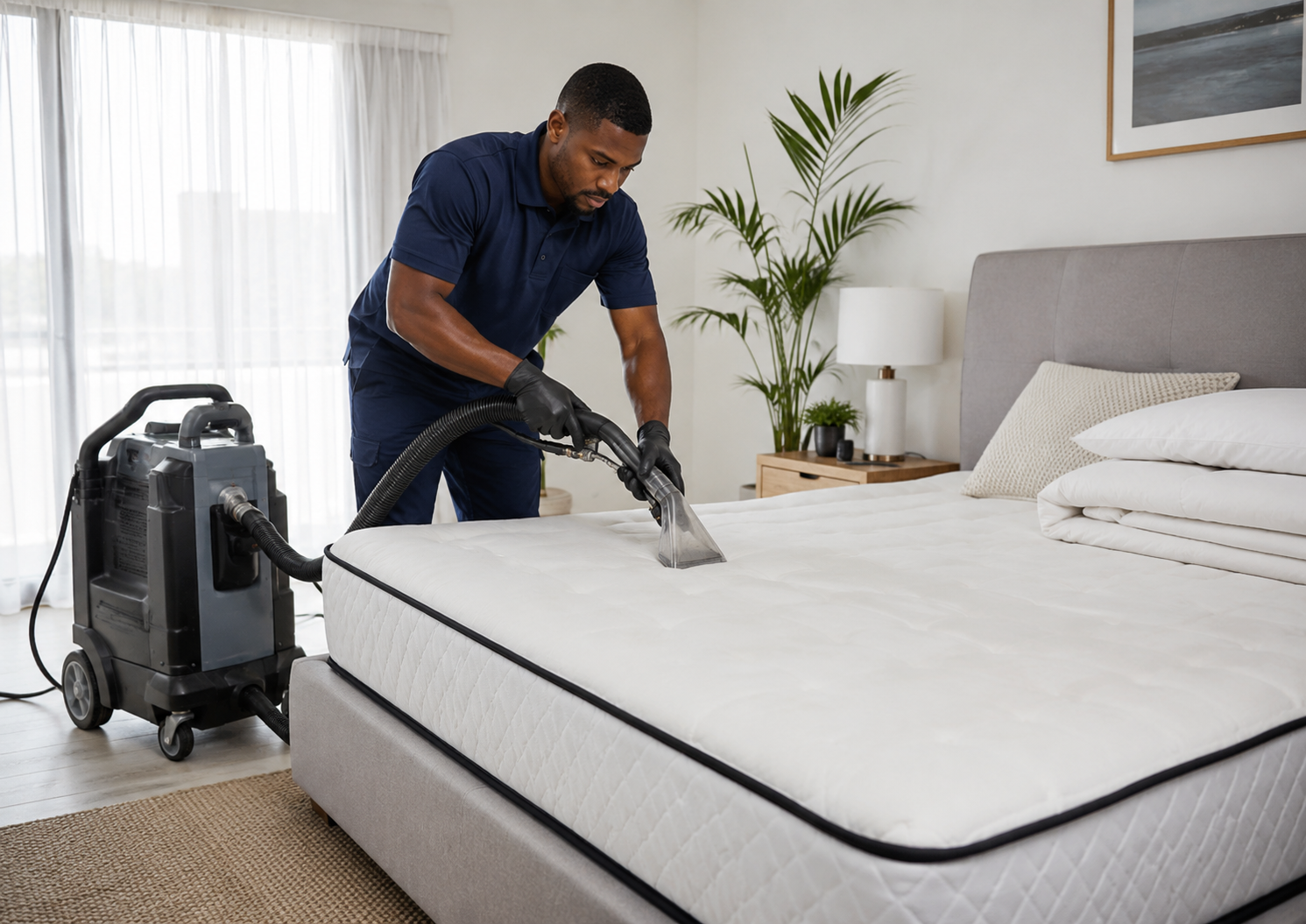
Professional mattress cleaning is different from wiping a mattress with a cloth, spraying a home remedy or sprinkling baking soda over the surface. Listed professionals use professional-grade extraction equipment, controlled moisture, suitable cleaning products and extraction tools designed to lift more embedded residue from the mattress surface and upper layers.
This is why professional mattress cleaning is usually the stronger option when the problem involves sweat, urine, pets, stains or odours that do not go away with basic home cleaning.
If your mattress has visible staining, stale smells, urine odours or sweat buildup, CleanLab SA’s professional mattress cleaning services give customers a structured way to arrange mattress cleaning through listed professionals.
Why mattresses need cleaning
Mattresses collect buildup slowly. Even if a mattress looks clean, it can hold dust, body oils, sweat, skin particles, hair, small spills, pet marks and bedroom odours.
Common reasons people clean a mattress include:
- sweat smells
- yellow marks
- stale bedroom odours
- urine accidents
- pet use
- light food or drink spills
- dust buildup
- guest mattress freshness
- rental property use
- moving into a new home
- children’s mattress accidents
- everyday freshness
Light surface freshness can often be improved at home. But once there are visible stains, strong smells, urine odours, sweat buildup or pet accidents, professional mattress cleaning is usually the correct next step.
DIY cleaning mostly treats the surface. Professional mattress cleaning uses professional-grade extraction equipment, controlled application and proper extraction methods to remove more residue than home remedies can usually reach.
Before you clean a mattress
Before using any product, check the mattress care label if there is one. Some mattresses are more sensitive to moisture, heat or cleaning solutions.
Ask yourself:
- Is the mark fresh or old?
- Is the smell mild or strong?
- Has liquid soaked into the mattress?
- Is the mattress still damp?
- Has vinegar, bleach, peroxide, soap or another product already been used?
- Is there urine, sweat, pet odour or a musty smell?
- Are there signs of mould or black spots?
- Is the mattress sagging, torn or very old?
These details matter because mattress cleaning results depend on the mattress condition, fabric type, stain age, odour source and depth of contamination.
A fresh surface mark is very different from an old urine smell that has moved deeper into the mattress. DIY can be enough for the first situation. Professional mattress cleaning is usually the better option for the second.
What you need to clean a mattress at home
For basic mattress cleaning, you may need:
- a vacuum cleaner
- clean white cloths or paper towels
- a small bowl
- mild dishwashing liquid
- cool water
- baking soda or bicarbonate of soda
- a soft brush
- a spray bottle used very lightly
- a fan or good ventilation
- clean dry towels
Use products carefully. More product does not mean better cleaning. With mattresses, too much moisture is one of the biggest risks because liquid can move deeper into the mattress and become difficult to dry.
This is one of the main reasons professional cleaning is stronger for serious mattress problems. Professional-grade extraction equipment applies and recovers moisture in a more controlled way than DIY cleaning with cloths, spray bottles or home remedies.
How to clean a mattress at home
Start with a careful, low-moisture process.
1. Remove all bedding
Remove sheets, pillowcases, mattress protectors and blankets. Wash these separately according to their care instructions.
Do not put clean bedding back on the mattress until it is completely dry. Covering a damp mattress can trap moisture and make odours worse.
2. Vacuum the mattress properly
Vacuum the full mattress surface, including:
- the top
- seams
- edges
- corners
- sides
- stitching
- buttoned or tufted areas
Vacuuming removes loose dust, hair, crumbs and surface debris before any moisture is used. This is an important first step because wet cleaning over dust can create residue.
3. Blot fresh spills immediately
If the mattress has a fresh spill, blot the area with a dry cloth or paper towel.
Do not scrub. Scrubbing can spread the mark, damage the fabric and push liquid deeper.
Press gently but firmly. Keep changing to a dry part of the cloth until no more liquid transfers easily.
4. Spot test before using any cleaner
Before applying any cleaning solution to a visible area, test a small hidden section of the mattress.
Check for:
- colour change
- fabric reaction
- water marks
- product residue
- texture damage
If the fabric reacts badly, stop. A small stain is better than a larger damaged patch.
5. Use very little moisture
Mattresses are not like washable clothing. They are thick, absorbent and difficult to rinse or dry internally.
If you use a mild cleaning solution, apply it to a cloth first. Do not pour water or cleaner directly onto the mattress.
A simple home option is a small amount of mild dishwashing liquid mixed with cool water. Use only the foam or a lightly damp cloth. Blot the mark gently, then use another lightly damp cloth with plain water to reduce residue.
After that, blot with a dry towel.
6. Deodorise lightly with baking soda
Baking soda or bicarbonate of soda can help with light surface odours and general freshness.
Sprinkle a light layer over the dry mattress surface, leave it for a few hours if possible, then vacuum thoroughly.
This is useful for mild stale smells, but it is not deep cleaning. Baking soda will not properly remove deep urine odours, old sweat buildup, pet contamination, mould inside the mattress or strong smells that have moved below the surface.
7. Dry the mattress completely
Drying is critical.
Open windows, increase airflow and use a fan if possible. The mattress should be completely dry before bedding is replaced.
A mattress that stays damp can smell worse later. Poor drying can also create a musty odour or make old smells return.
What to do about mattress stains
Small, fresh surface marks can sometimes be improved at home with careful blotting, light spot cleaning and proper drying.
Start by:
- removing bedding
- blotting fresh liquid
- avoiding scrubbing
- spot testing any cleaning solution
- using very little moisture
- drying the mattress completely
But mattress stains are not all the same. Urine, sweat, blood, yellow marks, food spills, pet accidents and old stains need different treatment.
If the main issue is visible staining, the dedicated guide on how to remove mattress stains safely should cover this in more detail. This article gives the general mattress-cleaning overview, while the stain guide should focus specifically on how to get stains out of a mattress, how to clean mattress stains, and how to deal with urine, sweat, blood, food marks and old discolouration.
Professional mattress cleaning is usually the better option for urine stains, sweat marks, yellowing, pet accidents, old stains and marks linked to odours. In most normal treatable cases, professional cleaning can remove or significantly reduce visible mattress stains and related smells, especially when the mattress is still in reasonable condition and the stain has not caused permanent damage.
How to deal with mattress smells
Mattress smells can come from sweat, urine, pets, dampness, old spills, poor airflow, dirty bedding or body oils.
For mild surface freshness:
- remove bedding
- vacuum the mattress
- sprinkle a light layer of baking soda
- leave it for a few hours
- vacuum thoroughly
- air the mattress well
This can help with light stale smells. But if the mattress has a strong sweat smell, urine odour, pet smell or damp smell, DIY freshening is usually not enough.
Professional mattress cleaning is usually the better option for mattress odours because it does more than cover the smell. Listed professionals use suitable cleaning products and professional-grade extraction equipment to remove more of the residue causing the odour from the mattress surface and upper layers.
In most normal treatable cases, professional mattress cleaning can remove or significantly reduce sweat odours, urine odours, pet smells and stale mattress smells.
How to freshen a sweaty mattress
Sweat smells are common because mattresses absorb body heat, moisture and body oils over time. Yellow marks can also develop slowly, especially where someone sleeps in the same position each night.
For light sweat freshness:
- remove all bedding
- vacuum the mattress
- sprinkle baking soda lightly over the dry surface
- leave it for a few hours
- vacuum thoroughly
- air the mattress well
- use a clean mattress protector afterwards
This can help with mild surface freshness. But if the mattress has stale sweat smell, yellow marks or body-oil buildup, professional cleaning is usually the stronger and more realistic solution.
Professional mattress cleaning in most cases can remove or significantly reduce sweat odours, stale smells and visible yellowing where the issue is still treatable. This is because professional cleaning works beyond surface deodorising by using professional-grade extraction equipment, controlled moisture and suitable cleaning products to lift body oils, sweat residue and odour sources from the mattress surface and upper layers.
Older yellow marks may not always disappear completely, especially if they have permanently discoloured the fabric. But professional mattress cleaning gives a much better chance of improvement than repeated DIY freshening with baking soda, sprays or vinegar.
What to do about urine on a mattress
Urine is one of the most difficult mattress problems because the surface can look better while the smell remains deeper inside.
For a fresh urine accident:
- Remove bedding immediately.
- Blot the area with dry cloths or paper towels.
- Do not rub.
- Avoid pouring water onto the mattress.
- Use a lightly damp cloth with mild cleaning solution only on the affected surface.
- Blot again with dry towels.
- Use airflow to dry the mattress properly.
- Sprinkle baking soda only once the area is no longer wet.
- Vacuum thoroughly after it has had time to sit.
These steps can reduce the immediate problem, especially if the accident is fresh. But urine odour is often difficult to remove properly with DIY cleaning because liquid can move below the surface.
If urine or pee smell is the main issue, the dedicated urine guide should cover the steps in more detail. This umbrella article should not become the full urine article.
For urine smells, child bedwetting, pet accidents or dried urine, professional mattress cleaning is usually the best option. In most normal treatable cases, professional mattress cleaning can remove or significantly reduce urine odours and visible urine marks, especially when the mattress is treated early and urine has not caused severe long-term saturation.
This is where professional equipment matters. DIY cleaning often wets the area without extracting enough residue back out. Professional mattress cleaning uses controlled cleaning and extraction methods to remove more of the urine residue and odour source from the surface and upper layers of the mattress.
The main limits are old urine, repeated accidents, pet urine that has soaked deeply, and contamination inside the foam or inner layers. Even then, professional mattress cleaning is usually a much stronger attempt than using more vinegar, water, powder or fragrance at home.
What to know about blood marks
Blood stains need careful handling. Heat can make blood marks harder to remove, so avoid hot water.
For a fresh blood mark:
- use cool water only
- blot gently
- avoid rubbing
- use very little moisture
- blot dry afterwards
This article only gives a broad overview because blood stains need their own specific guide. Fresh blood, dried blood, heat-treated marks and old blood stains behave differently.
Professional mattress cleaning can remove or significantly reduce many blood marks when they are treated early and have not permanently bonded with the mattress fabric. Fresh blood marks usually have a better chance of strong improvement than old, heat-treated or heavily scrubbed stains.
Can you clean a mattress with baking soda?
Yes, baking soda can be used on a mattress, but only for limited surface-level freshness.
It can help with:
- mild stale smells
- light surface odours
- general freshness
- some surface moisture after blotting
But baking soda does not deep clean a mattress. It will not properly remove urine saturation, deep sweat odours, pet urine, old stains, mould or strong smells inside the mattress.
If the mattress smells because of urine, pets, sweat, dampness or old spills, professional mattress cleaning is usually the better option. Baking soda can make the surface smell fresher for a while, but it does not extract the source of deeper odours.
Professional-grade extraction equipment is the key difference. Baking soda sits on the surface. Professional cleaning uses suitable cleaning methods and extraction equipment to remove moisture, residue and odour sources more effectively.
Can you clean a mattress with vinegar?
Vinegar is often suggested as a home remedy, but it should be used carefully.
The problem is that people often use too much. A mattress can absorb vinegar and water, leaving behind moisture, a strong vinegar smell and possible residue. If the mattress does not dry properly, the odour problem can become worse.
If you use vinegar at all, use it very lightly, spot test first and never soak the mattress.
For urine smells, sweat smells, pet accidents and old stains, professional cleaning is usually a better option than repeated vinegar use. Vinegar can reduce some surface odour, but it can also add moisture and make later cleaning more difficult.
If the mattress already smells bad, adding more liquid without proper extraction is often the wrong direction. Professional mattress cleaning is usually stronger because it is built around both cleaning and extraction.
How to deep clean a mattress
A true deep clean is difficult to do properly at home because mattresses are thick, absorbent and hard to rinse or dry internally.
At home, you can:
- vacuum thoroughly
- spot clean light marks
- reduce mild surface smells with baking soda
- air the mattress
- use a mattress protector going forward
But home cleaning is limited when the mattress has:
- urine smells
- repeated pet accidents
- old sweat odours
- yellow marks
- visible stains
- stale smells
- old liquid spills
- body oil buildup
- guesthouse or rental property use
- odours that return after cleaning
For these problems, professional mattress cleaning is usually the correct option. It gives the mattress a service-level clean rather than light surface freshening.
Professional mattress cleaning uses controlled moisture, suitable cleaning products and professional-grade extraction equipment designed to remove more embedded residue than DIY methods. This is why it is usually the better choice for mattresses affected by sweat, urine, pets, odours and visible marks.
What not to do when cleaning a mattress
Avoid these common mistakes:
- soaking the mattress with water
- pouring cleaning solution directly onto the mattress
- using too much vinegar
- scrubbing aggressively
- using bleach
- using hot water on blood stains
- putting bedding back before the mattress is dry
- using strong fragrances to hide odours
- ignoring urine smells that keep returning
- treating mould like a normal stain
- assuming every stain can be fully removed
Poor DIY cleaning can make mattress stains and odours harder to treat later. The main risk is pushing moisture or residue deeper into the mattress.
If a mattress already has urine odour, sweat smell, pet marks or old stains, repeated DIY attempts can make the issue worse. Professional mattress cleaning is usually the better move before too many home products are added.
When DIY mattress cleaning is enough
DIY cleaning can be enough when:
- the mattress only needs light freshening
- there is surface dust
- the stain is small and fresh
- the smell is mild
- there is no urine odour
- there is no pet urine
- the mattress dries quickly
- the fabric reacts well to spot cleaning
- the mattress is otherwise in good condition
In these cases, careful vacuuming, light spot cleaning, baking soda and proper drying can improve the mattress.
DIY cleaning is best for light maintenance. It is not the strongest option for real mattress odours, visible stains or deeper contamination.
When professional mattress cleaning is the better option
Professional mattress cleaning is usually the better option when the mattress has:
- urine smells
- visible urine marks
- sweat odours
- yellow stains
- pet accidents
- stale smells
- old stains
- food or drink marks
- body oil buildup
- guest-use odours
- rental property use
- child bed accidents
- smells that return after DIY cleaning
- stains that remain after spot treatment
- residue from previous home remedies
In most normal treatable cases, professional mattress cleaning can remove or significantly reduce visible marks and odours. This is especially true when the problem is in the surface fabric or upper layers and the mattress has not been permanently damaged.
CleanLab SA helps customers arrange mattress stain and odour cleaning through listed professionals. Customers can view available options, compare booking details and use Get Rates & Availability to select their location and secure a booking.
The main advantage of professional mattress cleaning is that it is not just surface freshening. Listed professionals use professional-grade extraction machines, suitable cleaning products and controlled cleaning methods designed to remove more embedded residue than household products can usually reach.
That is why professional mattress cleaning is usually the stronger choice for urine odours, sweat smells, yellow marks, pet accidents and stale mattress smells.
What professional mattress cleaning may not fully remove
Professional mattress cleaning is the stronger option for serious mattress freshness problems, but it still has realistic limits.
It may not fully remove or fix:
- permanent colour changes
- bleach marks
- very old stains that have set deeply
- severe long-term urine saturation
- liquid deep inside the foam or inner layers
- mould inside the mattress
- structural mattress damage
- sagging
- torn fabric
- odours from long-term internal contamination
- stains made worse by harsh DIY chemicals
This does not weaken the value of professional cleaning. It sets realistic expectations.
In most treatable cases, professional mattress cleaning gives a much better chance of removing or strongly improving stains and odours than DIY cleaning. The difficult cases are usually mattresses with permanent damage, deep internal contamination, severe mould or long-term saturation.
Should you replace the mattress instead of cleaning it?
In some cases, replacement is better than cleaning.
Consider replacing the mattress if:
- it has deep mould
- it stays damp
- it has severe long-term urine saturation
- the smell returns quickly after cleaning
- the mattress is sagging or damaged
- the internal foam is affected
- the mattress is very old
- there are widespread stains and odours
Cleaning is more suitable when the mattress is still structurally sound and the issue is mainly staining, odour, sweat, urine, pet marks or everyday freshness.
If you are unsure, professional cleaning is often a practical first step before replacing a mattress, especially when the mattress is still comfortable and structurally sound. In many cases, a mattress that looks or smells tired does not need to be replaced immediately. It may simply need a proper professional clean.
How to keep a mattress cleaner for longer
After cleaning, prevention helps.
Useful steps include:
- use a washable mattress protector
- wash bedding regularly
- air the bedroom when possible
- deal with spills quickly
- avoid eating or drinking in bed
- keep pets off the mattress where possible
- vacuum the mattress occasionally
- clean accidents early
- rotate the mattress if the manufacturer allows it
- let the mattress dry fully after any cleaning
A mattress protector is one of the simplest ways to reduce future stains and odours.
Why book mattress cleaning through CleanLab SA?
Booking through CleanLab SA gives customers a structured way to arrange mattress cleaning in South Africa.
CleanLab SA’s listed professionals are reviewed by customers and expected to meet clear standards. Customers can view available options, compare booking details and get support from booking to completion.
This is especially useful when the mattress has a real problem rather than light surface dust. Professional mattress cleaning is usually the stronger choice for urine smells, sweat odours, pet marks, yellow stains, old marks and stale mattress smells.
In most normal treatable cases, professional mattress cleaning can remove or significantly reduce mattress odours and visible marks. The benefit is that professional cleaning goes beyond household wiping, baking soda and sprays by using suitable methods and extraction equipment to remove more residue from the mattress surface and upper layers.
Customers may need help with:
- mattress stains
- sweat smells
- urine odours
- pet marks
- guest mattress refreshes
- rental property mattresses
- child bed accidents
- stale bedroom smells
- several cleaning services at once
The value is in the full booking structure:
- reviewed listed professionals
- clear standards to remain listed
- customer review visibility during booking
- support from booking to completion
- a practical way to arrange mattress cleaning
- local booking options across major South African areas
You can also learn more from CleanLab SA’s Booking Protection and Professional Standards pages.
Find mattress cleaning in your area
If your mattress has stains, smells, sweat marks, urine odours or pet-related accidents, you can start with CleanLab SA’s mattress cleaning services page.
Main city pages include:
- Cape Town mattress cleaners
- Durban mattress cleaning
- Johannesburg mattress cleaners
- Pretoria mattress cleaning
- Randburg mattress cleaners
- Sandton mattress cleaning services
You can also browse the wider cleaning services hub or explore available cleaning service locations.
Final answer
To clean a mattress safely, start by removing bedding, vacuuming thoroughly, blotting fresh spills, spot testing any cleaning solution, using very little moisture and drying the mattress completely before putting bedding back on.
DIY cleaning can work for light freshness, surface dust and small fresh marks. If the main issue is visible staining, a dedicated mattress stain guide should cover the stain-specific steps in more detail. For urine smells, sweat odours, yellow marks, pet accidents, stale smells and visible stains, professional mattress cleaning is usually the better option.
In most normal treatable cases, professional mattress cleaning can remove or significantly reduce mattress stains and odours, especially when the mattress is still in reasonable condition and the issue has not caused permanent damage.
The difference is that DIY cleaning mostly treats the surface. Professional mattress cleaning uses proper cleaning methods and professional-grade extraction equipment to remove more embedded residue from the mattress surface and upper layers. That makes it the stronger choice for sweat, urine, pets, odours and visible marks.
If the mattress is still structurally sound, professional cleaning is often worth considering before replacement. If the mattress has deep mould, severe saturation, internal damage or long-term contamination, replacement may sometimes be the more realistic option.