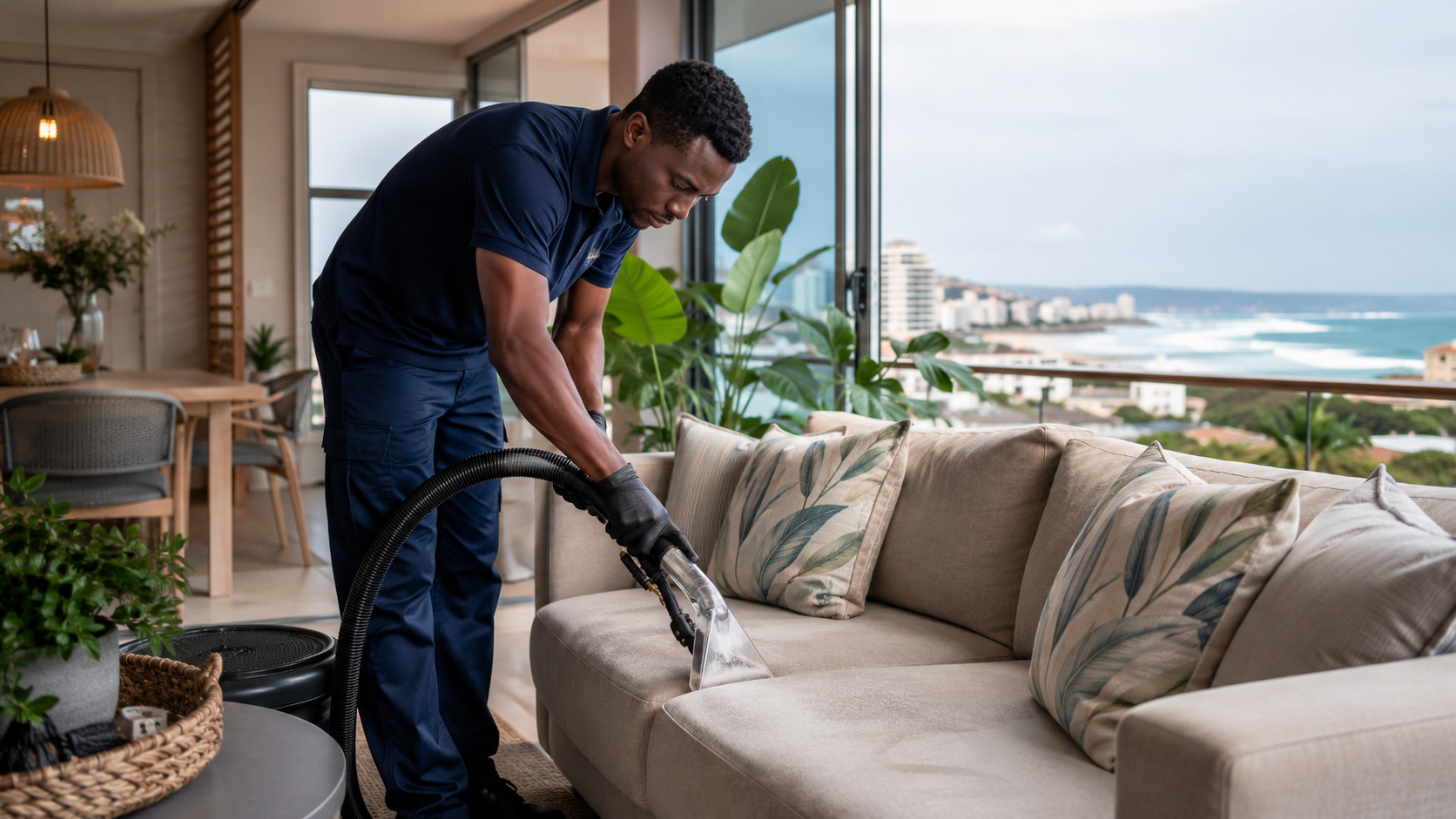
Durban’s warm, humid climate can be tough on couches, fabric chairs, mattresses, and upholstered furniture.
When the air is humid, fabrics can hold onto smells more easily. Everyday use, sweat, pets, food spills, body oils, dust, and indoor moisture can all build up inside upholstery fibres over time.
That is why Durban upholstery cleaning can be especially useful for homes where couches or fabric furniture no longer feel fresh.
The short answer is: yes — in most cases, professional upholstery cleaning can help remove or significantly improve trapped odours caused by normal household use, pets, humidity, spills, and everyday buildup.
This is especially relevant for lounges, TV rooms, bedrooms, rental properties, family homes, pet-friendly homes, and coastal or humid Durban properties where fabric furniture gets used every day.
If you are comparing options, you can start with CleanLab SA’s carpet and upholstery cleaning services page or browse the wider cleaning services hub.
Why upholstery in Durban can trap odours
Durban’s humidity can make fabric furniture feel stale faster than expected.
Upholstered furniture naturally absorbs daily household residue. This can include:
- sweat
- body oils
- pet smells
- food smells
- drink spills
- dust
- humidity
- damp air
- smoke residue
- general indoor odours
In a humid environment, those smells can feel stronger because fabrics may not air out as quickly as they would in a drier climate.
That is why a couch can look clean but still smell stale.
The issue is often not one visible stain. It is the gradual buildup of residues inside the fabric from daily use.
Professional upholstery cleaning helps treat the fabric more deeply than ordinary surface wiping or vacuuming.
Does upholstery cleaning remove trapped odours?
Yes — professional upholstery cleaning can help remove or noticeably reduce many trapped odours in couches, chairs, mattresses, and other fabric furniture.
This includes odours caused by:
- everyday use
- pets lying on furniture
- sweat and body oils
- food and drink spills
- humid indoor conditions
- dusty or stale rooms
- children using the furniture daily
- furniture that has not been cleaned for a long time
In many cases, upholstery smells improve significantly after cleaning because the cleaning process helps remove the residue that is causing the odour.
The main exceptions are severe mould, deep moisture damage, long-term urine saturation, water-damaged furniture, or odours that have penetrated deeply into foam or internal padding. Those cases may still improve, but cleaning may not fully remove the smell if the source is deep inside the furniture.
For normal Durban household odours, professional upholstery cleaning is usually a practical and worthwhile first step.
Why couches smell worse in humid weather
Couches are one of the most used items in the home.
People sit, lie down, eat, watch TV, entertain guests, and relax on the same upholstered surfaces every day. Pets may also sleep on the couch or rub against the fabric.
In humid Durban weather, fabric furniture can feel less fresh because the material holds moisture and odour more easily.
Common couch odour causes include:
- body oils from daily use
- sweat from warm weather
- pet hair and dander
- food crumbs
- drink spills
- children’s mess
- humidity and poor airflow
- fabric not drying quickly after small spills
A couch may not look dirty at first glance, but if it smells stale when you sit down or when the room is closed, the upholstery likely needs a deeper clean.
Can upholstery cleaning help with pet smells?
Yes — upholstery cleaning can help with many common pet smells.
Pet-related odours often come from fur, dander, saliva, body oils, muddy paws, and pets repeatedly lying in the same spot.
Professional cleaning can help freshen areas where pets:
- sleep on couches
- lie against cushions
- sit on fabric chairs
- rub against upholstery
- bring outdoor dirt inside
- leave hair and dander behind
In most cases, common pet smells can be reduced or significantly improved.
For stronger pet odours, the result depends on how deep the residue has gone. If a pet accident has soaked into the foam or inner padding, the surface fabric may clean well, but some odour may remain deeper inside.
The best advice is to show the team where your pet usually lies and where the smell is strongest. That helps the team focus on the affected areas.
Can upholstery cleaning remove stains?
Yes — many common upholstery stains can be removed or visibly improved with professional cleaning.
This includes many everyday marks such as:
- food spills
- drink marks
- sweat marks
- pet marks
- muddy paw marks
- general dirt buildup
- darkened armrests
- oily headrest areas
- dirty cushion fronts
These are common reasons customers book upholstery cleaning.
The result depends on the fabric type, stain age, previous cleaning attempts, and whether the stain has changed the fabric colour.
Fresh stains usually respond better than old stains. Older stains, bleach marks, dye transfer, or stains previously treated with harsh chemicals may be harder to remove completely.
But in most normal household cases, upholstery cleaning can improve the appearance and freshness of the furniture.
Which furniture usually needs cleaning most?
In Durban homes, the most used upholstered items usually need the most attention.
These often include:
- lounge couches
- TV room couches
- fabric dining chairs
- occasional chairs
- upholstered headboards
- mattresses
- ottomans
- office chairs
- pet-used furniture
- guest room furniture
The lounge couch is usually the main priority because it collects the most daily use.
Armrests, back cushions, headrests, and seat cushions often show the most buildup because those areas have direct contact with skin, hair, clothing, pets, and food.
Why upholstery can look clean but still smell
This is common.
A couch can look neat from a distance but still smell stale because odour is often trapped inside the fibres, seams, cushions, and high-contact areas.
The fabric may hold:
- sweat
- oils
- dust
- pet residue
- small spills
- moisture
- food crumbs
- skin particles
- general indoor odour
Over time, these create a stale smell even when the furniture looks tidy.
That is why upholstery cleaning is not only about visible stains. It is also about freshness, comfort, and making the room feel cleaner.
Is Durban humidity a reason to clean more often?
Yes, humidity can be a reason to clean upholstery more regularly.
In warm and humid conditions, fabric furniture may hold odour and moisture more easily. Homes near the coast, homes with limited airflow, and rooms that stay closed for long periods may feel stale faster.
You may want to consider cleaning more often if:
- the couch smells stale
- pets use the furniture
- the room feels humid
- children use the couch daily
- cushions have visible marks
- armrests look darker
- food or drinks are often used near the couch
- the furniture has not been cleaned in a long time
- the smell returns when windows are closed
The goal is to clean before the odour becomes deep and difficult to treat.
What if there is mould or a damp smell?
Professional upholstery cleaning can help with many stale or musty smells caused by ordinary use, but true mould or deep damp should be treated carefully.
If furniture has been exposed to water damage, leaks, flooding, or long-term damp, the problem may not only be on the fabric surface.
Possible deeper causes include:
- damp foam
- mould inside cushions
- water-damaged padding
- poor room ventilation
- leaks or building damp
- furniture stored in a damp room
In these cases, upholstery cleaning may improve the fabric surface, but the deeper source of the smell may still need to be addressed.
Customers should mention any mould concern, water damage, or strong damp smell before or during the booking so expectations can be realistic.
What should you do before upholstery cleaners arrive?
You do not need to prepare the home perfectly before upholstery cleaning.
The most useful preparation is simple:
- remove blankets and loose covers
- remove cushions that are not being cleaned
- clear toys, cables, and small items
- move fragile décor nearby
- point out stains and odours
- show where pets usually sit
- allow space around the furniture
- keep pets away from the work area
If the couch has a specific smell, show the team where it is strongest. If there are stains, point them out before cleaning starts.
This helps the team focus on the areas that matter most to you.
How long does upholstery take to dry in Durban?
Drying time depends on the fabric, ventilation, humidity, weather, room airflow, and how deeply the item was cleaned.
Because Durban can be humid, upholstery may take longer to dry than it would in a dry climate.
Practical drying tips include:
- open windows where possible
- improve airflow through the room
- use fans if available
- avoid sitting on damp furniture
- keep pets and children off cleaned areas
- avoid placing throws or blankets back too soon
- allow cushions to dry properly before heavy use
The team can give practical drying guidance on the day based on the fabric and room conditions.
When is the best time to clean upholstery in Durban?
Upholstery cleaning can be useful at several points during the year.
Consider cleaning:
- before guests arrive
- after holiday periods
- after heavy family use
- after pet-related buildup
- after humid or rainy periods
- before moving into a property
- after moving out
- before listing a rental property
- when the couch smells stale
- when fabric furniture looks dull or marked
For humid Durban homes, cleaning is especially useful when furniture still looks acceptable but no longer feels fresh.
That is often the first sign that odours and residues are trapped in the fabric.
What should customers expect from the result?
Customers should expect upholstery to feel cleaner, fresher, and more pleasant to use.
Professional upholstery cleaning can often improve:
- trapped odours
- pet smells
- sweat smells
- food and drink marks
- dirty armrests
- dull fabric
- high-use cushion areas
- stale indoor smells
- general household buildup
The result depends on the fabric type, age of the furniture, level of soiling, type of odour, previous cleaning attempts, and whether any deep moisture or internal padding issue exists.
In many normal household cases, upholstery cleaning can make a strong difference.
It is not the same as replacing damaged furniture, but it is often the most practical first step when a couch, chair, or mattress smells stale or feels heavily used.
Why book through CleanLab SA?
Booking through CleanLab SA gives customers a structured way to arrange carpet and upholstery cleaning in Durban and other service areas.
CleanLab SA’s listed professionals are reviewed by customers and expected to meet clear standards. Customers also get support from booking to completion.
That means the value is not only in the cleaning itself, but also in the booking structure around it:
- reviewed listed professionals
- clear standards to remain listed
- customer review visibility during booking
- support from booking to completion
- a clearer path for booking-related assistance where needed
For upholstery cleaning in Durban, this matters because customers often want clear expectations around humidity, odours, stains, drying time, pets, and fabric care.
You can learn more from CleanLab SA’s Booking Protection and Professional Standards pages.
Find upholstery cleaning in Durban
If you are looking for upholstery cleaning in Durban, you can start with CleanLab SA’s Durban carpet cleaners page.
You can also browse the main carpet and upholstery cleaning services page, the wider cleaning services hub, or explore available locations.
Other main city pages include:
- Cape Town carpet cleaners
- Johannesburg carpet cleaners
- Randburg carpet cleaners
- Pretoria carpet cleaners
This helps customers move from Durban upholstery-cleaning advice into the correct local booking path.
Final answer: Durban upholstery cleaning for humidity and trapped odours
Durban’s humid climate can make couches, fabric chairs, mattresses, and other upholstered furniture hold onto odours more easily.
Professional upholstery cleaning can help remove or significantly improve many common trapped smells caused by humidity, pets, sweat, food spills, body oils, and everyday household use.
In most cases, stale couch smells, pet-related odours, dirty armrests, high-use cushion areas, and normal household stains can be cleaned or visibly improved.
If the odour is caused by deep mould, water damage, damp foam, or long-term moisture inside the furniture, the deeper source may also need attention.
If you are ready to book, review CleanLab SA’s Durban carpet cleaners page or the main carpet and upholstery cleaning services page and use Get Rates & Availability to view prices, select your location, and secure your booking.