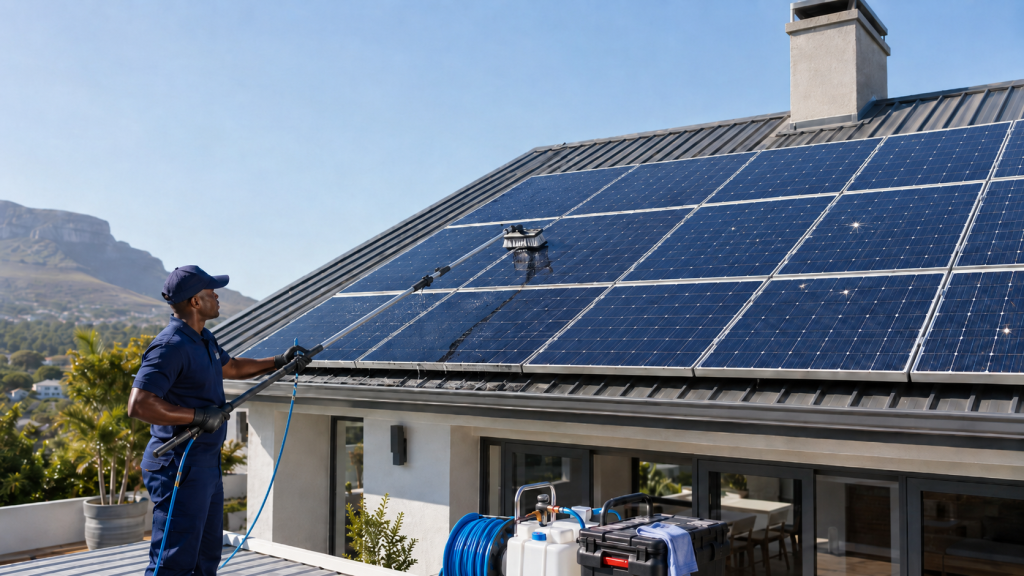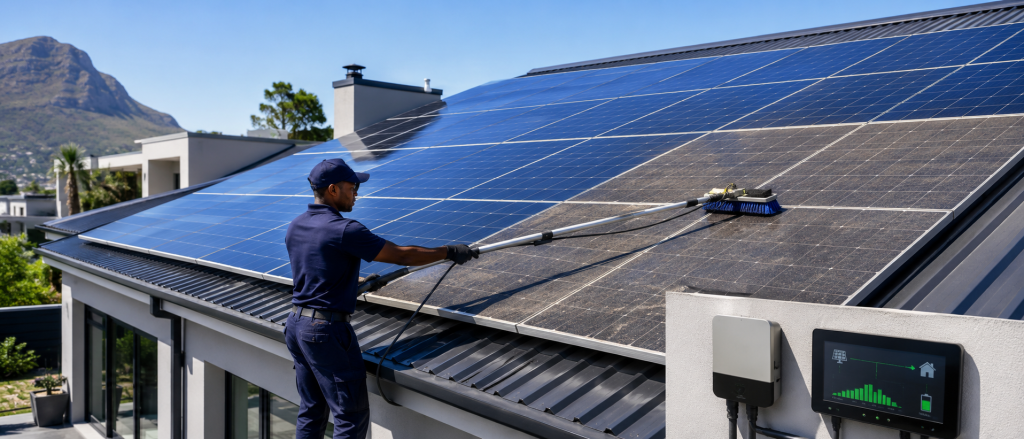
Knowing how to clean solar panels properly can help remove dust, bird droppings, pollen, leaves, pollution and general outdoor grime from the panel surface.
The basic method is simple: clean solar panels with water, a soft brush or solar-safe cleaning tool, and gentle pressure. The main risk is not usually the cleaning itself — it is unsafe roof access, using the wrong tools, scratching the glass, spraying water incorrectly or working near electrical components without understanding the system.
For low, safely accessible panels, some homeowners may be able to do light cleaning themselves. For roof-mounted panels, two-storey homes, difficult access, heavy dirt or uncertainty about the system, professional solar panel cleaning is usually safer and more practical.
To view current CleanLab SA listed options and live pricing for your area, use the Get Rates & Availability CTA where available. This lets you select your location, view listed solar panel cleaning options and check open slots.
Quick answer: how to clean solar panels
To clean solar panels safely:
- Check the manufacturer or installer guidance where possible.
- Turn off the system if the installer or manufacturer recommends it.
- Remove loose leaves, dust or debris gently.
- Use clean water and a soft brush, sponge or solar panel cleaning tool.
- Avoid abrasive pads, harsh chemicals and rough scrubbing.
- Rinse gently where safe and practical.
- Allow panels to dry naturally or use a suitable soft squeegee if accessible.
- Do not walk on panels.
- Do not climb onto unsafe roofs.
- Avoid high-pressure washing unless specifically approved.
The safest method depends on the panel position, roof height, access, water availability and system type.
What you need to clean solar panels
For basic solar panel cleaning, suitable items may include:
- clean water
- soft brush
- soft sponge
- solar panel cleaning brush
- telescopic cleaning pole
- soft squeegee
- hose with gentle water flow
- bucket
- microfiber cloth for accessible areas
- non-abrasive cleaning pad
- mild solar-safe cleaning solution where suitable
Avoid:
- abrasive pads
- hard brushes
- steel wool
- harsh chemicals
- strong detergents
- high-pressure washing
- rough scrubbing
- walking on panels
- unsafe ladders
- cleaning during very hot sunlight
Solar panels are exposed outdoor surfaces, but they are still technical equipment. The glass, seals, frames, wiring and mounting system should be treated carefully.
How to clean solar panels step by step
A simple solar panel cleaning process may look like this:
- Check whether the panels are safely accessible.
- Review any manufacturer or installer instructions.
- Remove loose debris such as leaves or twigs where safe.
- Rinse lightly with clean water if practical.
- Use a soft brush or solar-safe cleaning tool to loosen dust and grime.
- Pay extra attention to bird droppings and heavier marks.
- Rinse gently again.
- Allow the panels to air dry.
- Check the visible result from a safe position.
Do not scrape aggressively or use sharp tools to remove stubborn marks. If dirt, bird mess, lichen or hard residue does not come off with gentle cleaning, it may need professional attention.
How to clean solar panels from the ground
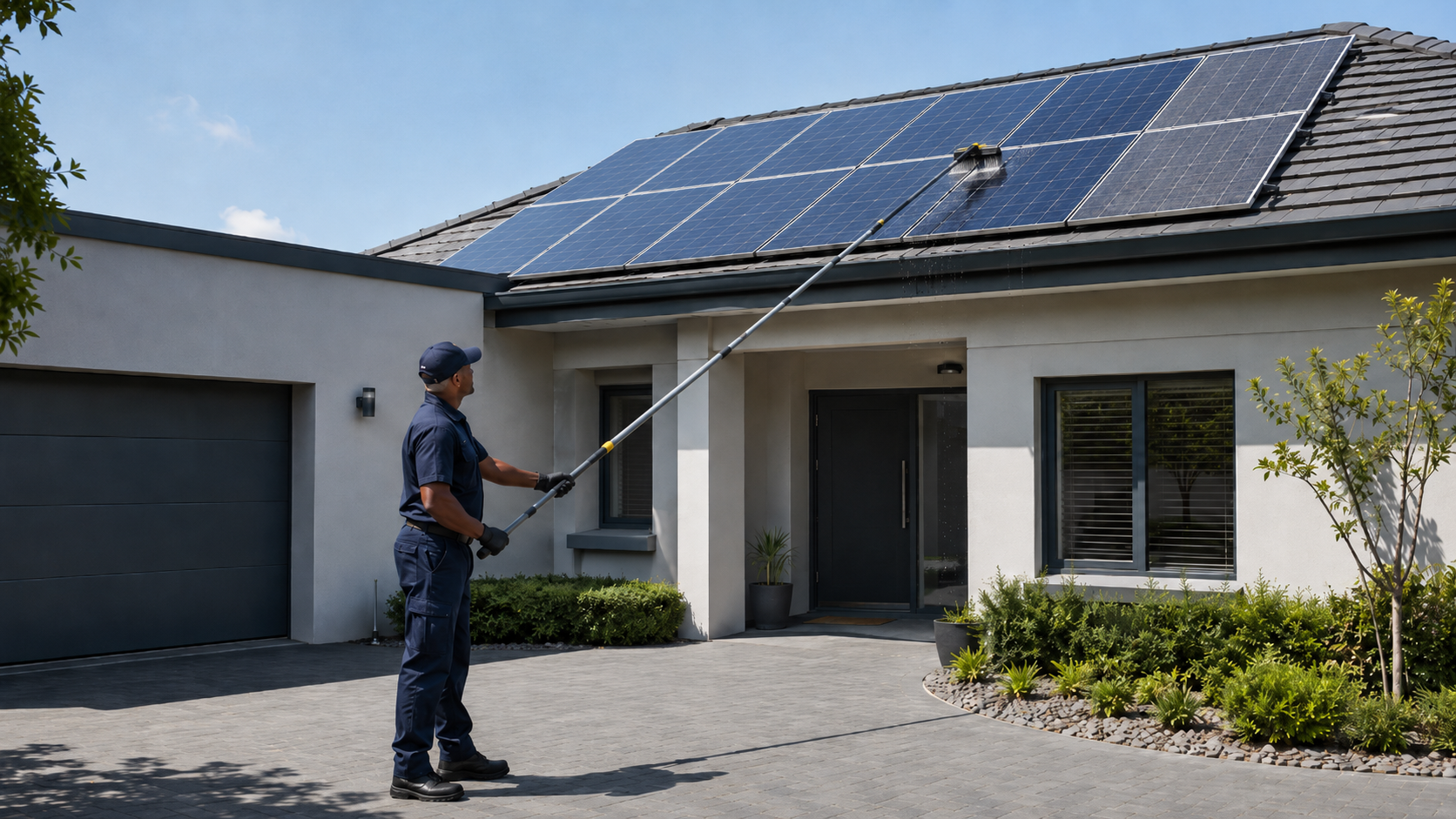
Cleaning solar panels from the ground can be safer than climbing onto a roof, but it only works if the panels are positioned within safe reach.
This may involve:
- a telescopic solar panel cleaning pole
- a soft brush head
- gentle water flow
- a water-fed pole system
- careful movement from ground level
This method may be suitable for some single-storey homes where the panels are visible and reachable from a safe standing position.
However, ground cleaning may not work well if:
- the roof is too high
- the panels are too far back
- the roof angle blocks access
- the panels are on a second storey
- the pole cannot reach safely
- electrical cables or obstacles are nearby
- the person needs to overreach
If the panels cannot be cleaned properly from a safe position, professional cleaning is usually the better option.
How to clean solar panels on a roof safely
Roof-mounted solar panels need extra caution.
Before cleaning roof solar panels, consider:
- roof height
- roof slope
- roof surface
- wet roof risk
- ladder safety
- edge protection
- panel placement
- electrical components
- weather conditions
- whether the panels can be reached from the ground
Do not climb onto a roof unless it is safe, suitable and you know what you are doing. Wet roof surfaces can become slippery, and solar panel cleaning often involves water, which increases the risk.
Avoid:
- standing on panels
- stepping over panels
- leaning across panels
- walking on wet roof tiles
- using unstable ladders
- cleaning near roof edges
- cleaning during windy conditions
- cleaning in strong midday heat
For two-storey homes, steep roofs, awkward roof layouts or panels near edges, professional solar panel cleaning is usually safer than DIY cleaning.
How to clean solar panels on a two-storey house
Cleaning solar panels on a two-storey house is usually not a good DIY job unless the panels can be safely reached from the ground with appropriate equipment.
Two-storey homes create extra risk because of:
- height
- roof slope
- difficult ladder placement
- long reach distance
- wind movement on telescopic poles
- limited visibility
- electrical and water safety concerns
- higher fall risk
For most homeowners, two-storey solar panel cleaning is better handled professionally.
The issue is not only whether the panels can be washed. The issue is whether they can be cleaned safely without damaging the panels, roof, gutters or surrounding property.
Should you turn off solar panels before cleaning?
Some solar panel systems may need to be switched off before cleaning, while others may have specific safety instructions from the installer or manufacturer.
Because systems can differ, it is best to check:
- inverter instructions
- installer guidance
- manufacturer cleaning advice
- system shutdown procedure
- whether cleaning is allowed while the system is operating
Do not guess if you are unsure.
Solar panels generate electricity when exposed to light, so water and electrical components should always be treated carefully. If you are not sure how the system should be handled, professional cleaning or installer advice is safer.
Can you pressure wash solar panels?
High-pressure washing is generally not recommended unless the panel manufacturer or installer specifically confirms that it is safe.
Pressure washing can be risky because incorrect pressure, distance or angle may:
- damage panel seals
- force water into edges
- damage frames
- affect wiring or junction boxes
- loosen components
- scratch or mark surfaces
- void warranty conditions
A normal hose with gentle water flow, a soft brush and suitable cleaning method is usually safer than high pressure.
If panels have heavy dirt that does not come off with gentle cleaning, professional solar panel cleaning is usually better than increasing pressure aggressively.
What not to use when cleaning solar panels
Avoid using:
- abrasive pads
- hard bristle brushes
- steel wool
- rough sponges
- strong chemical cleaners
- bleach
- ammonia-based products
- harsh degreasers
- high-pressure washers
- sharp scrapers
- dirty cloths with grit
- very cold water on very hot panels
- unsafe ladders or roof access
The goal is to remove surface dirt without damaging the panel glass, coating, seals, frame or wiring.
How to clean dust off solar panels
Dust is one of the most common reasons solar panels look dirty.
To clean dust off solar panels:
- Rinse gently with water where safe.
- Use a soft brush or solar-safe cleaning pole.
- Work from the top of the panel downward.
- Avoid grinding dust into the glass.
- Rinse gently again.
- Let the panels dry naturally.
Dust can become more stubborn when mixed with moisture, pollution, pollen or bird droppings. If dust has formed a film that does not rinse away easily, gentle brushing may be needed.
How to clean bird poop off solar panels
Bird droppings can block sunlight and may stick strongly to the panel surface.
To clean bird poop off solar panels:
- Soften the area with water.
- Allow the water to loosen the residue.
- Use a soft brush or sponge.
- Avoid scraping with sharp tools.
- Rinse gently.
- Repeat if needed.
Do not use metal scrapers or abrasive pads. If bird droppings are baked on, aggressive scraping can damage the panel surface.
For heavy bird mess, roof access issues or repeated bird problems, professional cleaning may be more practical.
How to clean dirty solar panels
Dirty solar panels may have a mix of dust, pollen, leaves, bird droppings, pollution, mud splash and general grime.
The safest method is usually:
- gentle rinse
- soft brush agitation
- suitable cleaning solution only if needed
- gentle final rinse
- no harsh chemicals
- no high pressure
- no abrasive scrubbing
Very dirty panels may need more than one gentle pass. It is better to clean carefully than to scrub aggressively.
If the panels are difficult to reach or the grime does not come off easily, professional solar panel cleaning can reduce the risk of damage or unsafe access.
How to clean cloudy solar panels
Cloudy solar panels may not always be dirty in the normal sense.
Cloudiness can be caused by:
- dust film
- pollution residue
- mineral deposits
- hard water marks
- old cleaning residue
- panel ageing
- damaged coating
- glass issues
If the cloudiness is only surface dirt, gentle cleaning may improve it.
If the panel still looks cloudy after careful cleaning, the problem may not be ordinary dirt. It may need professional assessment or solar technician advice, especially if there is a visible performance issue.
How to clean lichen off solar panels
Lichen can be more difficult than dust or bird droppings.
Do not scrape lichen aggressively from solar panels. Hard scraping, harsh chemicals or excessive pressure can damage the glass, seals or frame.
A safer approach is:
- wet the affected area gently
- allow it to soften
- use a soft brush
- avoid sharp tools
- avoid harsh chemical treatment unless approved
- repeat gently if needed
If lichen is widespread or strongly attached, professional cleaning is usually safer.
Can you clean solar panels without water?
Solar panels can sometimes be lightly dusted with a soft brush or dry solar panel cleaning tool, but water is often useful for removing stuck dust, bird droppings and grime.
Dry cleaning can be risky if there is grit on the panel surface, because rubbing grit across glass can cause fine scratches.
Waterless cleaning may be more suitable for light dust, but not for heavy dirt, sticky residue or bird droppings.
How much water is needed to clean solar panels?
The amount of water depends on:
- number of panels
- level of dirt
- panel size
- cleaning method
- water pressure
- whether a water-fed pole is used
The goal is not to flood the panels. It is to use enough water to loosen and rinse dirt safely.
For home cleaning, gentle water flow is usually better than high pressure.
How often should solar panels be cleaned?
Many residential solar panels may benefit from cleaning every 6 to 12 months, depending on the property and local environment.
More frequent cleaning may be useful where there is:
- heavy dust
- nearby trees
- bird activity
- coastal salt
- construction dust
- industrial pollution
- dry weather
- low rainfall
- visible grime
- pollen build-up
Some panels may need cleaning less often if rainfall, panel angle and local conditions help keep them clear.
The best guide is visual dirt, performance changes and local conditions.
Does rain clean solar panels?
Rain can help rinse loose dust from solar panels, but it does not always clean them properly.
Rain may not fully remove:
- bird droppings
- sticky pollen
- pollution film
- lichen
- coastal salt
- mud splash
- greasy residue
- dust that has dried into a film
Rain can also leave mineral marks depending on water quality and drying conditions.
So, while rain helps, it should not always be treated as a full replacement for proper solar panel cleaning.
How to keep solar panels clean for longer
You cannot stop outdoor panels from getting dirty, but you can reduce build-up by:
- trimming nearby branches where appropriate
- discouraging birds from sitting near panels
- checking for heavy dust after dry periods
- inspecting panels after storms
- monitoring bird droppings
- keeping gutters and roof areas maintained
- scheduling cleaning before heavy seasonal build-up
Avoid placing anything on or near panels that may scratch, shade or damage them.
When DIY solar panel cleaning is not enough
DIY solar panel cleaning may not be enough when:
- panels are on a high roof
- panels are on a steep roof
- the home is two storeys
- the panels are near roof edges
- the roof is slippery or fragile
- there is heavy bird mess
- lichen is present
- the panels look cloudy after cleaning
- the customer is unsure about switching the system off
- the panels are difficult to reach from the ground
- safety is a concern
In these cases, professional solar panel cleaning is usually more sensible than trying to force a DIY clean.
Professional solar panel cleaning services
Professional solar panel cleaning may include suitable tools, safer access planning and cleaning methods designed to remove surface dirt without damaging the panels.
This can be useful for:
- roof-mounted solar panels
- two-storey homes
- large residential systems
- small business systems
- panels with bird droppings
- panels with dust build-up
- panels that are difficult to reach
- properties where safety is a concern
To view current CleanLab SA listed options and live pricing for your area, use the Get Rates & Availability CTA where available. This lets you select your location, view listed solar panel cleaning options and check open slots.
For solar panel cleaning cost guidance, see the Solar Panel Cleaning Prices in South Africa guide.
For other home and business cleaning services, visit the main professional cleaning services hub.
Can solar panel cleaning be combined with other cleaning services?
Solar panel cleaning may be more practical when it is booked together with other listed cleaning services, especially if the solar panel cleaning job is small on its own.
Depending on availability, customers may also want to look at listed services such as:
- Window Cleaning
- Carpet Cleaning
- Couch Cleaning
- Chair Cleaning
- Mattress Cleaning
- Blind Cleaning
- Curtain Cleaning
This can help customers address more than one cleaning need in a single organised booking.
CleanLab SA also lists many other cleaning and property-care service options, depending on area availability.
Solar panel cleaning services by area
Solar panel cleaning availability can vary by area. You can view listed solar panel cleaning options in major areas here:
- Solar panel cleaners in Sandton
- Solar panel cleaners in Randburg
- Solar panel cleaners in Johannesburg
- Solar panel cleaners in Pretoria
- Solar panel cleaners in Cape Town
- Solar panel cleaners in Durban
You can also browse all available service areas on the main CleanLab SA locations page.
To view current CleanLab SA listed options and live pricing for your area, use the Get Rates & Availability CTA where available. This lets you select your location, view listed solar panel cleaning options and check open slots.
Why book solar panel cleaning through CleanLab SA?
CleanLab SA helps customers find listed solar panel cleaning options, view upfront pricing where available and book online.
This can be useful when customers want to compare listed options, check area availability and see open slots without needing to phone around for every quote.
Solar panel cleaning may also be more practical when booked as part of a broader cleaning visit. If customers are already arranging services such as window cleaning, carpets, couches, chairs, mattresses, blinds or curtains, adding solar panel cleaning can help turn a small stand-alone job into a more useful property-care booking.
Booking through CleanLab SA can also help with peace of mind because the platform includes support around Booking Protection and Professional Standards.
FAQs about how to clean solar panels
How do you clean solar panels?
Solar panels can usually be cleaned with clean water, a soft brush or solar-safe cleaning tool, and gentle pressure. Avoid harsh chemicals, abrasive pads, sharp tools and unsafe roof access.
How do I clean solar panels at home?
For low, safely accessible panels, use clean water, a soft brush or sponge, and avoid abrasive cleaning. If the panels are on a roof or difficult to reach, professional cleaning is usually safer.
How do you clean solar panels on a roof?
Roof solar panels should only be cleaned if access is safe. Avoid walking on panels, leaning near edges, using unstable ladders or cleaning on slippery roof surfaces. For steep, high or awkward roofs, professional solar panel cleaning is usually the better option.
How do you clean solar panels from the ground?
Solar panels can sometimes be cleaned from the ground using a telescopic solar panel cleaning pole, soft brush head and gentle water flow. This only works when the panels are safely reachable without overextending.
Can you pressure wash solar panels?
High-pressure washing is generally not recommended unless the panel manufacturer or installer confirms that it is safe. Incorrect pressure or angle may damage seals, frames, wiring or panel surfaces.
What is the best thing to clean solar panels with?
Clean water, a soft brush, soft sponge or solar panel cleaning tool is usually best for basic cleaning. Use only mild or solar-safe cleaning solutions where appropriate.
Can you use soap to clean solar panels?
A small amount of mild, suitable cleaning solution may be used if needed, but heavy soap can leave residue. Avoid harsh detergents, bleach, ammonia or strong chemical cleaners.
How do you clean bird poop off solar panels?
Soften the bird droppings with water, let the residue loosen, then use a soft brush or sponge. Do not scrape aggressively with sharp tools.
How do you clean dust off solar panels?
Rinse gently where safe, then use a soft brush or solar panel cleaning pole to loosen the dust. Avoid rubbing dry grit across the glass because it may cause fine scratches.
Should solar panels be turned off before cleaning?
Some systems may need to be switched off before cleaning. Check the installer or manufacturer guidance. If you are unsure, get professional advice.
How often should solar panels be cleaned?
Many homes may benefit from cleaning every 6 to 12 months, depending on dust, bird activity, coastal salt, nearby trees, pollution and rainfall.
Can I check professional solar panel cleaning prices online?
Yes. To view current CleanLab SA listed options and live pricing for your area, use the Get Rates & Availability CTA where available. This lets you select your location, view listed solar panel cleaning options and check open slots.
Final answer
The safest way to clean solar panels is to use clean water, soft cleaning tools and gentle pressure while avoiding harsh chemicals, abrasive scrubbing, high-pressure washing and unsafe roof access.
Some low, safely accessible panels may be cleaned by homeowners, but roof-mounted, high, steep, dirty or difficult-to-reach panels are usually better suited to professional solar panel cleaning.
To view current CleanLab SA listed options and live pricing for your area, use the Get Rates & Availability CTA where available, or see the Solar Panel Cleaning Prices in South Africa guide.