Knowing how to clean windows properly can make a big difference to how bright and fresh a home or business feels. Clean glass allows more natural light into the room, improves visibility and makes the whole property look better maintained.
The basic method is simple: remove loose dust first, wash the glass with a suitable cleaning solution, use a clean squeegee or microfiber cloth, then dry the edges properly. The most common problem is not usually the glass itself — it is streaks caused by dirty cloths, too much product, drying too slowly, cleaning in direct sun or leaving residue behind.
For larger homes, high windows, sliding doors, exterior glass, balustrade panels or hard-to-reach windows, professional window cleaning may be a better option.
To view current CleanLab SA listed options and live pricing for your area, use the Get Rates & Availability CTA where available. This lets you select your location, view listed window cleaning options and check open slots.
For more detail or to book online, visit the main window cleaning service page.
Quick answer: how to clean windows without streaks
To clean windows without streaks:
- Dust the frame, sill and glass first.
- Mix a mild window-cleaning solution or diluted vinegar solution.
- Wash the glass from top to bottom.
- Use a clean squeegee, microfiber cloth or lint-free cloth.
- Wipe the blade or cloth between passes.
- Dry the window edges and corners.
- Avoid cleaning hot glass in direct sunlight.
- Use clean water and clean cloths throughout.
The goal is to remove dirt and residue without leaving product, lint or dirty water behind.
What you need to clean windows
For basic home window cleaning, you may need:
- bucket
- clean water
- mild dishwashing liquid or glass cleaner
- white vinegar, if preferred
- microfiber cloths
- squeegee
- soft sponge or window washer
- dry lint-free cloth
- small brush for tracks and corners
- towel for protecting floors or sills
- telescopic pole for safer low-height exterior reach
Avoid harsh abrasives, rough scouring pads and strong chemicals unless you know they are safe for the glass, frame and surrounding surfaces.
How to clean windows step by step
Start with the window frame, sill and surrounding area. If you wash the glass first and then clean dusty frames afterwards, dust and dirty water can run back onto the glass.
A simple method is:
- Remove loose dust from the frame, sill and glass.
- Brush or wipe the window tracks if needed.
- Wet the glass lightly with cleaning solution.
- Wash the glass using a soft sponge, washer or microfiber cloth.
- Squeegee from top to bottom or side to side.
- Wipe the squeegee blade after each pass.
- Dry the edges, corners and bottom sill.
- Check from different angles for streaks.
For larger glass panels, work in sections so the cleaning solution does not dry before you remove it.
How to clean windows without leaving streaks
Streaks usually happen when dirty water, too much product or residue dries on the glass.
To reduce streaks:
- use clean water
- avoid using too much soap
- use clean microfiber cloths
- change cloths when they become damp or dirty
- wipe the squeegee blade between passes
- dry the edges properly
- avoid direct hot sunlight where possible
- do not let cleaning solution dry on the glass
A small amount of cleaning solution is usually enough. More product does not automatically mean cleaner windows. Too much soap can leave a film behind.
How to clean inside windows
Inside windows usually have fingerprints, dust, cooking residue, pet marks, hand marks and general household build-up.
To clean inside windows:
- Move small items away from the window area.
- Place a towel near the sill if needed.
- Dust the frame and sill.
- Spray or apply cleaning solution lightly.
- Wipe or wash the glass from top to bottom.
- Use a clean squeegee or microfiber cloth.
- Dry the edges and corners.
- Wipe the sill afterwards.
For inside windows, use less liquid than you would outside. Too much water can drip onto floors, walls, wooden sills or furniture.
How to clean outside windows
Outside windows usually collect more dust, rain marks, pollen, bird mess, soil splash, outdoor residue and general weather exposure.
To clean outside windows:
- Rinse or wipe loose dirt first where possible.
- Apply a mild cleaning solution.
- Wash the glass with a soft brush, sponge, washer or microfiber pad.
- Use a squeegee from top to bottom.
- Wipe the blade after each pass.
- Dry edges and visible drips.
- Repeat if the glass has heavy outdoor build-up.
For exterior windows, it is often better to remove loose dirt first instead of rubbing grit across the glass. This helps reduce the chance of marks or fine scratches.
How to wash windows outside
When washing windows outside, start from the top sections and work down. This prevents dirty water from dripping over areas you have already cleaned.
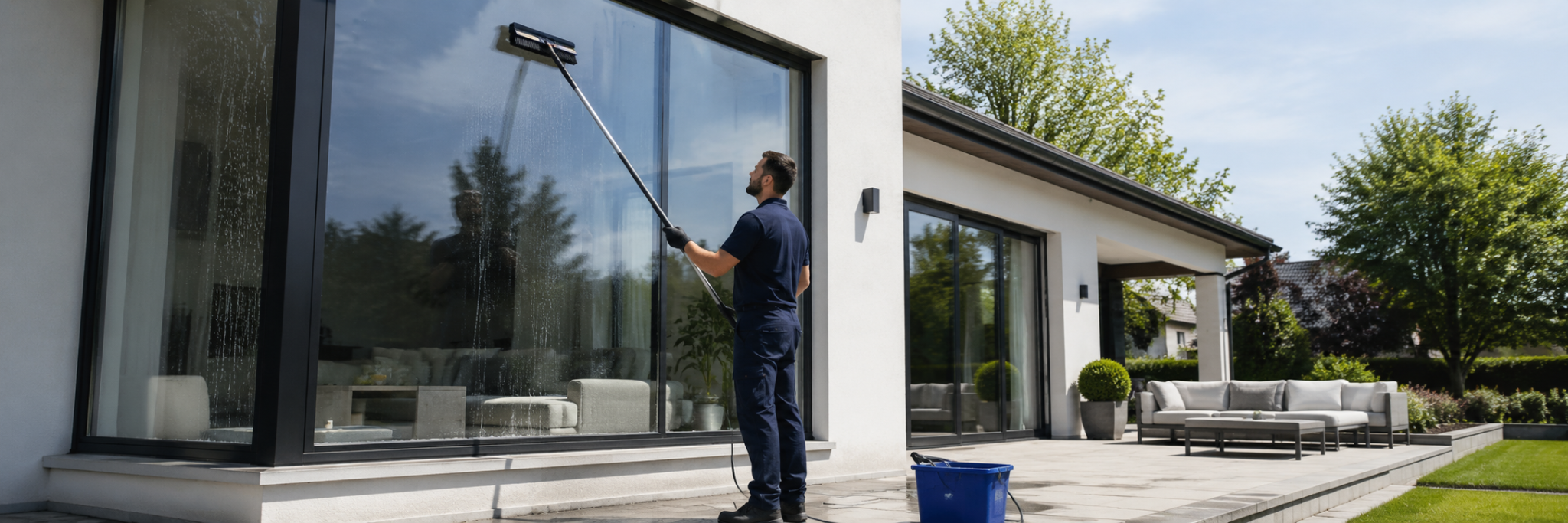
If the outside windows are low and easy to reach, a standard squeegee and microfiber cloth may be enough. For higher but still safely reachable windows, a telescopic window cleaning tool can help.
Do not overreach from balconies, chairs, walls or unstable surfaces. If a window cannot be reached safely, professional window cleaning is usually the better option.
How to clean glass windows
Glass windows should be cleaned with soft materials and a suitable cleaning solution.
For normal household cleaning, avoid:
- abrasive pads
- rough sponges
- blades unless used by someone experienced
- strong acidic chemicals
- strong alkaline chemicals
- dirty cloths
- newspaper that may transfer ink
- too much soap
For clean glass, the final drying step matters. Even if the window has been washed properly, poor drying can leave streaks or edge marks.
How to clean windows with vinegar
White vinegar can be used for light window cleaning because it helps cut through some residue and light marks.
A simple vinegar mixture is:
- 1 part white vinegar
- 1 part water
Apply lightly to the glass, wipe with a clean microfiber cloth or use a squeegee, then dry the edges.
Vinegar can be useful for light household window cleaning, but it is not a magic solution for every mark. If marks remain after normal cleaning, they may be mineral deposits, hard water stains, old residue, glass damage or another issue that needs a different approach.
Avoid using vinegar on surfaces where it may damage surrounding materials, stone, sealants or finishes.
How to clean windows with dish soap
A very small amount of mild dishwashing liquid in water can work well for general window cleaning.
The key is not to use too much. Too much soap can create foam and residue, which may cause streaks.
A simple mix is:
- a bucket of clean water
- a few drops of mild dishwashing liquid
Wash the glass, squeegee it off, then dry the edges with a clean microfiber cloth.
How to clean high windows safely
High windows need extra care. The safest option depends on the height, position and access.
For some low-to-medium height exterior windows, a telescopic window cleaning tool may help. This allows the window to be cleaned from the ground without using a ladder.
However, not all high windows are safe or practical to clean yourself.
Avoid:
- leaning too far out of windows
- standing on chairs or furniture
- using unstable ladders
- overreaching from balconies
- climbing on walls or ledges
- cleaning near electrical hazards
- using long poles in unsafe wind or tight spaces
If the windows are too high, awkward or unsafe to access, rather use a professional window cleaning option.
How to clean hard-to-reach windows
Hard-to-reach windows include windows above staircases, high exterior windows, upstairs windows, apartment windows, skylights and windows behind obstacles.
Possible DIY options include:
- telescopic window cleaning tools
- magnetic window cleaners for suitable glass types
- long-handled microfiber tools
- cleaning from inside where the window safely opens inward
- cleaning only the safely reachable side
However, hard-to-reach windows are one of the main reasons customers book professional window cleaning. The issue is not only getting the glass clean — it is doing so safely and without damaging frames, glass, walls or surrounding surfaces.
How to clean outside windows you can’t reach
If outside windows cannot be reached safely, do not try to force the job.
Some windows may be cleaned from inside if they open inward or tilt safely. Others may need a telescopic pole, water-fed pole system or professional access method.
For apartments, upstairs rooms or awkward exterior windows, professional window cleaning may be the most practical route.
To view current CleanLab SA listed options and live pricing for your area, use the Get Rates & Availability CTA where available. This lets you select your location, view listed window cleaning options and check open slots.
How to clean apartment windows
Apartment windows can be difficult because outside access may be limited.
For apartment windows:
- clean the inside glass normally
- clean reachable exterior sections only if safe
- check whether the window opens inward or tilts
- do not lean far outside
- do not remove glass panels unless you know how to do so safely
- avoid dropping tools or water onto lower balconies or walkways
- follow building rules where applicable
If exterior apartment windows cannot be accessed safely, professional cleaning or building-approved window cleaning may be needed.
How to clean window tracks and sills
Window tracks and sills can collect dust, insects, grit and grime.
To clean them:
- Brush out loose dirt.
- Vacuum the track if possible.
- Wipe with a damp cloth.
- Use a small brush for corners.
- Dry the area afterwards.
Do this before cleaning the glass. Otherwise, dirty water from the tracks can spread back onto the clean window.
How to clean window frames
Window frames should be cleaned according to the frame material.
For general cleaning:
- wipe dust first
- use mild soapy water
- avoid abrasive pads
- avoid harsh chemicals
- dry the frame afterwards
- be careful around seals, paint and finishes
Aluminium, uPVC, painted wood and other frame types may react differently to chemicals, so avoid strong products unless you are sure they are suitable.
Should you clean window screens?
Window screens can hold dust and outdoor residue. If the window has screens, clean them before cleaning the glass.
A simple method is:
- Remove the screen if it is designed to be removed.
- Brush or rinse loose dust.
- Wash gently with mild soapy water.
- Rinse and dry before replacing.
If the screen cannot be removed, use a soft brush, vacuum attachment or damp cloth carefully.
Common window cleaning mistakes
Common window cleaning mistakes include:
- cleaning windows in direct hot sun
- using too much soap
- using dirty cloths
- using paper towels that leave lint
- not cleaning frames and sills first
- letting cleaning solution dry on the glass
- using rough pads on glass
- forgetting to wipe the squeegee blade
- not drying the edges
- trying to clean unsafe high windows yourself
Most streaks come from residue, dirty tools or poor drying rather than from the glass being impossible to clean.
Why windows still look dirty after cleaning
Windows may still look dirty after cleaning if there is:
- soap residue
- hard water staining
- mineral deposits
- old water marks
- paint overspray
- silicone residue
- scratches
- damaged glass
- failed double-glazing seals
- dirt on the opposite side of the glass
- dirty frames dripping onto the glass
If the glass looks cloudy, patchy or marked even after careful cleaning, it may not be ordinary dirt.
When DIY window cleaning is not enough
DIY window cleaning is useful for regular maintenance, but it may not be enough for every property.
Professional window cleaning may be better when:
- there are many windows
- there are large sliding doors
- there are high or hard-to-reach windows
- exterior windows are heavily marked
- the property has balustrade glass
- the windows are part of a rental, sale or handover
- the building is a guesthouse, office, shop or restaurant
- streak-free results are important
- safety is a concern
Professional cleaning can save time and reduce the risk of unsafe access or poor results.
How do professionals clean windows?
Professional window cleaning may include different tools depending on the property and service option selected.
Common tools may include:
- squeegees
- microfiber cloths
- applicator washers
- scrapers where safe and appropriate
- telescopic poles
- water-fed pole systems
- purified water systems
- buckets and cleaning solution
- detailing cloths for edges and corners
The method depends on the glass, access, height, frame type and whether the job is residential or commercial.
Professional window cleaning services
CleanLab SA helps customers find listed window cleaning options, view upfront pricing where available and book online.
This can be useful for customers who want help with:
- standard windows
- cottage-pane windows
- sliding glass doors
- stack doors
- balcony glass
- balustrade panels
- skylights
- bay windows
- exterior windows
- residential window cleaning
- commercial window cleaning
To view current CleanLab SA listed options and live pricing for your area, use the Get Rates & Availability CTA where available. This lets you select your location, view listed window cleaning options and check open slots.
For more detail, visit the main professional window cleaning service page.
For other home and business cleaning services, visit the main professional cleaning services hub.
Window cleaning services by area
Window cleaning availability can vary by area. You can view listed window cleaning options in major areas here:
- Window cleaners in Sandton
- Window cleaners in Randburg
- Window cleaners in Johannesburg
- Window cleaners in Pretoria
- Window cleaners in Cape Town
- Window cleaners in Durban
You can also browse all available service areas on the main CleanLab SA locations page.
To view current CleanLab SA listed options and live pricing for your area, use the Get Rates & Availability CTA where available. This lets you select your location, view listed window cleaning options and check open slots.
Why book window cleaning through CleanLab SA?
CleanLab SA helps customers find listed window cleaning options, view upfront pricing where available and book online without needing to phone around for every quote.
For window cleaning, this is useful because homes and businesses can have many different glass types. Standard windows, cottage windows, sliding doors, stack doors, bay windows, skylights and balustrade glass panels may all need different price categories.
The live booking process may also include visual examples to help customers choose the closest matching window type.
Booking through CleanLab SA can also help with peace of mind because the platform includes support around Booking Protection and Professional Standards.
This gives customers a clearer booking process, especially when arranging window cleaning for homes, apartments, offices, rental properties, guesthouses and commercial spaces.
FAQs about how to clean windows
How do you clean windows without streaks?
Use clean water, a small amount of suitable cleaning solution, a clean squeegee or microfiber cloth, and dry the edges properly. Avoid cleaning hot glass in direct sunlight because the solution can dry too quickly and leave streaks.
What is the best way to wash windows?
The best way to wash windows is to dust the frame and sill first, wash the glass with a mild solution, squeegee from top to bottom, wipe the blade between passes and dry the edges with a clean microfiber cloth.
How do I clean windows at home?
For home windows, use mild soapy water or a suitable glass cleaner, a microfiber cloth and a squeegee. Clean the frames and sills first, then wash and dry the glass carefully.
How do you clean outside windows?
Remove loose dirt first, wash the glass with a mild cleaning solution, use a squeegee from top to bottom and dry the edges. For high or hard-to-reach outside windows, use a safe telescopic tool or consider professional window cleaning.
How do you clean windows with vinegar?
Mix equal parts white vinegar and water, apply lightly to the glass, then wipe or squeegee clean. Dry the edges afterwards. Avoid vinegar on surfaces or finishes that may be damaged by acidic products.
How do you clean high windows?
High windows can sometimes be cleaned with a telescopic window cleaning tool from the ground. If the windows are too high, awkward or unsafe to reach, professional window cleaning is usually safer.
How do you clean outside windows you can’t reach?
If outside windows cannot be reached safely, do not climb or overreach. Check if the window opens inward safely, use an appropriate telescopic tool if suitable, or book a professional window cleaning option.
Why are my windows streaky after cleaning?
Windows may look streaky because of too much soap, dirty cloths, hard water, cleaning in direct sunlight, residue left on the glass, or not drying the edges properly.
Can I use dish soap to clean windows?
Yes, a few drops of mild dishwashing liquid in a bucket of water can work for general window cleaning. Do not use too much, because excess soap can leave residue and streaks.
Can I check professional window cleaning prices online?
Yes. To view current CleanLab SA listed options and live pricing for your area, use the Get Rates & Availability CTA where available. This lets you select your location, view listed window cleaning options and check open slots.
Final answer
The best way to clean windows without streaks is to start with the frames and sills, wash the glass with a mild solution, use clean tools, squeegee carefully and dry the edges properly.
For large windows, exterior glass, high windows, sliding doors, balcony glass or hard-to-reach areas, professional window cleaning may be more practical.
To view current CleanLab SA listed options and live pricing for your area, use the Get Rates & Availability CTA where available, or visit the window cleaning service page.