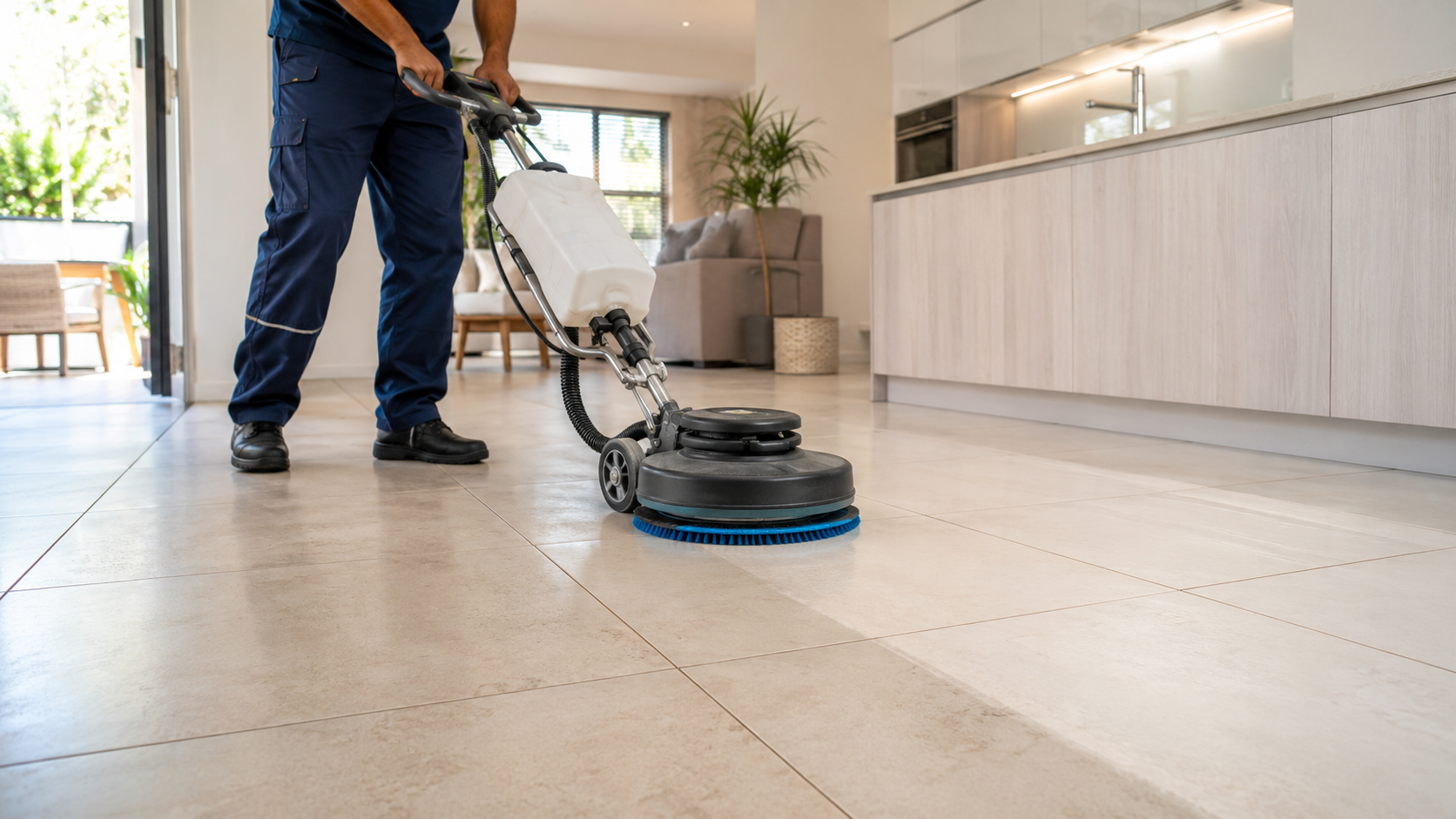
To clean tile floors and grout properly, start by removing loose dust and debris, mop the tile surface with a suitable cleaning solution, scrub the grout lines where dirt has built up, rinse away loosened residue and allow the floor to dry fully.
The reason tile floors often still look dirty after mopping is usually the grout. Tiles are generally easier to wipe clean, but grout lines sit slightly lower than the tile surface and can trap dirty mop water, soap residue, grease, dust and everyday grime.
This guide focuses on floor tiles and floor grout, including kitchen floors, bathroom floors, passages, patios, garages and tiled living areas.
For light dirt, DIY cleaning can help. For dull tiles, dark grout lines, built-up residue or large tiled areas, professional tile and grout cleaning is often more effective because the service may use an industrial-grade floor scrubber or heavy-duty floor scrubbing machine to deep clean the tiled floor and grout lines more thoroughly than normal mopping.
Quick answer: how to clean tile floors and grout
For regular home cleaning:
- Sweep or vacuum the tiled floor.
- Mop with warm water and a suitable floor-cleaning solution.
- Let the solution sit briefly where needed.
- Scrub dirty grout lines with a grout brush or stiff brush.
- Mop again with clean water to remove residue.
- Dry the floor or allow proper airflow.
- Repeat on high-traffic areas if needed.
For deeper cleaning, focus on the grout lines. Dirty grout can make the whole floor look dull, even if the tiles themselves are fairly clean.
For large areas, heavily used kitchens, bathrooms, patios, garages or commercial floors, professional tile and grout cleaning is usually more practical because the floor can be cleaned with stronger equipment than a mop or handheld brush.
Why tile floors still look dirty after mopping
Many tiled floors look dull even after being mopped because mopping often cleans the tile surface but not the grout properly.
This happens because:
- grout sits lower than the tile surface
- dirty mop water can settle into the grout lines
- grease and soap residue can build up over time
- old cleaning product can leave a dull film
- dust and foot traffic dirt can collect in the grout
- outdoor dirt can settle into textured tiles and grout lines
- grout is more porous than many tile surfaces
This is why a floor can look clean for a few hours after mopping, then dull again once it dries. The mop may have moved some residue around instead of fully removing it.
Why grout lines get dirty
Grout is one of the main reasons tiled floors lose their clean appearance.
Even when the tile surface is smooth, grout lines are usually more absorbent, textured and recessed. This makes them more likely to trap dirt.
Common causes of dirty grout lines include:
- dirty mop water
- soap residue
- grease from kitchens
- body oils and moisture in bathrooms
- dust and foot traffic
- pet residue
- outdoor dirt from shoes
- cleaning product build-up
- dampness
- old staining
- general wear over time
If grout lines have slowly become darker, the floor may need more than a normal mop. It may need targeted grout-line cleaning or professional tile and grout cleaning.
What you need before cleaning tile floors and grout
For basic DIY tile and grout cleaning, you may need:
- broom or vacuum
- mop
- bucket
- warm water
- suitable tile floor cleaner
- grout brush or stiff brush
- clean cloths or towels
- gloves if using cleaning products
- good ventilation
- clean water for rinsing
Avoid using strong chemicals without checking whether they are safe for your tile and grout type. Some chemicals can damage natural stone, sealed floors, coloured grout or delicate surfaces.
How to clean tile floors and grout step by step
Step 1: Remove loose dirt first
Sweep or vacuum the floor before using water.
This matters because dust, grit and loose dirt can turn into muddy residue once water is added. Removing dry dirt first makes the cleaning process more effective.
Pay attention to:
- corners
- skirting edges
- under counters
- around furniture
- kitchen edges
- bathroom corners
- doorways
- high-traffic paths
Step 2: Mop the tile surface
Use warm water and a suitable tile-cleaning solution.
Mop the floor evenly, but avoid over-wetting. Too much water can settle into grout lines and leave residue behind.
For everyday cleaning, the goal is to remove light surface dirt from the tile.
Step 3: Focus on the grout lines
After mopping the tile surface, inspect the grout lines.
If the grout still looks dark, use a grout brush or stiff brush to scrub the lines more directly. Work in small sections so the cleaning solution does not dry before you can remove it.
This is the most important part of cleaning tile floors and grout because grout lines often need more agitation than a mop can provide.
Step 4: Rinse away loosened residue
After scrubbing the grout, mop again with clean water.
This helps remove loosened dirt and cleaning solution residue. If residue is left behind, the floor may dry dull or sticky.
Rinse the mop regularly so dirty water is not spread back onto the floor.
Step 5: Dry the floor properly
Allow the floor to dry with good airflow.
Drying helps prevent streaks, water marks and residue settling back into the grout lines.
In bathrooms, kitchens and damp areas, drying is especially important because moisture can contribute to mould-prone grout or musty smells.
How to clean grout between tiles
To clean grout between tiles, first clean the tile surface, then focus directly on the grout lines.
When cleaning grout between floor tiles, the key is to use enough agitation to loosen the dirt sitting inside the grout lines.
A simple method:
- Sweep or vacuum the floor.
- Mop the tiles lightly.
- Apply a suitable grout-safe cleaning solution.
- Let it sit briefly if needed.
- Scrub the grout lines with a grout brush.
- Mop away loosened dirt.
- Rinse with clean water.
- Dry the floor.
The key is agitation. Grout lines usually need brushing or scrubbing because they hold dirt more easily than the tile surface.
For stubborn grout lines, professional cleaning may be better because a heavy-duty floor scrubber can agitate the tile and grout surface more strongly and consistently than hand scrubbing.
How to clean dirty grout on floor tiles
Dirty grout on floor tiles usually needs more than a quick mop.
Start with the least aggressive method:
- warm water
- suitable floor cleaner
- grout brush
- clean rinse water
- proper drying
If the grout is still dark, the issue may be built-up residue, old staining or deeply embedded dirt.
Professional tile and grout cleaning can in many cases remove or improve dirty grout lines, general grime and surface build-up. However, permanent grout staining, damaged grout, missing grout, deep mould staining or old chemical damage may not fully reverse through cleaning alone.
How to clean tile grout
To clean tile grout, focus on the grout lines after the tile surface has already been swept and mopped.
This matters because trying to clean grout before removing loose dirt can push more grime into the grout lines. Clean the surface first, then work directly on the grout.
A practical tile grout cleaning method is:
- Remove loose dust and grit.
- Mop the tile surface.
- Apply a suitable cleaner to the grout lines.
- Scrub the grout with a grout brush.
- Rinse away loosened residue.
- Dry the floor properly.
If the tile grout still looks dark after DIY cleaning, it may be due to old staining, residue build-up or dirt that needs stronger agitation than hand scrubbing.
How to clean floor tile grout without damaging it
To clean floor tile grout safely:
- avoid harsh chemicals unless you know they are suitable
- avoid metal brushes that can damage grout
- avoid too much water
- avoid mixing chemicals
- avoid strong acids on natural stone or sensitive surfaces
- test a small area first
- rinse properly after cleaning
- dry the floor well
Grout can be damaged by aggressive scrubbing, acidic products, bleach misuse, old chemical build-up or repeated over-wetting. The aim is to loosen dirt without damaging the grout itself.
How to clean floor tile grout without scrubbing
Many people want to know how to clean floor tile grout without scrubbing, but the honest answer is that dirty grout usually needs some form of agitation.
For very light dirt, a suitable cleaner, short dwell time and careful rinsing may improve the grout without heavy scrubbing. However, dark grout lines, grease build-up, dirty mop-water residue and old grime usually need brushing or machine agitation.
A low-effort method may help with light residue:
- Sweep or vacuum the floor.
- Mop the tile surface.
- Apply a suitable grout-safe cleaner.
- Let it sit briefly where appropriate.
- Mop or rinse thoroughly.
- Dry the floor.
This may improve light dirt, but it may not fully clean dirty grout lines.
Professional tile and grout cleaning can reduce the need for hand scrubbing because an industrial-grade floor scrubber or heavy-duty scrubbing machine provides stronger agitation across the floor.
How to clean grout on tile floor without scrubbing
If you want to clean grout on a tile floor without scrubbing, focus on light maintenance rather than heavy restoration.
You can reduce the amount of scrubbing needed by:
- sweeping or vacuuming before mopping
- using clean mop water
- using a suitable floor cleaner
- giving the cleaner short contact time where appropriate
- rinsing properly
- drying the floor
- cleaning regularly before grout becomes very dark
But if grout is already deeply dirty, fully avoiding scrubbing is difficult. Dirty grout lines normally need direct brushing, machine agitation or professional cleaning.
How to deep clean tile floors and grout
Deep cleaning tile floors and grout means going beyond ordinary mopping.
A deeper DIY clean may include:
- sweeping or vacuuming thoroughly
- applying a suitable tile and grout cleaner
- allowing short dwell time where appropriate
- scrubbing grout lines
- agitating textured tiles
- rinsing the floor properly
- removing loosened residue
- drying the area fully
Professional deep cleaning can go further because listed technicians may use an industrial-grade floor scrubber or heavy-duty scrubbing machine. This gives the floor more consistent agitation and helps lift build-up from the tile surface and grout lines.
This is the key difference between ordinary mopping and professional tile and grout cleaning.
How to clean kitchen floor tiles and grout
Kitchen floor tiles and grout often collect grease, food residue, spills, sticky marks and everyday foot traffic dirt.
To clean kitchen floor tiles and grout:
- Sweep or vacuum loose crumbs and dust.
- Mop with a suitable kitchen-safe floor cleaner.
- Focus on greasy areas near counters, appliances and cooking spaces.
- Scrub dark grout lines with a grout brush.
- Rinse with clean water.
- Dry the floor properly.
Kitchen grout can darken over time because grease and dirty mop water settle into the grout lines. If the floor still looks dull after cleaning, professional tile and grout cleaning may help remove more built-up residue than basic mopping.
How to clean bathroom floor tiles and grout
Bathroom floor tiles and grout are exposed to moisture, soap residue, body oils, dust and sometimes mould-prone marks.
To clean bathroom floor tiles and grout:
- Remove loose dirt and hair.
- Mop with a suitable bathroom floor cleaner.
- Scrub grout lines where soap residue or dark marks have built up.
- Rinse the floor with clean water.
- Dry properly and improve airflow.
If mould staining has penetrated deeply into grout, cleaning may improve the area but may not fully remove permanent staining. Missing grout or deep mould issues may need repair or replacement rather than cleaning alone.
How to clean tiled living areas, passages and bedrooms
Tiled living areas, passages and bedrooms usually collect dust, foot traffic marks, pet residue and everyday dirt.
For these areas:
- sweep or vacuum first
- mop with a suitable tile cleaner
- scrub any dark grout lines
- rinse with clean water if needed
- dry properly
These areas may not have the grease of kitchens or the moisture of bathrooms, but grout lines can still become dull over time from daily use.
How to clean patio and outdoor floor tiles and grout
Patio and outdoor tiles can collect soil, dust, leaves, water marks and outdoor shoe dirt.
To clean patio floor tiles and grout:
- Sweep away loose outdoor dirt.
- Remove leaves and debris from corners.
- Apply a suitable outdoor tile-cleaning solution.
- Scrub grout lines and textured areas.
- Rinse properly.
- Allow the surface to dry.
Outdoor tiles may need more agitation because the dirt is often heavier than indoor dirt. Professional floor scrubbing can be useful for patios and outside tiled areas because it gives more cleaning power than basic hosing or mopping.
How to clean garage floor tiles and grout
Garage tiles can collect dust, tyre marks, outdoor dirt, oil residue and general grime.
To clean garage floor tiles and grout:
- sweep thoroughly first
- mop or scrub with a suitable cleaner
- focus on tyre paths and high-use areas
- scrub dirty grout lines
- rinse away loosened dirt
- dry where possible
Some deep oil stains, chemical marks or old tyre staining may not fully come out, especially if they have penetrated the tile or grout.
Professional tile and grout cleaning can improve many garage floors, but it should not be treated as tile restoration or repair.
Can you clean tile floors and grout without scrubbing?
For light surface dirt, you may be able to clean tile floors with normal mopping.
However, if grout lines are dark, sticky, greasy or dull, some scrubbing or agitation is usually needed.
This is because grout lines trap residue more easily than tile surfaces.
A “no-scrub” method may improve light dirt, but it often does not fully clean dirty grout. For a deeper result, grout lines usually need one of the following:
- hand scrubbing
- grout brushing
- machine agitation
- professional floor scrubbing
- proper rinsing and residue removal
Professional tile and grout cleaning is effective because the machine does much of the agitation that would otherwise need to be done by hand.
What to avoid when cleaning tile floors and grout
Avoid these common mistakes:
- mopping with dirty water
- using too much cleaning product
- not rinsing after cleaning
- using harsh chemicals on sensitive tiles
- using abrasive tools that can damage grout
- mixing chemicals
- over-wetting the floor
- leaving residue to dry on the tiles
- ignoring the grout lines
- using one mop bucket for a very dirty floor
- assuming all tile types can be cleaned the same way
These mistakes can leave the floor dull, sticky, streaky or still dirty after cleaning.
When professional tile and grout cleaning is better
Professional tile and grout cleaning is usually better when:
- grout lines stay dark after mopping
- the floor still looks dull after cleaning
- the tiled area is large
- the floor has heavy foot traffic
- the kitchen floor has grease build-up
- bathroom grout has soap residue
- patio or garage tiles have outdoor grime
- several rooms need cleaning
- hand scrubbing would take too long
- you want a deeper clean than normal mopping
Professional cleaning is also useful for homes, rental properties, offices, guesthouses and commercial spaces where the floor needs to look cleaner and more presentable.
How professionals clean tile and grout
Professional tile and grout cleaning normally focuses on stronger agitation and better residue removal than ordinary mopping.
The service may include:
- checking the tiled area
- moving normal furniture where needed
- applying suitable tile and grout cleaning solutions
- using a heavy-duty floor scrubber or industrial-grade floor cleaning machine
- scrubbing or agitating the tile and grout surface
- cleaning grout lines more deeply than basic mopping
- removing loosened dirt and residue
- rinsing or extraction where suitable
- improving the appearance of dull tiles
- improving darkened grout lines where possible
- drying guidance after cleaning
The most important customer-facing difference is the use of professional equipment. An industrial-grade floor scrubber can agitate the tile and grout surface more effectively than a mop, helping loosen build-up that ordinary cleaning often leaves behind.
Does professional tile and grout cleaning remove stains?
Professional tile and grout cleaning can remove or improve many general marks, stains and dirty grout lines.
It can often help with:
- general dirt
- foot traffic marks
- dullness
- grease residue
- soap residue
- muddy marks
- everyday grime
- light grout discolouration
- built-up cleaning product residue
However, some issues may not fully reverse, including:
- permanent grout staining
- damaged grout
- missing grout
- cracked tiles
- etched tiles
- rust marks
- paint marks
- deep oil staining
- old chemical damage
- mould staining that has penetrated deeply
- discolouration caused by age or wear
Professional cleaning can improve many floors, but it is not the same as regrouting, tile restoration, tile repair or replacing damaged grout.
Tile and grout cleaning prices
Tile and grout cleaning prices in South Africa are usually based on the room or area category for residential jobs, and square metres for commercial jobs.
As a general market guide:
| Cleaning item or area | Typical guide range |
|---|---|
| Smaller tiled areas, passages, closets or studies | R200 – R350 |
| Standard bedroom, lounge, dining, kitchen, bathroom or living room tiled floors | R300 – R550 |
| Patio, outside tiled areas or garage tiled floors | R300 – R550 |
| Commercial tile and grout cleaning | R20 – R35 per sq. m |
For more detail, see the full tile and grout cleaning prices in South Africa guide.
To check current CleanLab SA listed prices for your area, use the Get Rates & Availability CTA where available.
Tile and grout cleaning services by area
Tile and grout cleaning availability can vary by area. You can view listed options in major areas here:
- Tile cleaners in Sandton
- Tile cleaners in Randburg
- Tile cleaners in Johannesburg
- Tile cleaners in Pretoria
- Tile cleaners in Cape Town
- Tile cleaners in Durban
You can also browse all available service areas on the main CleanLab SA locations page.
For other home and business cleaning services, visit the main professional cleaning services hub.
Why book tile and grout cleaning through CleanLab SA?
CleanLab SA helps customers find listed tile and grout cleaning options, view upfront pricing where available and book online without needing to phone around for every quote.
For tile and grout cleaning, this is useful because different rooms and floor areas may use different pricing categories. Smaller tiled areas, standard rooms, patios, garages and commercial floors may all be priced differently.
Customers can select their area, view available options and use the Get Rates & Availability CTA to check current live prices and open slots where available.
Booking through CleanLab SA can also help with peace of mind because the platform includes support around Booking Protection and Professional Standards.
This gives customers a clearer booking process, especially when arranging tile and grout cleaning for homes, offices, guesthouses, rental properties and commercial spaces.
FAQs about cleaning tile floors and grout
How do you clean tile floors and grout?
Sweep or vacuum first, mop the tile surface with a suitable cleaning solution, scrub the grout lines where dirt has built up, rinse with clean water and allow the floor to dry fully.
How do you clean grout between tiles?
Clean the tile surface first, then apply a suitable grout-safe cleaner to the grout lines. Scrub with a grout brush, rinse away loosened dirt and dry the floor properly.
How do you clean tile grout?
To clean tile grout, remove loose dirt first, mop the tile surface, apply a suitable cleaner to the grout lines, scrub with a grout brush, rinse properly and allow the floor to dry.
Why does grout stay dirty after mopping?
Grout stays dirty because it is porous and sits lower than the tile surface. Dirty mop water, grease, soap residue and everyday grime can settle into the grout lines, while the mop mostly wipes the tile surface.
How do you clean dirty grout on floor tiles?
Dirty grout usually needs direct brushing or scrubbing. Use a suitable cleaner, scrub the grout lines, rinse properly and dry the floor. For stubborn grout, professional tile and grout cleaning may be more effective.
Can you clean floor tile grout without scrubbing?
Light dirt may improve with mopping and a suitable cleaner, but dirty grout usually needs some form of scrubbing or agitation. Professional cleaning can reduce the need for hand scrubbing because machine agitation does more of the work.
How do professionals clean tile and grout?
Professionals may use suitable cleaning solutions and an industrial-grade floor scrubber or heavy-duty scrubbing machine to agitate the tile and grout surface, loosen build-up and remove more residue than normal mopping.
Is professional tile and grout cleaning worth it?
Professional tile and grout cleaning is often worth it when grout lines are dark, tiles look dull, mopping no longer gives a clean result, or the floor has grease, soap residue, foot traffic marks or built-up dirt.
Does professional tile and grout cleaning remove dirty grout lines?
Professional tile and grout cleaning can in many cases remove or improve dirty grout lines, general grime and surface build-up. Permanent staining, damaged grout, missing grout or deep mould staining may not fully reverse.
Final answer
To clean tile floors and grout, start by removing loose dirt, mop the tile surface, scrub the grout lines, rinse away loosened residue and dry the floor properly.
The reason tiled floors often still look dirty after mopping is that grout lines trap dirty water, grease, soap residue, dust and grime. Cleaning the tile surface alone is often not enough.
For light dirt, DIY cleaning can help. For dark grout lines, dull tiles, large tiled areas, kitchens, bathrooms, patios, garages or commercial floors, professional tile and grout cleaning is usually more effective because it may use an industrial-grade floor scrubber or heavy-duty scrubbing machine to deep clean the tile and grout surface more thoroughly than normal mopping.