
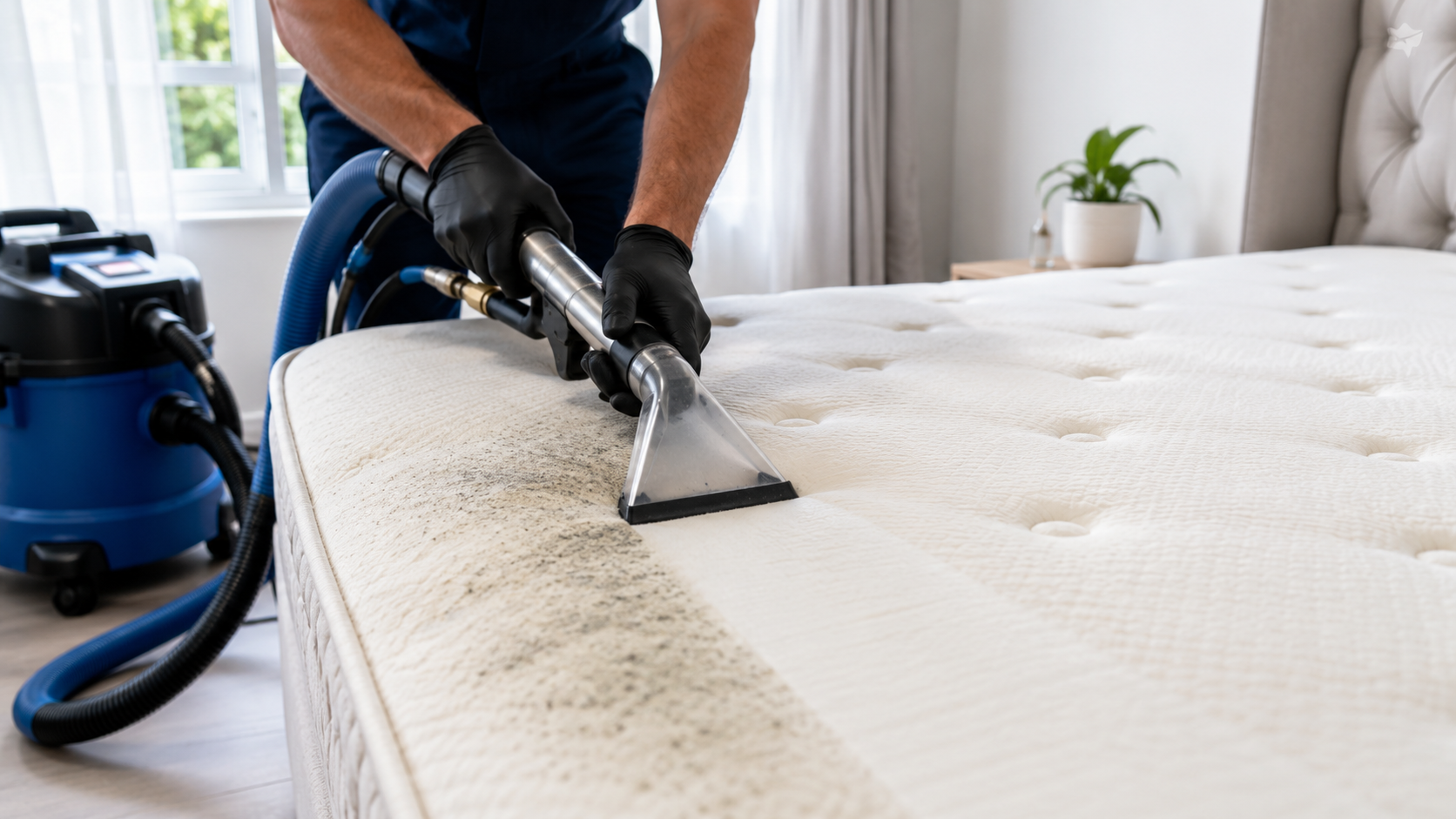
If you searched for how to remove mould from a mattress, you may be dealing with visible mould marks, a mouldy mattress smell, musty odours, dampness, mildew or a mattress that has been stored or used in a room with poor airflow. Mould is different from an ordinary stain because it is usually linked to moisture. That means the goal is not only to clean the visible mark, but also to dry the mattress properly and stop the dampness from coming back.
To remove mould from a mattress, remove all bedding, inspect the top, sides and underside of the mattress, improve airflow, dry the mattress properly, vacuum carefully, clean the affected area without soaking it, dry it again fully and check whether the smell or marks return. Very minor recent surface marks may improve with careful DIY cleaning. But visible mould, mouldy mattress smells, musty odours, damp residue, mould stains and recurring mould are often beyond basic home cleaning. In most normal treatable cases, professional mattress cleaning can remove or significantly improve mould marks, mouldy smells, musty odours and damp-related residue, especially when the mattress is still structurally sound and the contamination has not spread deeply through the core.
Professional mattress cleaning is not just a light surface wipe. It is a more serious cleaning process using controlled moisture, professional cleaning methods and professional-grade deep extraction equipment. For mould concerns that do not lift properly with careful DIY cleaning, professional cleaning is usually the better next step before deciding to replace the mattress.
Some people search for “how to clean a moldy mattress” or “how to clean moldy mattress”. In South Africa and the UK, the spelling is usually mouldy mattress. In the US, it is usually moldy mattress. The cleaning problem is the same: a mattress has moisture-related contamination that needs careful cleaning, proper drying and a realistic decision about whether the mattress can be saved.
CleanLab SA’s mattress cleaning services help customers arrange professional mattress cleaning through listed professionals when a mattress has mould concerns, mouldy odours, damp-related residue or musty smells after moisture exposure.
Can you remove mould from a mattress?
Yes, mould can in most cases be removed or significantly improved on a mattress, especially when the mattress is still structurally sound and the contamination has not spread deeply through the core.
The result depends on:
- how long the mould has been there
- whether the mattress is still damp
- whether the mould is on the top, sides or underside
- whether the bed base or wall is also damp
- whether the mattress smells mouldy throughout
- whether the mattress was cleaned with too much water
- whether mould keeps returning
- whether the mattress is still comfortable and worth saving
Very minor, recent surface marks may improve with careful DIY drying and surface cleaning.
But if there are visible mould marks, mouldy mattress smells, musty odours, damp residue or mould that has not lifted properly with basic cleaning, professional mattress cleaning is usually the stronger next step. In most normal treatable cases, professional deep extraction mattress cleaning can remove or significantly reduce mould-related odours, surface mould marks and damp-related residue more effectively than repeated home cleaning attempts.
Cleaning may not be enough only when the mattress has severe internal mould, widespread mould on multiple sides, long-term damp damage, visible mould inside the mattress structure or a strong mould smell throughout the whole mattress. Those are more extreme cases where replacement may be safer.
Is it safe to sleep on a mattress with mould?
Mould on a mattress should be taken seriously.
A mattress is something you sleep on for hours at a time, close to your face and skin. If there is visible mould, a strong musty smell or dampness that keeps returning, it is not just a cosmetic issue.
Avoid sleeping on a mattress with visible mould or a strong mouldy smell until the issue has been inspected and treated. This is especially important for children, guests, people with allergies, asthma, sinus issues or respiratory sensitivities.
This article is about cleaning decisions, not medical advice. If anyone in the home is experiencing breathing issues, persistent allergy symptoms or health concerns linked to mould exposure, it is safer to speak to a qualified health professional.
What causes mould on a mattress?
Mould on a mattress usually starts with moisture, poor airflow or damp storage.
Common causes include:
- poor bedroom ventilation
- damp walls
- humid rooms
- mattress placed directly on the floor
- poor airflow under the mattress
- sweating at night
- spills that did not dry properly
- urine or other accidents that were not fully dried
- bedding replaced before the mattress dried
- mattress protector trapping moisture
- water leaks
- condensation
- damp rental or guest rooms
- cleaning with too much water
- storing a mattress in a garage or damp room
A mattress can look mostly normal on top while still holding moisture below the surface. This is why a musty mattress smell matters. If the mattress smells damp, stale or mouldy, there may be more going on than a surface mark.
How to check how serious the mould is
Before trying to clean mould off a mattress, inspect the mattress carefully.
Check:
- the top surface
- side panels
- seams and stitching
- the underside of the mattress
- the area near the headboard
- the bed base or slats
- the wall behind the bed
- the floor under the bed
- any mattress protector
- the smell of the mattress
- whether the mattress feels damp
The problem is usually more serious when:
- the mattress smells mouldy throughout
- there are large mould patches
- mould is on the underside
- the edges feel damp
- mould returns after cleaning
- the bed base is mouldy
- the wall or floor nearby is damp
- the mattress feels wet or clammy
- there is discolouration across large areas
If these signs are present, the mattress needs more than casual DIY cleaning. Professional cleaning may still be worth trying if the mattress is structurally sound and not deeply damaged, but severe internal mould or widespread long-term dampness may require replacement.
How to remove mould from a mattress step by step
For minor surface mould, careful DIY cleaning may help. The key is to avoid soaking the mattress and to dry it properly before using it again.
1. Remove all bedding
Remove sheets, blankets, pillowcases, mattress protectors and any bedding touching the mattress.
Wash the bedding separately. If the bedding smells musty, it may also need proper cleaning and drying.
Do not put clean bedding back onto a damp or mouldy mattress.
2. Move the mattress to a dry, ventilated area
Fresh airflow is important.
Open windows if possible. Use a fan if needed. If the mattress can be moved safely into a dry, sunny, well-ventilated area, that can help with drying.
Do not leave the mattress in a closed, damp room while trying to clean it.
3. Check the bed base, wall and floor
Before cleaning the mattress, check whether the dampness is coming from the room.
Look for:
- damp walls
- mould behind the headboard
- mould on wooden slats
- damp flooring
- mould under the bed
- poor airflow below the mattress
- condensation near windows
- a solid base with no ventilation
If the room or bed base is causing the moisture, the mould can come back even after the mattress is cleaned.
4. Let the mattress dry before cleaning
If the mattress feels damp, let it dry first.
Do not start by adding more liquid to a damp mattress. That can push moisture deeper and make the problem worse.
Use airflow, sunlight where practical and a fan to help dry the mattress. A dehumidifier can also help in humid rooms.
5. Vacuum the mattress carefully
Once the mattress is dry, vacuum the affected area carefully.
Use slow passes around the mouldy area, seams and stitching. This may help remove loose surface debris before cleaning.
If the mould is heavy, widespread or powdery, avoid aggressive DIY handling because you may spread material into the air. In that case, professional help is a better option.
6. Lightly clean the affected area
For a minor surface mark, use a light cleaning approach. The aim is to clean the surface without soaking the mattress.
Use a lightly damp cloth rather than pouring liquid onto the mattress. Work gently over the affected area. Blot rather than scrub aggressively.
Do not flood the mattress. Do not pour water, vinegar or any cleaning mixture directly into the mattress.
7. Blot with a clean dry cloth
After wiping the affected area, blot it with a dry clean cloth or towel.
Press down and lift. Repeat with a dry section of the cloth.
The goal is to remove as much moisture as possible from the surface.
8. Dry the mattress fully
This step matters most.
After cleaning, keep the mattress uncovered until it is fully dry. Use airflow, a fan and sunlight where practical.
Do not put sheets, protectors or bedding back onto the mattress while it is still damp.
9. Check the mattress again after 24 to 48 hours
After the mattress has dried, check it again.
Look for:
- returning musty smell
- mould marks that remain
- dampness
- discolouration
- mould on the underside
- smell that comes back when the room is closed
If the mouldy smell or marks remain, basic DIY cleaning has probably reached its limit. Professional mattress cleaning is usually the stronger next step if the mattress is still worth saving.
How to clean a moldy mattress
Many people search for how to clean a moldy mattress. The safest answer is: do not treat a mouldy mattress like a hard bathroom surface. A mattress is thick, absorbent and difficult to dry if it is over-wet.
A mouldy mattress needs three things:
- moisture control
- proper drying
- cleaning that removes residue without pushing dampness deeper
If the mould is tiny, recent and the mattress is dry, careful DIY surface cleaning may help.
But if there is a mouldy mattress smell, larger visible marks, dampness, recurring mould or musty odour that does not go away, basic DIY cleaning is usually not enough. Professional mattress cleaning is usually the better next step when the mattress is still worth saving.
How to clean mould from mattress fabric
To clean mould from mattress fabric, first understand that the fabric is only one part of the issue.
Mould can affect:
- top fabric
- side panels
- seams
- stitching
- quilting
- padding below the surface
- underside fabric
- areas near the bed base
Surface wiping may improve what you can see, but it may not remove odour-causing residue in the mattress fabric and padding.
Professional mattress cleaning is stronger because it can treat the affected surface and extract more residue from the mattress than household wiping. This is especially useful when the mattress has musty odours, stale damp smells, visible marks or contamination from being stored or used in a humid room.
How to get rid of mould on mattress surfaces
If you are trying to get rid of mould on a mattress, the real issue is moisture.
Mould may show as:
- small dark dots
- grey marks
- faint greenish patches
- black specks
- yellowish or brownish damp marks
- musty-smelling areas
- marks near the side or underside of the mattress
The faster you deal with it, the better the chance of improvement.
Professional cleaning is worth considering when:
- the mattress is still comfortable
- the affected area is visible but not extreme
- the main issue is mouldy smell or musty odour
- the mattress has damp-related residue
- DIY cleaning has not solved the problem
- the mattress is used by guests, children or tenants
- the mattress is valuable enough to try cleaning before replacement
Replacement should not be the first assumption unless the mattress is badly damaged, mouldy throughout, wet inside or affected by severe long-term contamination.
What can you use to clean mould off a mattress?
People often look for a product that will solve mould quickly. The problem is that mattresses are absorbent, so product choice is only part of the issue. Moisture control and drying are just as important.
For minor surface marks, people commonly consider:
- a lightly damp cloth
- a mild cleaning solution
- vinegar
- baking soda
- sunlight
- a fan
- a dehumidifier
Whatever you use, the rule is the same: avoid soaking the mattress and dry it fully afterwards.
If the mattress has visible mould, a mouldy smell or musty odour that remains after basic cleaning, professional mattress cleaning is usually the better next step than repeating DIY cleaning with more liquid.
Can baking soda remove mould from a mattress?
Baking soda is not a proper mould-removal method.
Baking soda may help absorb light surface moisture or reduce mild odour, but it does not properly remove mould from a mattress. It also does not fix dampness inside the mattress.
Baking soda is limited for:
- visible mould
- black or green mould marks
- musty mattress smell
- damp mattress padding
- mould on the underside
- mould that keeps returning
- long-term moisture problems
You can read the dedicated guide on how to clean a mattress with baking soda for baking soda limits and common mistakes.
For mould concerns, baking soda should not be treated as the main solution. It may help with light freshness after the mattress is dry, but it should not replace proper mould cleaning, drying or professional cleaning where needed.
Can vinegar remove mould from a mattress?
Vinegar is often suggested for mould, but using it on a mattress can be risky if it adds too much moisture.
A mattress is not like a hard surface. If you spray too much vinegar or water, the liquid can soak into the padding and make the mattress harder to dry.
Light surface treatment may help in minor cases, but it will not solve deeper dampness or internal mould.
Avoid heavy vinegar use, soaking or repeated wet cleaning. If the mattress smells musty, has visible mould patches, or the mould keeps returning, professional cleaning is usually a stronger and safer next step than repeated DIY experiments.
Can sunlight help remove mould from a mattress?
Sunlight and airflow can help dry a mattress and reduce mustiness.
If it is practical and safe, placing the mattress in a dry, sunny, well-ventilated area may help with moisture and light surface freshness.
But sunlight alone does not guarantee mould removal. If mould has settled into the mattress fabric, stitching, padding or underside, airing alone may not solve the problem.
Sunlight is useful as part of drying, but not as a full cleaning method for serious mould.
Should you use bleach on a mouldy mattress?
Bleach is not a good first choice for a mattress.
A mattress is absorbent, and bleach can damage fabric, leave strong chemical smells, discolour the mattress and add moisture if used incorrectly. It may also make the room unpleasant to sleep in afterwards.
Bleach is more suited to certain hard surfaces, not absorbent mattress layers.
For a mattress, the safer approach is controlled cleaning, proper drying and professional cleaning if mould marks or musty odours remain.
Can rubbing alcohol or hydrogen peroxide remove mould from a mattress?
Some DIY guides mention rubbing alcohol or hydrogen peroxide, but both should be used cautiously.
They may affect fabric colour, leave residue or create uneven marks depending on the mattress material. Hydrogen peroxide can lighten fabrics and may leave visible patches. Rubbing alcohol can also affect certain materials and should not be used near heat or flames.
If you use any product, test carefully in a small hidden area first and avoid soaking the mattress.
For visible mould, mouldy smells or musty odours that remain after basic cleaning, professional mattress cleaning is usually the more reliable next step.
How to remove mould stains from mattress fabric
Mould stains can be harder than mould smell.
A mattress may have a musty odour, visible mould marks or both. Even when the mattress is cleaned, some mould staining may remain if the fabric has been discoloured.
Mould stains are more difficult when:
- the marks are old
- the mattress stayed damp for a long time
- black or green marks are visible
- the mould has affected stitching or seams
- the underside is marked
- harsh products were used
- the fabric has permanently discoloured
Professional cleaning can in most normal treatable cases remove or significantly reduce surface mould marks, musty odours and damp-related residue. But permanent discolouration may not always fully disappear.
This is why it is better to deal with mould early, before the mattress fabric becomes permanently stained.
What about mildew on a mattress?
Some people search for how to clean mildew off mattress or how to remove mildew from a mattress. Mildew is also moisture-related and should be treated seriously.
In everyday language, people often use “mould” and “mildew” to describe similar damp, musty problems on fabric surfaces.
The same practical rules apply:
- dry the mattress
- improve airflow
- avoid soaking
- check the underside
- inspect the room for dampness
- do not cover the mattress while damp
- consider professional cleaning if the smell or marks remain
If the mattress has visible mildew, mouldy odours or musty smells that do not clear properly, professional cleaning is usually the better next step than repeated home deodorising.
Why mould smell comes back after cleaning
If the musty smell comes back after cleaning, the source was probably not fully removed or the mattress became damp again.
Common reasons include:
- the mattress was not dried properly
- the room is still humid
- the bed base has poor airflow
- mould is on the underside
- moisture is inside the mattress
- bedding was replaced too soon
- the wall or floor is damp
- too much liquid was used during DIY cleaning
- the mattress protector trapped moisture
- mould was deeper than the surface
Returning mould smell is a sign that surface cleaning is not enough.
Professional mattress cleaning may help when the issue is still treatable, but the room and bed setup also need to be fixed. If the environment stays damp, mould can return.
When DIY mould cleaning may be enough
DIY mould cleaning may be enough when:
- the mould mark is very small
- the mattress is dry
- the issue is recent
- there is no strong mouldy smell
- there is no mould on the underside
- the room is not damp
- the mattress dries fully after cleaning
- the mark does not return after 24 to 48 hours
In these cases, careful drying, light surface cleaning and better ventilation may solve the issue.
But DIY is less likely to be enough when:
- the mattress smells mouldy
- the musty odour returns
- the mould mark is large
- there are multiple mould patches
- the underside is affected
- the mattress was wet for a long time
- the bed base or wall is damp
- repeated DIY cleaning has not worked
That is when professional mattress cleaning becomes the stronger next step.
When professional mattress cleaning is better for mould concerns
Professional mattress cleaning is usually the better option when:
- the mattress has a mouldy smell
- the mattress has a musty odour
- there are visible mould marks
- DIY cleaning did not solve the smell
- the mattress is still comfortable and worth saving
- the mould appears limited enough to treat
- the mattress has damp-related residue
- there are stale odours after moisture exposure
- the mattress has been over-wet during DIY cleaning
- the mattress is used by guests, tenants or children
In most normal treatable cases, professional mattress cleaning can remove or significantly reduce musty odours, mouldy mattress smells, surface mould marks and damp-related residue more effectively than DIY surface cleaning.
CleanLab SA helps customers arrange professional mattress cleaning through listed professionals. Customers can view available options, compare booking details and use Get Rates & Availability to select their location and secure a booking.
This is useful when the mattress does not appear ruined, but the odour, visible marks or damp-related contamination needs a proper cleaning process.
What professional cleaning may not fully fix
Professional mattress cleaning is the stronger option for most treatable mattress mould and musty odour problems, but mould still needs honest limits.
Cleaning may not fully fix:
- internal mould
- mould deep inside the mattress core
- severe long-term dampness
- visible widespread mould across the whole mattress
- mould on both sides of the mattress
- structural foam damage
- a mattress that stayed wet for a long time
- mould caused by a damp room that is not fixed
- a mattress with strong mould smell throughout
These are not ordinary cleaning limitations. They are signs that the mattress may have damage beyond normal cleaning.
The stronger practical point is this: if the mattress is still comfortable, structurally sound and the mould problem appears treatable, professional cleaning is often the sensible first step before deciding to replace it.
Should you clean or replace a mouldy mattress?
Professional cleaning is often worth trying before replacement when the mattress is still comfortable, structurally sound and not ruined by severe long-term dampness.
Cleaning is more realistic when:
- the mattress is still comfortable
- the mattress is worth saving
- the affected area is not the entire mattress
- the mattress is not wet inside
- there is no heavy mould on the underside
- there is no strong mould smell throughout
- the room dampness can be fixed
- the main issue is visible marks, musty odour or damp residue
Replacement becomes more realistic only when the mattress is visibly mouldy across large areas, smells mouldy throughout, has mould on the underside, stayed wet for a long time, or keeps developing mould even after proper cleaning and drying.
For most normal treatable mould and musty odour problems, professional cleaning is a sensible first step before replacement.
How to prevent mould on a mattress
Prevention is very important because mould is usually linked to moisture.
Useful steps include:
- keep the bedroom well ventilated
- avoid placing the mattress directly on the floor
- allow airflow under the mattress
- use a breathable bed base or slats
- avoid trapping moisture under protectors
- dry spills immediately
- deal with urine accidents quickly
- do not replace bedding while the mattress is damp
- pull the bed slightly away from damp walls
- check for condensation near windows
- use a dehumidifier in humid rooms
- air the mattress when changing bedding
- arrange cleaning after dampness or musty odours
If the room stays damp, mould can return even after cleaning.
Why book mattress cleaning through CleanLab SA?
Booking through CleanLab SA gives customers a structured way to arrange mattress cleaning in South Africa.
CleanLab SA’s listed professionals are reviewed by customers and expected to meet clear standards. Customers can view available options, compare booking details and get support from booking to completion.
This is useful when a mattress has mould concerns, mouldy odours, damp-related residue, musty smells or stale smells after moisture exposure.
Customers may need help with:
- mould on mattress
- mold on mattress
- mouldy mattress smell
- musty mattress smell
- mould stains on mattress fabric
- damp mattress odours
- stale mattress smell
- mildew on mattress
- mattress cleaning after moisture exposure
- sweat-related damp odours
- urine-related moisture issues
- guest mattress cleaning
- rental property mattress cleaning
- mattress cleaning after DIY over-wetting
Professional mattress cleaning is usually stronger than DIY surface cleaning because it uses professional cleaning methods, controlled moisture and professional-grade deep extraction equipment to remove more residue from the mattress fabric, stitching, padding and absorbent layers.
The value is in the full booking structure:
- reviewed listed professionals
- clear standards to remain listed
- customer review visibility during booking
- support from booking to completion
- a practical way to arrange mattress cleaning
- local booking options across major South African areas
You can also learn more from CleanLab SA’s Booking Protection and Professional Standards pages.
Find mattress cleaning for mould and musty odour concerns in your area
If your mattress has mould concerns, mouldy smells, musty odours, damp odours or stale smells after moisture exposure, you can start with CleanLab SA’s mattress cleaning services page.
Main city pages include:
- Cape Town mattress cleaners
- Durban mattress cleaning
- Johannesburg mattress cleaners
- Pretoria mattress cleaning
- Randburg mattress cleaners
- Sandton mattress cleaning services
You can also browse the wider cleaning services hub or explore available cleaning service locations.
Final answer
To remove mould from a mattress, remove bedding, inspect the top, sides and underside, improve airflow, dry the mattress properly, vacuum carefully, clean the affected area without soaking it and dry it fully before using it again.
Very minor recent surface marks may improve with careful DIY cleaning. But visible mould, mouldy mattress smells, musty odours, damp residue, mould stains and mould that keeps returning are usually beyond basic DIY cleaning.
For mould concerns where the mattress is still structurally sound and worth saving, professional mattress cleaning is usually the better next step before replacement. In most normal treatable cases, professional deep extraction mattress cleaning can remove or significantly reduce musty odours, mouldy smells, surface mould marks and damp-related residue more effectively than baking soda, vinegar or repeated DIY wiping.
If the mattress has severe internal mould, widespread mould across multiple sides, strong mould smell throughout or long-term damp damage, replacement may be safer.