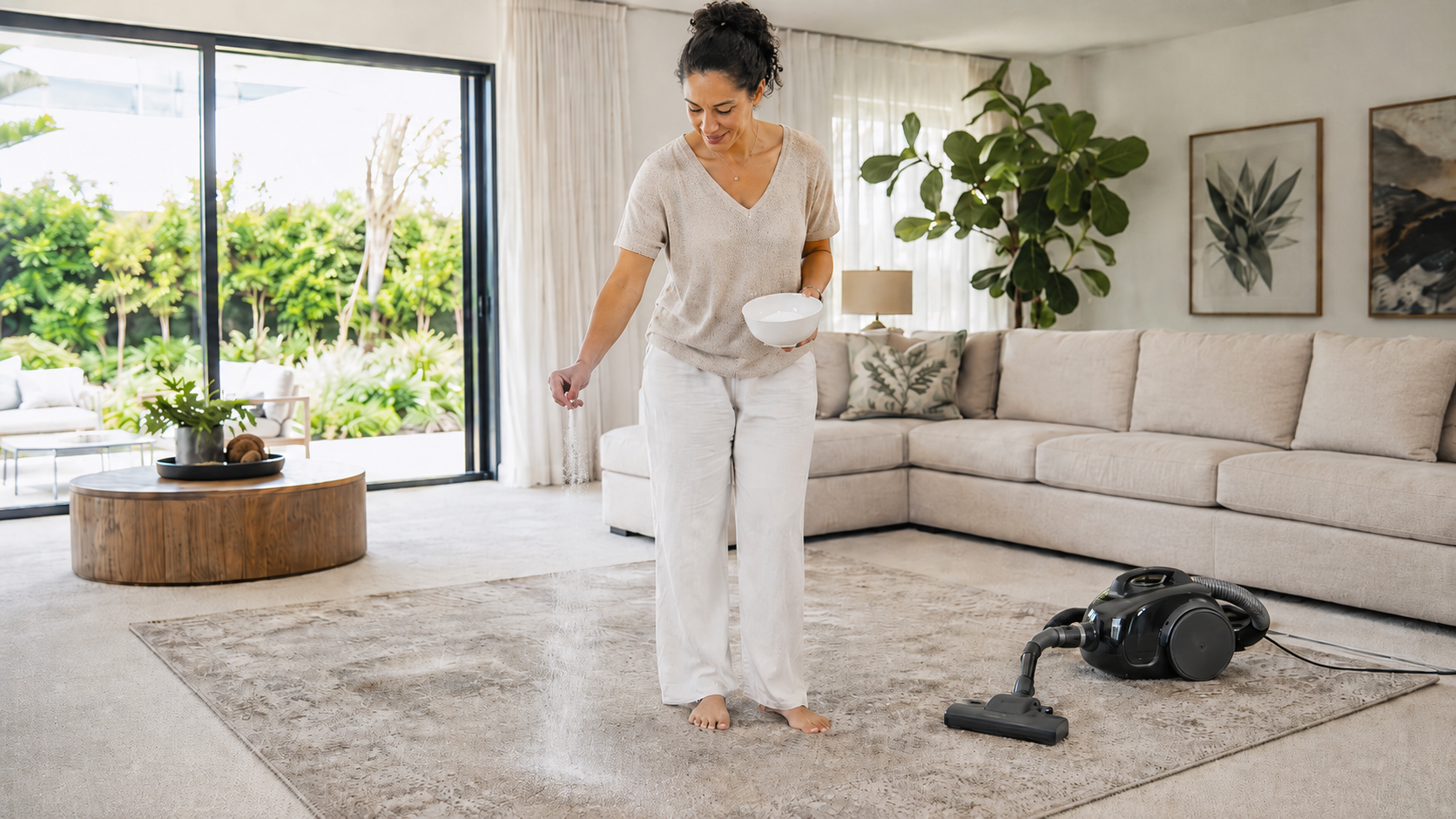
If you are wondering how to clean rugs with baking soda, the simple answer is that baking soda can sometimes help freshen light odours and absorb minor surface smells before vacuuming. It can also be used carefully on some carpets for light freshness, but it is not a deep-cleaning method.
Baking soda may help when a rug or carpet smells slightly stale, has light everyday odour, or needs a basic home refresh. But it will not properly remove embedded dirt, old stains, pet urine, deep odours, heavy traffic marks, or buildup trapped inside the fibres.
Rugs also need extra care because some are wool, woven, dyed, fringed, delicate, layered, or not designed for moisture or aggressive cleaning. A fitted carpet and a loose rug may look similar, but they can behave very differently when treated at home.
For light freshness, baking soda may be useful. For stains, pet smells, urine odours, traffic lanes, damp rugs, delicate fibres, or valuable rugs and carpets, professional cleaning is usually the safer and more complete option.
If your rug or carpet needs more than a light home refresh, you can review CleanLab SA’s carpet and upholstery cleaning page or choose your nearest local carpet-cleaning page.
Can you clean rugs with baking soda?
Yes, you can use baking soda on some rugs to help freshen light odours, but it should be used carefully.
Baking soda is best for mild surface-level freshness.
It may help with:
- light stale smells
- mild pet odour on the surface
- everyday room odours
- light surface freshness
- minor moisture absorption after blotting a small spill
- basic home maintenance before vacuuming
But baking soda does not properly deep-clean a rug.
It does not extract embedded dirt, remove old stains, rinse the fibres, treat the backing, or solve deeper odour problems.
This matters because many rugs are more delicate than fitted carpets. Some rugs have dyes, fringe, woven backing, wool fibres, or layered construction that may not respond well to DIY cleaning.
Can you clean carpet with baking soda?
Yes, you can use baking soda on some carpets for light freshness, especially when the carpet is dry and the issue is mild odour.
Baking soda may help reduce surface smells before vacuuming, but it is not a full carpet-cleaning solution.
It does not remove:
- deep dirt
- old stains
- pet urine
- strong dog smell
- damp carpet odours
- traffic-lane buildup
- oils from feet and shoes
- food and drink residue
- dirt trapped below the surface
So the better way to think about it is:
Baking soda can freshen some rugs and carpets, but it does not properly clean them deeply.
How to clean a rug with baking soda
For a light rug refresh, use baking soda carefully and keep the process simple.
A cautious method is:
- Make sure the rug is dry.
- Vacuum the rug first to remove loose dirt and hair.
- Sprinkle a light amount of baking soda over the affected area.
- Do not use thick piles of powder.
- Leave it for a limited time.
- Vacuum slowly and thoroughly.
- Check that no powder remains in the fibres.
- Repeat vacuuming if needed.
Do not use this method on valuable, delicate, wool, silk, antique, heavily dyed, or fragile rugs without proper guidance.
If the rug has a care label, check it first.
If you are unsure, test a small hidden area before applying baking soda more widely.
How to clean carpet with baking soda
For fitted carpet, the process is similar, but you should still be cautious.
A basic method is:
- Make sure the carpet is dry.
- Vacuum the area first.
- Sprinkle a small amount of baking soda lightly.
- Let it sit for a short period.
- Vacuum slowly in several directions.
- Check that the powder has been removed properly.
Avoid using too much baking soda.
Fine powder can be difficult to remove fully, especially if the carpet is thick, damp, or your vacuum does not have strong suction.
If baking soda is left behind, it may collect in the fibres or affect your vacuum cleaner over time.
How long should you leave baking soda on a rug?
For light odour freshening, baking soda is usually left on a rug for a short period before vacuuming.
The exact time depends on the rug, odour, fibre type, and how much baking soda was used.
The safer principle is:
Use less baking soda, leave it only as long as needed, and vacuum thoroughly.
Do not leave heavy amounts of baking soda sitting in a rug for too long, especially if the rug is damp, delicate, wool, or difficult to vacuum.
If the rug is valuable or delicate, avoid experimenting.
How long should you leave baking soda on carpet?
For carpet, baking soda may be left briefly for light freshness, but it should not be treated as a long-term cleaning solution.
Leaving baking soda on carpet for too long may make it harder to remove.
This is especially true if:
- the carpet is thick
- the carpet is damp
- too much powder was used
- the vacuum has weak suction
- the carpet has deep pile
- the powder settles into the backing
If you use baking soda, vacuum thoroughly and check that the carpet does not feel dusty afterwards.
Does baking soda remove rug smells?
Baking soda may help reduce some light rug smells, especially if the odour is close to the surface.
It may help with mild smells from:
- everyday use
- dust
- light pet presence
- stale room air
- minor food odours
- light surface dampness
But baking soda may not remove the source of stronger odours.
Rug smells can come from:
- pet urine
- damp backing
- mould or mildew
- food spills
- drink spills
- body oils
- pet dander
- dirty fibres
- old stains
- moisture trapped underneath
If the smell returns after vacuuming, the odour source is probably deeper than baking soda can reach.
Does baking soda remove carpet smells?
Baking soda can sometimes help with mild carpet smells, but it is not reliable for deeper carpet odours.
Carpet odours may come from:
- pet urine
- damp underlay
- dirty carpet backing
- old spills
- food residue
- drink residue
- body oils
- shoe residue
- mould or mildew
- long-term pet use
- poor drying
If the smell is light and recent, baking soda may help freshen the surface.
If the smell is strong, old, pet-related, or keeps coming back, professional carpet cleaning is usually the better option.
Can baking soda remove pet smell from rugs?
Baking soda may reduce light pet smell on the surface of a rug, but it is not the best solution for stronger pet odours.
Pet-used rugs often collect:
- pet hair
- pet dander
- saliva residue
- muddy paw marks
- pet body oils
- dirty resting spots
- urine odours
If the smell is light, baking soda may help freshen the rug.
If the rug has repeated pet use, urine smell, or strong dog or cat odour, baking soda is unlikely to solve the issue properly.
A professional clean gives a better chance of treating and extracting more of the odour source.
Can baking soda remove dog urine smell from rugs or carpets?
Baking soda alone is usually not enough for dog urine smell in rugs or carpets.
Urine can soak into:
- rug fibres
- rug backing
- carpet fibres
- carpet backing
- underlay
- flooring gaps below the carpet
- the surrounding area if the accident spreads
Baking soda may reduce some surface smell, but the deeper urine source may remain.
If the smell returns when the room is warm, humid, or closed up, the urine is probably deeper than the surface.
For urine odours, professional cleaning is usually the safer and stronger option.
Can you use baking soda on a wet rug?
Be careful using baking soda on a wet rug.
If a rug is slightly damp from a small fresh spill, baking soda may help absorb some surface moisture after blotting.
But if a rug is very wet, smells musty, or has stayed damp for too long, baking soda is not enough.
Wet rugs can develop bigger problems, including:
- damp backing
- musty smells
- colour transfer
- mould risk
- mildew smell
- trapped moisture
- damage to floors underneath
- fibre distortion
If a rug is wet, drying it properly matters more than covering it with baking soda.
For valuable rugs, wool rugs, or rugs with strong odours, get professional advice before using DIY powders or liquids.
Can you use baking soda on wet carpet?
You can use baking soda on lightly damp carpet in some cases, but it should not be used as a fix for serious dampness.
If the carpet is wet from a small spill, blot first and use airflow.
If the carpet is very wet, smells musty, or may have moisture in the underlay, baking soda will not solve the real problem.
Wet carpet can become a bigger issue if there is:
- poor airflow
- underlay moisture
- dirty water
- leaking pipes
- flooding
- mould risk
- repeated dampness
- delayed drying
Do not rely on baking soda for wet carpet problems that need proper drying or professional attention.
Is baking soda safe for wool rugs?
Baking soda should be used very carefully on wool rugs.
Wool can be more sensitive than synthetic carpet fibres.
Potential issues include:
- powder trapped in the fibres
- difficulty vacuuming fully
- texture changes
- moisture sensitivity
- odour retention
- damage from rubbing or scrubbing
- problems if mixed with vinegar or too much liquid
If a wool rug is valuable, delicate, antique, or heavily soiled, professional rug cleaning is usually safer than DIY baking soda treatments.
Is baking soda safe for all carpets?
Baking soda is generally low-risk on many dry synthetic carpets when used lightly, but it is not automatically safe for every carpet.
Be careful if:
- the carpet is wool
- the carpet is delicate
- the carpet is damp
- the carpet is very thick
- the carpet has old stains
- there is urine smell
- the carpet has been treated with other chemicals
- the vacuum may not remove fine powder properly
Testing first is always safer.
Can baking soda damage a vacuum cleaner?
Yes, too much baking soda can be hard on some vacuum cleaners.
Baking soda is a fine powder.
If used heavily, it may:
- clog filters
- reduce suction
- collect inside the vacuum
- affect motor airflow
- sit in hoses
- remain in carpet fibres
- become harder to remove if damp
Use baking soda lightly and vacuum thoroughly.
If your vacuum is not designed to handle fine powder, avoid using large amounts.
Is baking soda and vinegar good for rugs?
Baking soda and vinegar are often suggested online, but they are not always a good idea for rugs.
The fizzing reaction can look effective, but it does not automatically deep-clean the rug.
On rugs, baking soda and vinegar can create problems such as:
- excess moisture
- residue
- dye movement
- fabric rings
- damp backing
- lingering vinegar smell
- fibre changes
- powder stuck in the rug
This is especially risky on wool, delicate, dyed, woven, or valuable rugs.
For minor surface marks, it may help in some cases, but it should not be treated as a safe all-purpose rug-cleaning method.
Is baking soda and vinegar good for carpet?
Baking soda and vinegar may help with some minor carpet surface marks, but it is not a reliable deep-cleaning method.
It can sometimes cause:
- excess moisture
- residue
- spreading stains
- uneven cleaning
- lingering smell
- water marks
- powder trapped in fibres
- deeper dampness
If you try it, use very small amounts and test first.
For serious stains, urine smells, pet odours, or traffic-lane buildup, professional carpet cleaning is usually better.
Baking soda vs professional rug and carpet cleaning
Baking soda and professional cleaning do very different things.
| Option | Best for | Limits |
|---|---|---|
| Baking soda | Light odour freshening and surface maintenance | Does not deep-clean or extract embedded dirt |
| Baking soda and vinegar | Some minor surface marks when used carefully | Can leave residue or cause moisture issues |
| Professional rug cleaning | Rug stains, odours, pet smells, delicate fibres, deeper buildup | Results depend on rug type and condition |
| Professional carpet cleaning | Carpet stains, traffic lanes, pet odours, urine smells, deeper dirt | Results depend on carpet type and stain history |
Baking soda can help with light freshness.
Professional cleaning is better when rugs or carpets need a proper reset.
When is baking soda enough?
Baking soda may be enough when:
- the rug or carpet is mostly clean
- the smell is mild
- the surface is dry
- there are no deep stains
- there is no strong pet odour
- there is no urine issue
- the rug is not delicate or valuable
- the carpet is easy to vacuum
- you only want a light refresh
In these cases, baking soda can be a useful home-care option.
When should you avoid baking soda?
Avoid relying on baking soda when:
- the rug is valuable
- the rug is wool or delicate
- the carpet is very wet
- there is mould concern
- there is a strong urine smell
- the stain is old
- the odour keeps returning
- the carpet smells musty
- the underlay may be affected
- previous DIY cleaning has failed
- there are dark traffic lanes
- the rug or carpet needs proper extraction
In these cases, baking soda may hide the issue temporarily without solving it properly.
When should you book professional rug or carpet cleaning?
Professional rug or carpet cleaning is the better option when:
- rugs smell stale
- carpets smell stale
- pet odours keep returning
- urine smells are present
- visible stains remain
- traffic lanes look dark
- the rug is delicate
- the carpet is heavily used
- children play on the carpet
- pets use the rug or carpet often
- DIY cleaning has not worked
- guests are coming
- the rug or carpet is important or expensive
Professional cleaning is designed to treat and extract more of the dirt, residue, and odour source than baking soda can.
Can professional cleaning remove rug and carpet stains?
In many normal cases, professional cleaning can remove or significantly improve common rug and carpet stains and smells caused by everyday use.
This may include:
- food marks
- drink spills
- muddy marks
- pet smells
- light urine odours
- traffic lanes
- dusty carpets
- stale rug smells
- body oil residue
- high-use areas
Results depend on the rug or carpet type, age of the stain, previous cleaning attempts, level of soiling, and whether there is permanent fibre damage.
Professional cleaning cannot guarantee every mark will disappear, but it is usually the stronger option when compared with baking soda alone.
Should you use baking soda before professional cleaning?
If you are planning to book professional rug or carpet cleaning soon, avoid applying too many DIY products first.
Multiple home cleaning attempts can sometimes:
- spread stains
- set stains deeper
- leave residue
- affect cleaning results
- create water marks
- make odours harder to treat
- delay proper treatment
If there is a serious stain or smell, take a photo, avoid over-wetting the rug or carpet, and explain the issue when booking.
Why book carpet and rug cleaning through CleanLab SA?
Booking through CleanLab SA gives customers a structured way to arrange carpet and upholstery cleaning in South Africa.
CleanLab SA’s listed professionals are reviewed by customers and expected to meet clear standards. Customers also get support from booking to completion.
That matters because rug and carpet cleaning is not only about a visible mark. Customers want a practical booking process, clear expectations, and a better chance of improving stains, smells, pet odours, traffic lanes, and everyday buildup.
The value is in the full booking structure:
- reviewed listed professionals
- clear standards to remain listed
- customer review visibility during booking
- support from booking to completion
- a clearer path for booking-related assistance where needed
- a practical way to arrange related carpet and upholstery cleaning
You can also learn more from CleanLab SA’s Booking Protection and Professional Standards pages.
Find carpet and rug cleaning in your area
If you are asking how to clean rugs with baking soda because your rug smells stale, has pet odours, or has everyday marks, professional cleaning may be the better option.
You can start with CleanLab SA’s carpet and upholstery cleaning page or choose a local carpet-cleaning page.
Main city pages include:
- Cape Town carpet cleaners
- Durban carpet cleaners
- Johannesburg carpet cleaners
- Pretoria carpet cleaners
- Randburg carpet cleaners
You can also browse the wider cleaning services hub or explore available locations.
Final answer: how to clean rugs and carpets with baking soda
You can clean or freshen some rugs and carpets with baking soda when the surface is dry, the smell is mild, and the rug or carpet is not delicate.
For a light refresh, vacuum first, sprinkle a small amount of baking soda, leave it briefly, and vacuum thoroughly.
But baking soda is not a deep-cleaning solution. It does not properly remove old stains, pet urine, embedded dirt, strong odours, traffic-lane buildup, or deeper residue.
Be especially careful with rugs because many are delicate, wool, dyed, woven, fringed, or more sensitive than fitted carpets.
For stained, smelly, pet-used, valuable, or heavily used rugs and carpets, professional cleaning is usually the safer and more effective route.
If you are ready to book, review CleanLab SA’s carpet and upholstery cleaning page and use Get Rates & Availability to view prices, select your location, and secure your booking.