The best way to clean a fabric couch depends on the fabric type, the kind of dirt or stain, how long the mark has been there, and whether the couch needs light maintenance or deeper professional cleaning.
For light dust, crumbs, pet hair, and fresh surface marks, careful DIY cleaning may help. For deeper body oils, pet smells, food stains, drink spills, stale odours, and dirty high-use seating areas, professional couch cleaning is usually the better option.
The short answer is: the best way to clean a fabric couch is to vacuum it properly, check the fabric care guidance, blot fresh spills carefully, avoid over-wetting or harsh home remedies, and book professional upholstery cleaning when the couch has stains, odours, pet use, body oils, or deeper fabric buildup.
If you are comparing options, you can review CleanLab SA’s couch, carpet and upholstery cleaning page or browse the wider cleaning services hub.
What is the best way to clean a fabric couch?
The best way to clean a fabric couch is to start gently and avoid rushing into strong DIY products.
A safe basic approach is:
- Remove loose items and cushions where possible.
- Vacuum the couch thoroughly.
- Check the fabric care label or manufacturer guidance.
- Blot fresh spills instead of scrubbing.
- Test any cleaning product in a hidden area first.
- Avoid soaking the fabric.
- Let the couch dry properly.
- Book professional couch cleaning for deeper stains, odours, or heavy use.
This matters because fabric couches are not all the same.
Some fabrics tolerate water-based cleaning better than others. Some may be more delicate, more absorbent, more prone to water marks, or more likely to hold residue.
That is why the “best” method is not always one homemade recipe. It depends on the couch.
Why fabric couches get dirty even when the home is clean
A fabric couch can look neat but still collect everyday buildup.
This is because couches are used differently from many other household surfaces. People sit, relax, eat, drink, work, watch TV, hold pets, and rest on the same fabric repeatedly.
Over time, fabric couches can collect:
- dust
- body oils
- sweat residue
- pet hair
- pet dander
- food crumbs
- drink spills
- skin particles
- makeup marks
- hair product residue
- stale household odours
- dirty armrest and headrest marks
The couch may not look badly dirty at first. But the fabric can start to feel dull, smell stale, or look darker in high-contact areas.
This is especially common on:
- armrests
- seat cushions
- back cushions
- headrest areas
- pet resting spots
- family TV room couches
- light-coloured fabric sofas
- couches used daily
Professional upholstery cleaning can help when normal vacuuming and surface cleaning are no longer enough.
How can I clean my fabric couch myself?
You can clean a fabric couch yourself for light maintenance, but you need to be careful.
DIY cleaning is most suitable for:
- loose crumbs
- dust
- pet hair
- light surface marks
- very fresh spills
- mild everyday maintenance
- small areas that are safe to treat
A simple DIY maintenance routine can include:
- vacuuming the couch slowly
- using the upholstery attachment if available
- lifting loose cushions where possible
- vacuuming seams and gaps
- gently blotting fresh spills
- keeping pets and food controlled
- airing the room
- cleaning removable covers only according to the care instructions
The key is to avoid making the problem worse.
Many couch-cleaning problems happen when people scrub too hard, use too much water, or apply random household mixtures without checking the fabric.
What should you do first before cleaning a fabric couch?
Before cleaning a fabric couch, check the fabric care label or manufacturer instructions where available.
This is especially important because different couches can have different fabric types, dyes, stitching, cushion fillings, and cleaning limitations.
If you cannot find a care label, be more cautious.
Before using any product, test it on a hidden area first and wait to see whether it causes:
- colour change
- water marks
- fabric damage
- texture change
- residue
- spreading
- fading
This is especially important for delicate fabrics, older couches, light-coloured sofas, expensive upholstery, and couches with unknown fabric composition.
If you are unsure, it is usually safer to avoid experimenting with strong products or too much water.
DIY vs professional couch cleaning: which is better?
DIY and professional couch cleaning are not the same.
DIY cleaning can help with light surface maintenance. Professional couch cleaning is better when the problem is deeper, more widespread, or more important to fix properly.
| Situation | DIY cleaning may help | Professional couch cleaning is better |
|---|---|---|
| Loose crumbs | Yes | Not always needed |
| Pet hair on surface | Yes | Useful if odours are also present |
| Fresh small spill | Sometimes | Better if stain is spreading or serious |
| Body oils on armrests | Limited | Yes |
| Dirty headrest areas | Limited | Yes |
| Pet smells | Limited | Yes |
| Food or drink stains | Sometimes | Yes, especially if old or visible |
| Large couch or lounge suite | Limited | Yes |
| Stale fabric smell | Limited | Yes |
| Unknown fabric type | Be cautious | Often safer |
| Expensive or delicate couch | Risky | Often better |
The best approach is not “DIY is bad” or “professional cleaning is always needed.”
The better question is: how deep is the problem?
If the couch only needs light maintenance, DIY care may be enough. If the couch smells stale, looks dull, has stains, or has been heavily used, professional upholstery cleaning is usually the stronger option.
Can you deep clean a fabric sofa at home?
You can do some deeper maintenance at home, but a full deep clean is difficult without the right equipment, product knowledge, and extraction process.
A home attempt may remove some surface dirt, but it can also create problems if the couch is over-wet or treated with the wrong product.
Common DIY deep-cleaning risks include:
- water marks
- damp smells
- colour bleeding
- sticky residue
- spread stains
- fabric shrinkage
- texture damage
- trapped moisture
- slow drying
- dirt returning faster
The problem is not only the cleaning product. It is also the removal of loosened dirt and moisture.
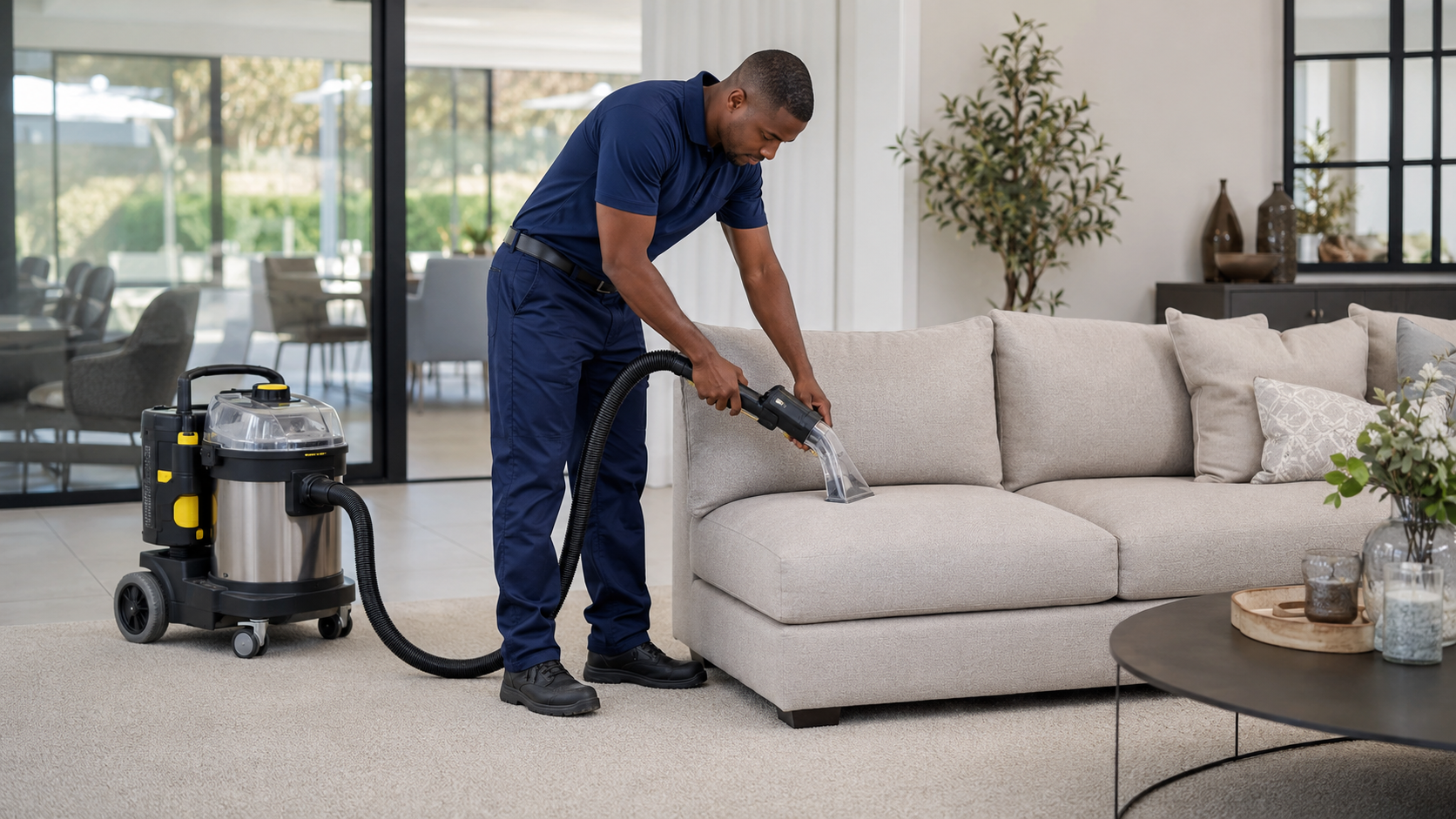
Professional upholstery cleaning is usually better for deeper cleaning because the technician can treat the couch more systematically and use professional equipment designed for upholstery cleaning.
What is the best thing to clean a fabric sofa?
There is no single “best thing” to clean every fabric sofa.
The right method depends on:
- fabric type
- care label
- stain type
- stain age
- colour of the fabric
- whether the couch has pet odours
- whether the couch has body oil buildup
- whether the fabric is delicate
- whether the couch has been cleaned before
For light maintenance, vacuuming is often the safest first step.
For fresh spills, careful blotting with a clean absorbent cloth is usually better than scrubbing.
For deeper stains, odours, and high-use areas, professional couch cleaning is usually the safer and stronger option.
Be careful with online recipes that suggest using one product for every couch. Fabric upholstery is not one universal surface.
Can I clean my fabric couch with water?
Sometimes, but not always.
Some fabrics tolerate water-based cleaning better than others. Other fabrics may water-mark, shrink, fade, or hold moisture.
If you use water, use it carefully and avoid soaking the couch.
Over-wetting can cause:
- water marks
- damp smells
- slow drying
- residue spreading
- deeper moisture inside cushions
- stains spreading further into the fabric
- musty smells in poor drying conditions
For fresh marks, a small amount of controlled blotting may help. But if the couch needs a deeper clean, professional upholstery cleaning is usually safer than soaking the fabric at home.
Can I use vinegar to clean a fabric couch?
Vinegar is a common home remedy, but it is not suitable for every fabric couch.
It may help with some light household odours or minor surface issues, but it can also create problems if used incorrectly.
Possible risks include:
- vinegar smell lingering
- colour changes
- fabric damage
- water marks
- residue
- stain spreading
- over-wetting
- poor results on oily marks
You should not spray vinegar broadly across a couch without checking the fabric and testing a hidden area first.
Vinegar is also not a proper substitute for professional cleaning when the couch has body oils, pet odours, old stains, food marks, drink spills, or deep fabric buildup.
If the couch is valuable, delicate, light-coloured, or already stained, it is safer to be cautious.
Can baking soda clean a fabric couch?
Baking soda is often used by homeowners to help absorb light odours, but it has limits.
It may help slightly with surface freshness, but it does not properly deep clean a couch.
Baking soda will not reliably remove:
- body oils
- deep dirt
- pet urine
- old stains
- drink spills
- food residue
- dirty armrests
- embedded odours
It can also leave powder residue if not vacuumed properly.
Baking soda may be useful as light maintenance in some cases, but it should not be treated as a full couch-cleaning solution.
What not to use on a fabric couch
Be careful with products that are too harsh, too wet, too soapy, or not designed for your couch fabric.
Avoid:
- bleach
- harsh chemicals
- strong detergents
- excessive dish soap
- too much water
- random stain removers
- abrasive scrubbing brushes
- steamers used carelessly
- vinegar sprayed heavily
- mixing multiple products together
- products not tested on the fabric
The wrong product can make the mark worse or damage the couch.
This is especially important with light-coloured couches, delicate upholstery, older fabric, or high-value furniture.
Why scrubbing can make couch stains worse
Scrubbing feels logical, but it can make couch stains worse.
Hard scrubbing may:
- spread the stain
- damage fibres
- distort the fabric texture
- push residue deeper
- create a larger wet mark
- lift colour from the fabric
- make the area look worn
For fresh spills, blotting is usually safer than scrubbing.
Blotting helps lift moisture without pushing the stain deeper into the fabric.
If a stain does not improve with careful blotting, it may need professional attention rather than stronger scrubbing.
Why couches smell stale
Fabric couches can smell stale because they absorb everyday odours over time.
Common causes include:
- body oils
- sweat residue
- pets
- food crumbs
- drink spills
- dust
- dampness
- poor airflow
- dirty cushions
- old stains
- family TV room use
The smell may not come from one obvious stain. It may come from the combined buildup of daily use.
This is why vacuuming may improve the couch slightly but not fully remove the smell.
Professional upholstery cleaning can help when odours are linked to dirt, body oils, pet use, and residue in the fabric.
Can professional couch cleaning remove stains?
Professional couch cleaning can often remove or visibly improve many common couch stains.
This may include:
- food marks
- drink spills
- muddy paw marks
- pet-related marks
- body oil marks
- dirty armrests
- dusty fabric
- light water marks
- everyday household stains
The result depends on the fabric type, stain type, stain age, previous cleaning attempts, and whether the stain has caused permanent colour change.
Older stains, dye transfer, bleach marks, sun damage, and damaged fabric may not disappear completely.
A realistic expectation is that professional cleaning can often make a used couch look and feel much fresher, but it cannot make damaged fabric brand new.
Can professional couch cleaning remove odours?
Professional couch cleaning can help reduce many common couch odours, especially when they come from everyday use.
This includes odours linked to:
- pets
- body oils
- sweat
- food crumbs
- drink spills
- stale fabric
- dusty upholstery
- family lounge use
The result depends on how deep the odour source is.
If the odour is mainly in the fabric, professional cleaning can often help. If contamination has gone deep into cushions, foam, or internal layers, improvement may still be possible but the result can be less predictable.
This is why it is better to clean couches before odours become old or deeply embedded.
Fabric couch cleaning for pets
Homes with pets often need couch cleaning more regularly.
Pets can leave:
- hair
- dander
- saliva marks
- muddy paw marks
- pet smells
- dirty resting spots
- light urine marks
- outdoor dirt
- food crumbs near resting areas
Pet-used couches can smell stale even when they do not look badly stained.
If your pet regularly lies on the couch, professional upholstery cleaning can help freshen the fabric and reduce everyday pet-related buildup.
For very old urine, repeated saturation, or odours deep inside cushions, results may be more difficult. But many normal pet-related marks and smells can be improved.
How to make a fabric couch look fresher
To make a fabric couch look fresher, focus on the main areas that affect appearance and smell.
Helpful steps include:
- vacuum the couch thoroughly
- clean crumbs from seams
- rotate loose cushions where possible
- keep pet hair under control
- clean fresh spills quickly
- avoid eating messy foods on the couch
- improve room airflow
- wash removable covers only if the care label allows it
- book professional cleaning for deep dirt, odours, and stains
A couch often looks better when the surrounding carpet and rugs are also clean.
That is why customers often book couch cleaning together with carpet and rug cleaning.
You can review CleanLab SA’s professional couch, carpet and upholstery cleaning page if you want to compare related cleaning options.
When is DIY couch cleaning enough?
DIY couch cleaning may be enough when the couch only has light surface dirt.
This may apply when:
- the couch is not badly stained
- there are no strong odours
- marks are fresh and minor
- the fabric care label is clear
- the couch is not delicate or high-risk
- the issue is mainly dust or pet hair
- you are doing regular maintenance
In these cases, vacuuming, careful blotting, and simple fabric-safe maintenance may be enough.
But if the couch still looks dull, smells stale, or has visible stains after basic care, professional cleaning may be the better next step.
When should you book professional couch cleaning?
You should consider professional couch cleaning when the couch has deeper or more noticeable issues.
This includes:
- stale smells
- pet odours
- food stains
- drink spills
- body oil marks
- dirty armrests
- darkened headrests
- old stains
- dull fabric
- high-use family seating
- couch fabric that no longer feels fresh
Professional cleaning is also useful before:
- guests arrive
- family visits
- holidays
- moving into a new home
- preparing a rental property
- refreshing a lounge or TV room
- cleaning after pets or children have used the couch heavily
If the couch is part of a larger room refresh, it may make sense to clean carpets, rugs, and upholstery together.
Should you clean the couch and carpet together?
In many homes, yes.
Couches and carpets are often used in the same room, which means they collect related dirt and odours.
For example, a family lounge may have:
- a couch with body oils
- a carpet with traffic marks
- a rug with pet hair
- drink marks near the coffee table
- stale odours from daily use
- crumbs around seating areas
Cleaning only the couch may help, but the room may still feel less fresh if the carpet or rug is holding odours.
Cleaning only the carpet may help, but the room may still feel stale if the couch fabric is holding body oils or pet smells.
This is why couch, carpet and upholstery cleaning often work well together.
What should customers do before professional couch cleaning?
Before professional couch cleaning, simple preparation can help.
Useful steps include:
- remove loose items from the couch
- clear toys, blankets, and personal items
- move fragile décor nearby
- show the technician visible stains
- mention pet odours or old spills
- point out dirty armrests or headrests
- keep pets away from the work area
- allow access around the couch
- mention any previous DIY cleaning attempts
You do not need to prepare the home perfectly.
The goal is to help the technician understand what matters most and access the couch safely.
What should customers do after couch cleaning?
After couch cleaning, follow the drying and aftercare guidance given for the service.
Helpful aftercare may include:
- allowing the fabric to dry properly
- keeping pets away until suitable
- improving airflow in the room
- avoiding sitting on damp upholstery too soon
- avoiding food or drinks on the couch immediately after cleaning
- keeping the room uncluttered
- dealing with future spills quickly
Good aftercare helps the couch feel fresher for longer.
It also helps avoid new stains or odours building up immediately after cleaning.
Is professional couch cleaning worth it?
For many homes, yes.
Professional couch cleaning is often worth it when the couch is used regularly, especially in family lounges, TV rooms, pet-used areas, and homes with children.
It can help with:
- freshness
- visible marks
- pet hair
- pet smells
- food stains
- drink spills
- body oils
- dirty armrests
- stale fabric odours
- general everyday buildup
The value is not only appearance. It is also the comfort and freshness of a couch people use every day.
If the couch is still in good condition but no longer feels clean, professional upholstery cleaning is usually a sensible step before replacing it.
Why book couch and upholstery cleaning through CleanLab SA?
Booking couch and upholstery cleaning through CleanLab SA gives customers a structured way to arrange professional cleaning services.
CleanLab SA’s listed professionals are reviewed by customers and expected to meet clear standards. Customers also get support from booking to completion.
That means the value is not only in the cleaning itself, but also in the booking structure around it:
- reviewed listed professionals
- clear standards to remain listed
- customer review visibility during booking
- support from booking to completion
- a clearer path for booking-related assistance where needed
- a practical way to compare service options before booking
For couch and upholstery cleaning, this matters because customers often want to know what is safe, what can improve, and when professional cleaning is a better option than DIY.
You can learn more from CleanLab SA’s Booking Protection and Professional Standards pages.
Find couch and upholstery cleaning in your area
If you are trying to find the best way to clean a fabric couch, you can start with CleanLab SA’s main couch, carpet and upholstery cleaning page.
You can also browse the wider cleaning services hub or explore available cleaning service locations.
Main city pages include:
- Cape Town carpet and upholstery cleaners
- Durban carpet and couch cleaning
- Johannesburg couch and upholstery cleaning
- Pretoria carpet and couch cleaning
- Randburg upholstery and carpet cleaners
- Sandton carpet and upholstery cleaners
These pages help customers move from couch-cleaning research into the right local booking path for carpet and upholstery cleaning.
Final answer: best way to clean a fabric couch
The best way to clean a fabric couch is to start with safe maintenance: vacuum thoroughly, check the care label, blot fresh spills gently, avoid over-wetting, and test any product in a hidden area first.
DIY cleaning can help with light dust, crumbs, pet hair, and fresh surface marks.
Professional couch cleaning is usually better when the couch has stains, odours, pet use, body oils, dirty armrests, stale fabric, or deeper buildup that ordinary home cleaning cannot properly remove.
If you are ready to book, review CleanLab SA’s professional couch and upholstery cleaning page and use Get Rates & Availability to view prices, select your location, and secure your booking.